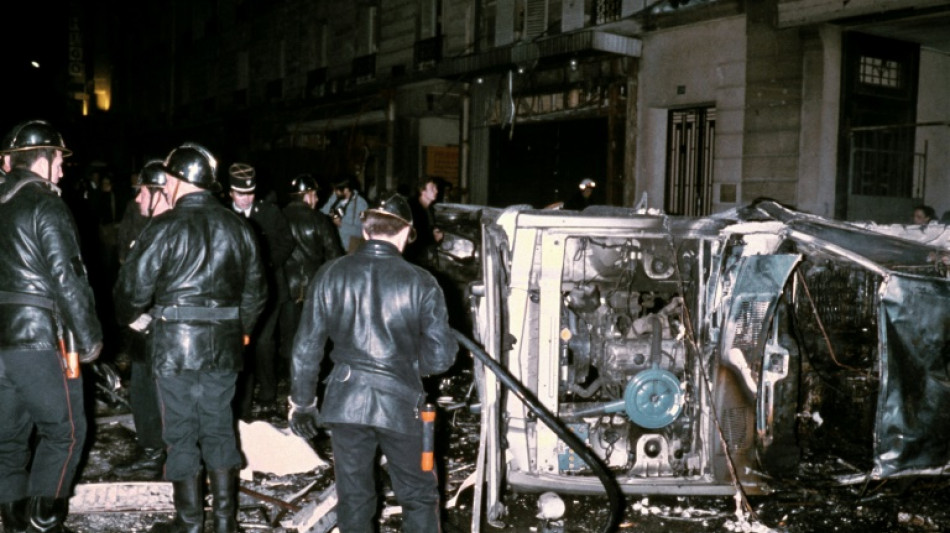
Trial over fatal Paris synagogue attack opens after 43 years / Photo: © AFP/File

 South African election results renew debate over identity-based voting

 South African voters report smoother local election but declining IEC trust

 Dolly Parton museum and Nashville hotel open after singer’s death

 George and Amal Clooney attend New York political-comedy reading

 British buyers pay substantial premiums for period-home appearance

 Thomas Markle released to house arrest after child-abuse-image charge

 Dawn of War 4 developers chose Adeptus Mechanicus for tactical variety

 Italy face unbeaten South Africa in Turin Nations Championship match

 ChatGPT interactive interface feature tested across six custom tools

 Freshways milk-price cut deepens pressure on UK dairy farms

 Labour and National remain virtually tied as New Zealand vote count advances

 The Good Daughter adapts Karin Slaughter thriller with Rose Byrne and Meghann Fahy

 Heavy-lift drone evacuates wounded Ukrainian soldier from frontline kill zone

 Morrison says West Brom recovered after pressure from successive derby losses

 Britain considers 2027 state visit for Ukraine’s Zelensky

 Arizona Democrats Secure Historic Trifecta with New Legislative Leadership

 Carney Welcomes U.S. Trade Reversal After Democratic Midterm Victory

 Armenian FM Discusses EU Accountability for Palestinian Rights in Madrid

 Trump and Vance Pursue Secret Diplomacy with Iran Amid Military Pressure

The trial of a 69-year-old Lebanese-Canadian charged over a fatal 1980 bomb attack outside a Paris synagogue opened on Monday after more than four decades of legal wrangling.
Canada-based Hassan Diab, who denies any involvement in the attack which killed four and wounded dozens, told the court during preliminary hearings that he would not show up for the trial, after accusations against him had been dropped in an earlier investigation.
In the early evening of October 3, 1980, explosives placed on a motorcycle detonated close to a synagogue in Rue Copernic in Paris's chic 16th district, killing four people -- a student passing by on a motorbike, a driver, an Israeli journalist and a caretaker.
Forty-six people were injured in the blast.
The bombing was the first deadly attack against a Jewish target on French soil since World War II.
No organisation ever claimed responsibility but police suspected a splinter group of the Popular Front for the Liberation of Palestine.
French intelligence in 1999 accused Diab, a sociology professor, of having made the 10-kilogramme (22-pound) bomb.
They pointed to Diab's likeness with police sketches drawn at the time and handwriting analyses that they said confirmed him as a suspect.
They also produced a key item of evidence against him -- a passport in his name, seized in Rome in 1981, with entry and exit stamps from Spain, where the attack plan was believed to have originated.
In 2014, Canada extradited Diab at the request of the French authorities.
However, investigating judges were unable to prove his guilt conclusively during the investigation and Diab was released, leaving France for Canada a free man in 2018.
- 'End of an ordeal' -
Three years later, a French court overturned the earlier decision and ordered Diab to stand trial after all, on charges of murder, attempted murder and destruction of property in connection with a terrorist enterprise.
French authorities stopped short of issuing a new international arrest warrant for Diab, effectively leaving it up to him to attend his trial or not.
He could be sentenced to life in prison in absentia if found guilty.
"This trial has to happen now," said Benjamin Chambre, one of the prosecutors, accusing Diab of "cowardice" for not showing up.
But the suspect's celebrity lawyer, William Bourdon, said his client's decision to stay away was "humanly understandable".
The French judiciary "falsely gave the impression" that Diab was guilty because the plaintiffs "were demanding a guilty person at any price".
"The case should have been closed when the investigation was dropped," Bourdon said.
Diab won some backing from NGOs, including Amnesty International, who said his assertion that he was in Lebanon at the time of the attack was credible.
Bernard Cahen, a lawyer for around 100 plaintiffs in the case, said the start of the trial marked "the end of a long ordeal" for his clients.
The verdict is expected on April 21.
O.Lorenz--BTB