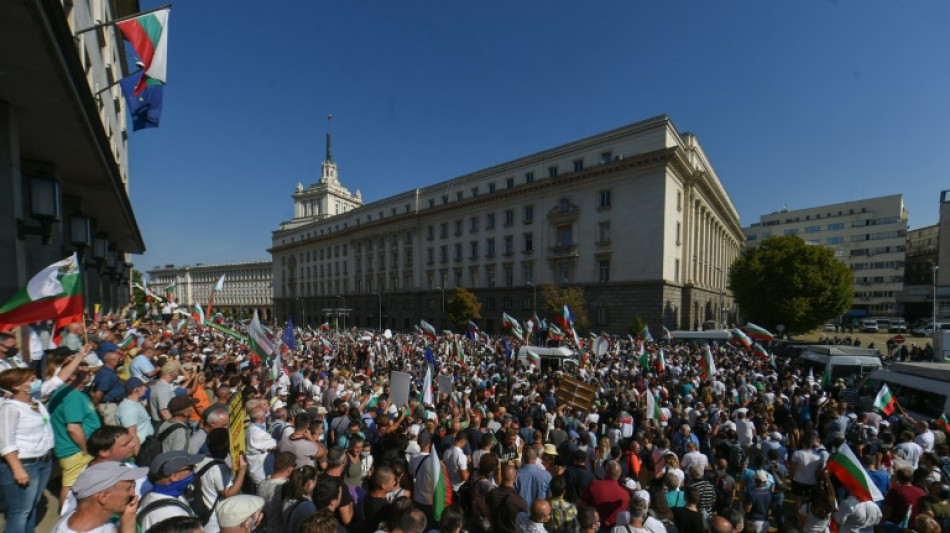
Bulgaria votes for fifth time in two years under Ukraine shadow / Photo: © AFP/File

 South African election results renew debate over identity-based voting

 South African voters report smoother local election but declining IEC trust

 Dolly Parton museum and Nashville hotel open after singer’s death

 George and Amal Clooney attend New York political-comedy reading

 British buyers pay substantial premiums for period-home appearance

 Thomas Markle released to house arrest after child-abuse-image charge

 Dawn of War 4 developers chose Adeptus Mechanicus for tactical variety

 Italy face unbeaten South Africa in Turin Nations Championship match

 ChatGPT interactive interface feature tested across six custom tools

 Freshways milk-price cut deepens pressure on UK dairy farms

 Labour and National remain virtually tied as New Zealand vote count advances

 The Good Daughter adapts Karin Slaughter thriller with Rose Byrne and Meghann Fahy

 Heavy-lift drone evacuates wounded Ukrainian soldier from frontline kill zone

 Morrison says West Brom recovered after pressure from successive derby losses

 Britain considers 2027 state visit for Ukraine’s Zelensky

 Arizona Democrats Secure Historic Trifecta with New Legislative Leadership

 Carney Welcomes U.S. Trade Reversal After Democratic Midterm Victory

 Armenian FM Discusses EU Accountability for Palestinian Rights in Madrid

 Trump and Vance Pursue Secret Diplomacy with Iran Amid Military Pressure

Bulgarians vote on Sunday in their fifth general election in two years, a record in the European Union, amid deep divisions over the war in Ukraine.
Russia's invasion of its neighbour has deepened the political crisis that has engulfed Bulgaria since 2020, the worst instability since the fall of Communism.
The poor Balkan nation of 6.5 million people is a member of the EU and NATO. But it is historically and culturally close to Russia.
The country witnessed massive anti-corruption rallies three years ago but, contrary to protesters' hopes of a clean-up in public life, the demonstrations triggered a series of elections.
Conservative prime minister Boyko Borisov, whose decade in office was tainted by allegations of graft, lost power in 2021.
But the country's political parties have struggled since to form stable coalitions, leading to a deeply fragmented parliament and series of interim governments.
"What if the results are the same as in previous legislative elections?" asked Silvia Radoeva, a 42-year-old care worker.
"It's high time that politicians united to deal with everyday problems," Radoeva told AFP, citing "crazy prices, poverty and deplorable medical care".
- 'Worrying spiral' -
"Faced with war and inflation, (Bulgarian) society is crying out for a solution," Parvan Simeonov, a political analyst with Gallup International, told AFP.
The fight against corruption has taken a back seat, leaving many 2020 protesters disillusioned.
The main players in Sunday's ballot are the same as in recent elections.
The latest polls put Borisov's GERB party neck-and-neck with the reformist We Continue the Change (PP), led by Harvard-educated Kiril Petkov, who was briefly premier in 2022.
Both have around 25 percent support.
This time, the PP has joined forces with a small right-wing coalition called Democratic Bulgaria.
"We find the same pattern as in other central European countries -- a former leader who clings on and the other parties who refuse to ally with him, without having much else in common," said Lukas Macek, associate researcher at the Jacques Delors Institute for Central and Eastern Europe.
Macek sees no end to this "worrying spiral of elections" unless Borisov withdraws.
- Pro-Russian influence -
"I fear the influence of pro-Russian parties in the next parliament," Ognian Peychev, a 60-year-old engineer, told AFP at a recent protest against the war in Ukraine.
The ultra-nationalist Vazrazhdane party, which defends the Kremlin's war, stands to gain some 13 percent of the votes, according to polls, up from the 10 percent it won at the last general election in October.
The Socialist BSP, the successor of Bulgaria's Communist Party, has also sided with Moscow and objects to sending weapons to Ukrainian forces.
Many in Bulgaria still look to the east, revering Russia as the country that ended five centuries of Ottoman rule in 1878.
"Both Petkov and Borisov are too aggressively critical of Russia," said Mariana Valkova, a 62-year-old entrepreneur who used to work in what was then the Soviet Union.
"I'd rather there wasn't a government and (President Rumen) Radev remained in charge."
Pro-Russian Radev, who has appointed interim cabinets between the string of inconclusive elections, has denounced Petkov and his allies as "war mongers".
He has also spoken out against sending arms to Ukraine.
At the same time, Bulgaria's munitions factories have been running at full capacity making ammunition to be exported to Kyiv via third countries.
Polling stations will open at 7:00 am (0400 GMT) on Sunday.
The first exit polls are expected after polls close at 8:00 pm (1700 GMT).
C.Kovalenko--BTB