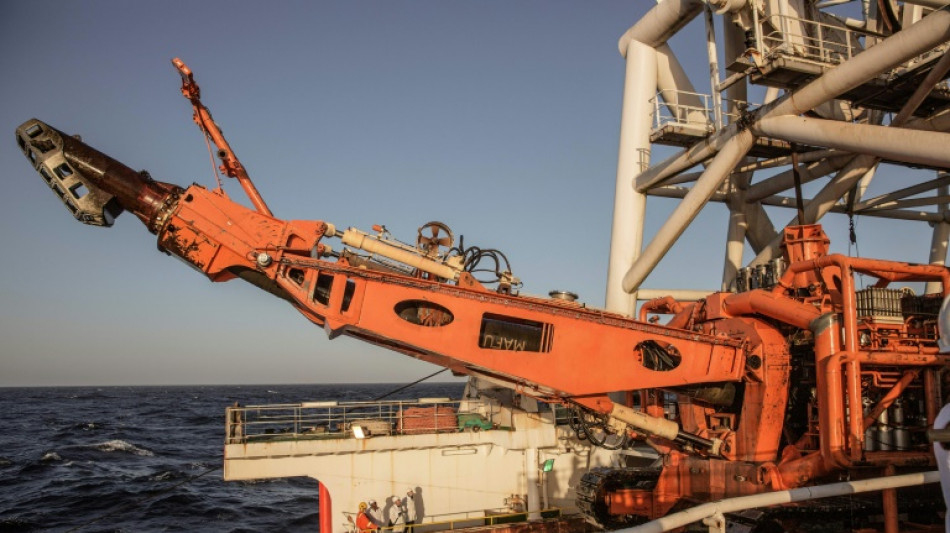
NGOs slam missed chance to prevent seabed mining / Photo: © AFP/File

 South African election results renew debate over identity-based voting

 South African voters report smoother local election but declining IEC trust

 Dolly Parton museum and Nashville hotel open after singer’s death

 George and Amal Clooney attend New York political-comedy reading

 British buyers pay substantial premiums for period-home appearance

 Thomas Markle released to house arrest after child-abuse-image charge

 Dawn of War 4 developers chose Adeptus Mechanicus for tactical variety

 Italy face unbeaten South Africa in Turin Nations Championship match

 ChatGPT interactive interface feature tested across six custom tools

 Freshways milk-price cut deepens pressure on UK dairy farms

 Labour and National remain virtually tied as New Zealand vote count advances

 The Good Daughter adapts Karin Slaughter thriller with Rose Byrne and Meghann Fahy

 Heavy-lift drone evacuates wounded Ukrainian soldier from frontline kill zone

 Morrison says West Brom recovered after pressure from successive derby losses

 Britain considers 2027 state visit for Ukraine’s Zelensky

 Arizona Democrats Secure Historic Trifecta with New Legislative Leadership

 Carney Welcomes U.S. Trade Reversal After Democratic Midterm Victory

 Armenian FM Discusses EU Accountability for Palestinian Rights in Madrid

 Trump and Vance Pursue Secret Diplomacy with Iran Amid Military Pressure

Ocean advocates warned on Friday that the door may fly open for undersea mining in the near future in the absence of solid environmental rules that more and more nations demand.
As two weeks of negotiations concluded Friday over possible environmental rules restricting large-scale mining of the seabed, NGOs voiced fear that industry may soon be given the green light.
Several nations called for a moratorium on such mining at the International Seabed Authority (ISA) council meeting.
"The first thing to highlight is that the political atmosphere has shifted quite radically since that time last year," Emma Wilson of the Deep Sea Conservation Coalition told AFP.
"There wasn't a single state at that point that had stood up and said no to mining."
But as the two-week meeting wrapped up, she remained "very worried" the door could be opened to mining applications later this year.
The Jamaica-based ISA, established under the UN Convention on the Law of the Sea, has authority over the ocean floors outside of its 167 member states' Exclusive Economic Zones, which extend up to 200 nautical miles (370 kilometers) from coastlines.
It has so far awarded seabed exploration contracts only to research centers and companies in well-defined areas of potential mineral wealth.
Industrial exploitation of nickel, cobalt or copper is not expected to begin until the adoption of a mining code that has been under discussion for nearly 10 years -- including at the latest talks in Kingston.
For years, nongovernmental organizations and scientists have warned of the damage seabed mining could inflict on deep-sea ecosystems.
- 'Back from the brink' -
Countries are increasingly echoing that concern: Canada, Australia and Belgium among others have insisted that international seabed mining cannot begin without strict rules.
"The conditions do not exist for the exploitation of the seabed to begin," insisted Marcelino Miranda, representative of Mexico, on Friday.
Other nations -- among them France, Germany, Chile and Vanuatu -- are pushing more explicitly for a "moratorium" or "pause" on exploitation.
"Deep-sea mining would go beyond harming the seabed and have a wider impact on fish populations, marine mammals, and the essential function of the deep-sea ecosystems in regulating the climate," Vanuatu's representative, Sylvain Kalsakau, said during the negotiations.
"We encourage our fellow Pacific states who have expressed interest in deep-sea mining to step back from the brink."
Nauru, impatient with the pace of progress, invoked in June 2021 a clause allowing it to demand that a mining code be adopted within two years.
Once that deadline is reached, on July 9, Nauru's government could request a mining contract for NORI (Nauru Ocean Resources), a subsidiary of Canada's The Metals Company.
But without a code in place, the 36-member council is divided over the process for reviewing an application for a mining contract -- and it looked on course to part without agreement, with a draft seen by AFP calling for further talks on the matter.
The continuing uncertainty is "creating a lot of anxiety here," said Pradeep Singh, a law of the sea expert and fellow at the Research Institute for Sustainability in Potsdam.
- 'Like sleepwalkers' -
Nauru's ambassador Margo Deiye repeated on Friday that her country would wait for the conclusion of a July session before filing an application, hoping that the mining code could be adopted.
However, many observers and negotiators say this is unlikely.
"It is now clear that there is still a long way to go and that the two-week session in July will be largely insufficient to finalize the code," Belgian ambassador Hugo Verbist said Friday.
And the 36 members of ISA's executive body failed to agree at this session on the process for reviewing an application for an exploitation contract that would be filed in the absence of a mining code.
"Walking like sleepwalkers towards an uncertain legal situation beyond July 9 has become a reality," Verbist said, lamenting this "legal loophole" created by the lack of a decision.
"Governments are recklessly leaving the backdoor open for deep sea mining to sneak through and start operating later this year," said Greenpeace's Louisa Casson in a statement.
If The Metals Company starts gearing up for a launch of production in late 2024, NGOs fear that other industry groups will spy an opening -- and file their own applications when the two-year clause ends.
A few weeks after the historic adoption of a treaty to protect the high seas, "this deeply irresponsible outcome is a wasted opportunity to send a clear signal (...) that the era of ocean destruction is over," Casson added.
K.Brown--BTB