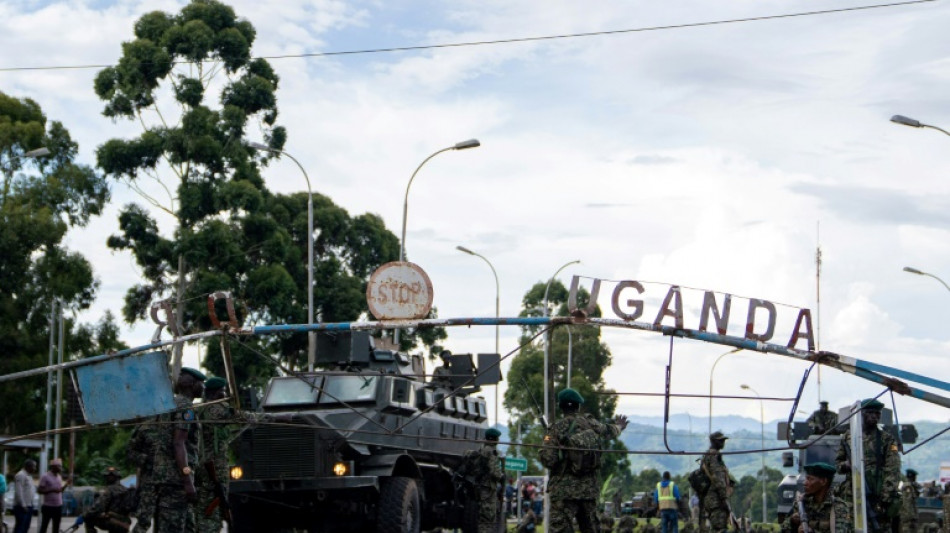
Ugandan troops join regional force in DR Congo / Photo: © AFP

 South African election results renew debate over identity-based voting

 South African voters report smoother local election but declining IEC trust

 Dolly Parton museum and Nashville hotel open after singer’s death

 George and Amal Clooney attend New York political-comedy reading

 British buyers pay substantial premiums for period-home appearance

 Thomas Markle released to house arrest after child-abuse-image charge

 Dawn of War 4 developers chose Adeptus Mechanicus for tactical variety

 Italy face unbeaten South Africa in Turin Nations Championship match

 ChatGPT interactive interface feature tested across six custom tools

 Freshways milk-price cut deepens pressure on UK dairy farms

 Labour and National remain virtually tied as New Zealand vote count advances

 The Good Daughter adapts Karin Slaughter thriller with Rose Byrne and Meghann Fahy

 Heavy-lift drone evacuates wounded Ukrainian soldier from frontline kill zone

 Morrison says West Brom recovered after pressure from successive derby losses

 Britain considers 2027 state visit for Ukraine’s Zelensky

 Arizona Democrats Secure Historic Trifecta with New Legislative Leadership

 Carney Welcomes U.S. Trade Reversal After Democratic Midterm Victory

 Armenian FM Discusses EU Accountability for Palestinian Rights in Madrid

 Trump and Vance Pursue Secret Diplomacy with Iran Amid Military Pressure

Ugandan troops operating as part of an East African regional military force entered eastern Democratic Republic of Congo on Friday, joining Kenyan and Burundian contingents to supervise a planned pull-back of M23 rebels.
The M23 has conquered swathes of territory in eastern DRC since taking up arms again in late 2021 after years of dormancy.
Hundreds of thousands of people have been displaced by the conflict, with the rebels also threatening to surround the city of Goma.
Last June, the seven-nation East African Community (EAC) decided to create a military force with the aim of stabilising volatile eastern Congo.
The Ugandan contingent of the EAC force entered the Congolese town of Bunagana on Friday morning, according to the force commander, Kenyan General Jeff Nyagah.
He told reporters that about 1,000 Ugandan soldiers had crossed into Bunagana -- which lies on the Ugandan border -- as part of a contingent that is expected to eventually comprise 2,000 troops.
Nyagah added that the M23 withdrawal would be "sequenced".
A Bunagana resident also told AFP that Ugandan troops had entered the town, with vehicles and tanks.
On Thursday evening, Ugandan President Yoweri Museveni stated that the troops are not due to fight the M23.
Rather, they will "occupy some of the positions that the M23 has handed over to the East African Force as a neutral force", he said.
March 30 was supposed to mark the end of the withdrawal of "all armed groups", according to a timetable adopted in mid-February by the EAC.
The deadline was not respected.
Another Bunagana resident, who declined to be named, said the M23 was still in the town on Friday.
"We're waiting for them to withdraw, then we can say there's been a change," the resident said.
- Failed ceasefires -
The M23 first came to international prominence in 2012 when it captured Goma, before being driven out and going to ground.
But the Tutsi-led group re-emerged from dormancy in late 2021, arguing that the government had ignored a promise to integrate its fighters into the army.
It then won a string of victories against the Congolese army and captured large chunks of North Kivu province, including the important border crossing of Bunagana.
Several regional initiatives intended to defuse the conflict have failed.
A ceasefire mediated by Angola was due to take effect on March 7, for example, but collapsed almost immediately.
Although there has been no major fighting between the army and the M23 for the past two weeks, the rebels have regularly clashed with opposing militias.
The Ugandan troops who entered the DRC on Friday are due to deploy to several locations in Rutshuru, a region of North Kivu which is under extensive M23 control.
- 'Our humiliation' -
Kenyan and Burundian soldiers have also deployed to the DRC as part of the EAC force, and South Sudanese troops are also expected to arrive shortly.
However, the force has faced increasing criticism from Congolese people who hoped that the regional troops would drive out the M23.
Jean-Pierre Bemba, an ex-rebel commander who was recently named Congolese defence minister, said last week that the task facing the country was as large as "our humiliation as a nation".
Upon taking office, he pledged to boost the effectiveness of the Congolese military, which has so far been unable to contain the M23 rebels.
The DRC accuses its smaller neighbour Rwanda of backing the M23, something the United States, several other Western countries and independent UN experts agree with, but which Kigali denies.
O.Bulka--BTB