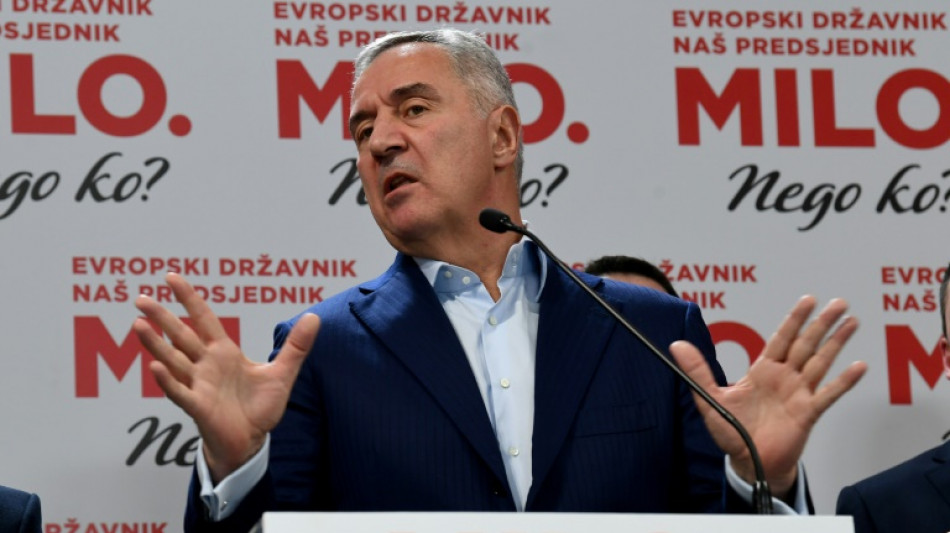
Montenegro votes in presidential run-off after months of gridlock / Photo: © AFP

 South African election results renew debate over identity-based voting

 South African voters report smoother local election but declining IEC trust

 Dolly Parton museum and Nashville hotel open after singer’s death

 George and Amal Clooney attend New York political-comedy reading

 British buyers pay substantial premiums for period-home appearance

 Thomas Markle released to house arrest after child-abuse-image charge

 Dawn of War 4 developers chose Adeptus Mechanicus for tactical variety

 Italy face unbeaten South Africa in Turin Nations Championship match

 ChatGPT interactive interface feature tested across six custom tools

 Freshways milk-price cut deepens pressure on UK dairy farms

 Labour and National remain virtually tied as New Zealand vote count advances

 The Good Daughter adapts Karin Slaughter thriller with Rose Byrne and Meghann Fahy

 Heavy-lift drone evacuates wounded Ukrainian soldier from frontline kill zone

 Morrison says West Brom recovered after pressure from successive derby losses

 Britain considers 2027 state visit for Ukraine’s Zelensky

 Arizona Democrats Secure Historic Trifecta with New Legislative Leadership

 Carney Welcomes U.S. Trade Reversal After Democratic Midterm Victory

 Armenian FM Discusses EU Accountability for Palestinian Rights in Madrid

 Trump and Vance Pursue Secret Diplomacy with Iran Amid Military Pressure

Montenegro is girding for a closely watched presidential run-off on Sunday, when a young upstart could upend the Balkan nation's political landscape, dominated for decades by incumbent Milo Djukanovic.
The outcome of the race will likely determine the balance of power ahead of a snap parliamentary vote due in June, following months of deadlock after the government collapsed in August.
The election comes two weeks after the first round, where Djukanovic fended off a range of rivals hoping to shake up the political scene, garnering 35 percent of the vote compared to 29 percent for his main challenger, Jakov Milatovic.
However, analysts have largely tipped Milatovic to win the presidency, saying the pro-European economist is likely to appeal to a large number of voters desperate for change after decades of rule by Djukanovic and his Democratic Party of Socialists (DPS).
"The fall of Djukanovic would probably mean the fall of the DPS as we know it, which had absolute power in Montenegro," Predrag Zenovic, a political analyst based in the capital Podgorica, told AFP.
The DPS has been on the back foot since the party suffered a historic defeat in the 2020 parliamentary elections.
Since then Montenegro has lurched from crisis to crisis that has seen the collapse of two governments.
- Decades in power -
Djukanovic, 61, was installed at the helm of the former Yugoslav republic in 1991 by former Serbian strongman Slobodan Milosevic when he was just 29.
But as Serbia increasingly became an international pariah, Djukanovic pivoted West, broke ties with Belgrade and helped oversee Montenegro's independence in 2006.
Under the leadership of Djukanovic and his party, Montenegro joined NATO, kick-started the negotiating process for EU membership and moved away from Russia's influence.
However, his party's rule has been plagued by allegations of widespread corruption and links to organised crime, which Djukanovic denies.
"We have a man in power here for 30 years who is the epitome of dictatorship, abuse of power, who made it possible for corruption and criminality to flourish," Mladen Vukovic, a doctor in Podgorica, told AFP.
For him, Sunday's vote is the "last chance to remove such a man from power and for someone new to come".
Ahead of Sunday's vote, Djukanovic has repeatedly questioned whether Milatovic, 36, and his Europe Now party are able to secure a European future for Montenegro, while accusing him of being vulnerable to Serbian influence.
"I cannot support Milatovic and the Europe Now movement since I'm afraid that it will allow too much influence from Serbia," said Zorica, a 39-year-old economist in Podgorica, who declined to provide her surname.
"Milatovic is too ambitious and too young and I don't trust that he will have the political skills to resist the influence of Serbia" and the Serbian Orthodox Church, she said.
For years, Djukanovic has been eager to curb the influence of Belgrade and the Serbian church in Montenegro, while helping cement a separate Montenegrin national identity.
But it has been no easy task, with a third of Montenegro's population of 620,000 identifying as Serbs.
- Fresh faces -
Milatovic will likely be looking to harness the eagerness of young voters looking for an injection of fresh faces into the country's leadership.
Milatovic made political headlines as minister of economic development after the 2020 parliamentary elections, which resulted in the first government not ruled by the DPS.
The father-of-three gained popularity with a controversial economic programme that, among other things, doubled the minimum wage.
For Podgorica resident Milena Sekulic, 31, the election will be about fomenting change and creating better economic conditions in Montenegro, where many young people flock abroad in the thousands for better opportunities.
"To get a job, political affiliation is more important than professionalism," she told AFP.
The minimum wage is just 450 euros ($490) a month in the tiny country along the Adriatic, which remains heavily reliant on tourism thanks to its picturesque beaches and rugged mountains.
Montenegro's president, elected for a five-year term, has a largely ceremonial role while most of the political power rests with the prime minister.
S.Keller--BTB