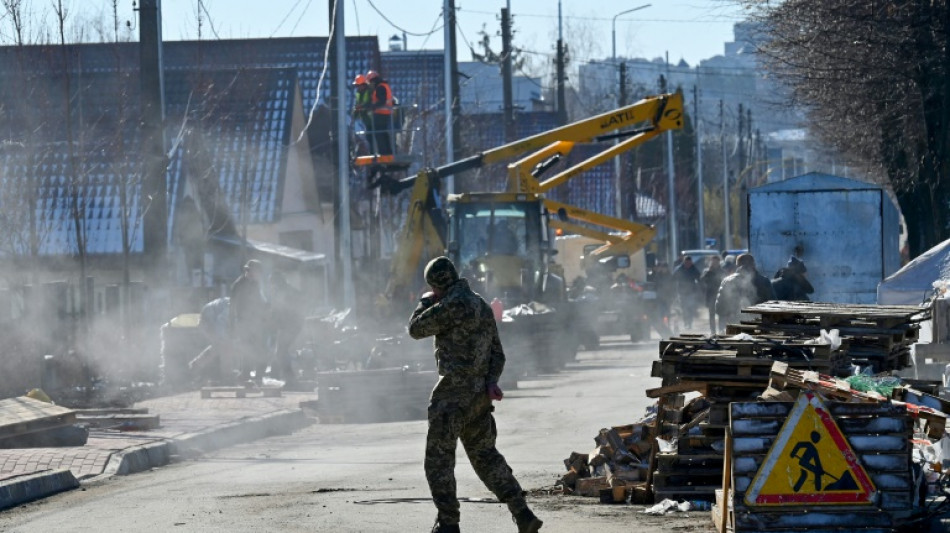
Ukraine's Bucha rebuilds, seeks justice for war killings / Photo: © AFP

 South African election results renew debate over identity-based voting

 South African voters report smoother local election but declining IEC trust

 Dolly Parton museum and Nashville hotel open after singer’s death

 George and Amal Clooney attend New York political-comedy reading

 British buyers pay substantial premiums for period-home appearance

 Thomas Markle released to house arrest after child-abuse-image charge

 Dawn of War 4 developers chose Adeptus Mechanicus for tactical variety

 Italy face unbeaten South Africa in Turin Nations Championship match

 ChatGPT interactive interface feature tested across six custom tools

 Freshways milk-price cut deepens pressure on UK dairy farms

 Labour and National remain virtually tied as New Zealand vote count advances

 The Good Daughter adapts Karin Slaughter thriller with Rose Byrne and Meghann Fahy

 Heavy-lift drone evacuates wounded Ukrainian soldier from frontline kill zone

 Morrison says West Brom recovered after pressure from successive derby losses

 Britain considers 2027 state visit for Ukraine’s Zelensky

 Arizona Democrats Secure Historic Trifecta with New Legislative Leadership

 Carney Welcomes U.S. Trade Reversal After Democratic Midterm Victory

 Armenian FM Discusses EU Accountability for Palestinian Rights in Madrid

 Trump and Vance Pursue Secret Diplomacy with Iran Amid Military Pressure

A year after its liberation by Ukrainian forces, Bucha and its people are still confronted by the atrocities blamed on Russian forces during their occupation of the city.
But the community is rebuilding, and local people say "the pain is diminishing" and that they must "continue to live" despite their collective trauma.
Vokzalna Street, now an open-air building site where dozens of builders weave between diggers and dump trucks, rebuilding homes and roads, is a far cry from the height of the fighting.
It was on the arterial road that a column of Russian armoured vehicles was destroyed by Ukrainian forces in the battle to recapture the area.
The charred carcasses of military vehicles littered the street after Russian troops withdrew on March 31, 2022, having failed to take the capital Kyiv.
Many of the homes along the road were destroyed.
Anatoly Yevdokimenko is now delighted to show off his reconstructed home.
"The roof was broken, the doors and windows were broken. The shells hit everywhere," the 60-year-old told AFP.
"Volunteers started coming and rebuilding. Later, there was a programme to reconstruct Bucha, especially Vokzalna Street," he said.
During the occupation, which began on February 27, "the Russians lived in our cellar and prepared their food in the courtyard", he said.
Yevdokimenko was able to leave the city through a humanitarian corridor on March 12.
- Dressed in civilian clothes -
Further on, Natalia Zelinska is also seeing the fruits of the effort to rebuild at her home on the crossroads of Vokzalna and Yablunska streets.
It was on this street that on April 2, 2022, AFP journalists found the bodies of 20 men dressed in civilian clothes, one with his hands tied behind his back.
They were images that shocked the world, and were described by Kyiv as examples of summary executions of civilians that amounted to war crimes.
"We were there during the fighting at the end of February and the beginning of March, and at the start of the occupation," Zelinska told AFP, adding that she had also been able to leave the city by mid-March.
"I didn't see the moment of (the) killing... but when we were forced to leave the house... we saw a lot of bodies laying here, a lot of killed people."
The restoration effort has helped Zelinska turn a corner, saying she was "very happy to have been included".
But the memories of what she saw still loom large.
"I need to consult a military psychologist to talk about the occupation," she said. "Sometimes when I fall asleep, I remember that time -- and it's horrible."
- 'Evil must be punished' -
In the grounds of the St. Andrew church, near Bucha town hall, municipal workers built a stage for the official anniversary ceremonies planned for Friday.
A mass grave had been dug next to the golden-domed structure to hastily bury the corpses of those who fell victim to the occupation.
"A year ago, when the Russians were here, the residents could only sit in their basements. It was dangerous for them, they were persecuted and robbed," said priest Andriy, who runs the parish.
"It's very important that we don't forget the people who, unfortunately, are not with us today.
"It is also important for us not to live in the past, but in the future. To live in the future, you must not only win (and) defeat the occupiers... but it is very important that evil is condemned.
"Criminals must be condemned, evil must be punished."
Natalia Plessa, 47, came with her family to visit the grave of her mother, who died recently having survived the Russian occupation.
At the bottom of the cemetery are nearly 80 unmarked graves of local people who died during the Russian presence, and who cannot be identified.
Plessa and her husband remained under occupation for two weeks before leaving the city through a humanitarian corridor.
"It was a terrible time. It was very scary to leave through the corridor," she said.
"With time, the pain subsides and you forget it, you continue to live. There are new ways of life, work, children, grandchildren, for which you continue to live," she said.
"I am sure that Bucha will be an even more beautiful city than it was before the occupation."
S.Keller--BTB