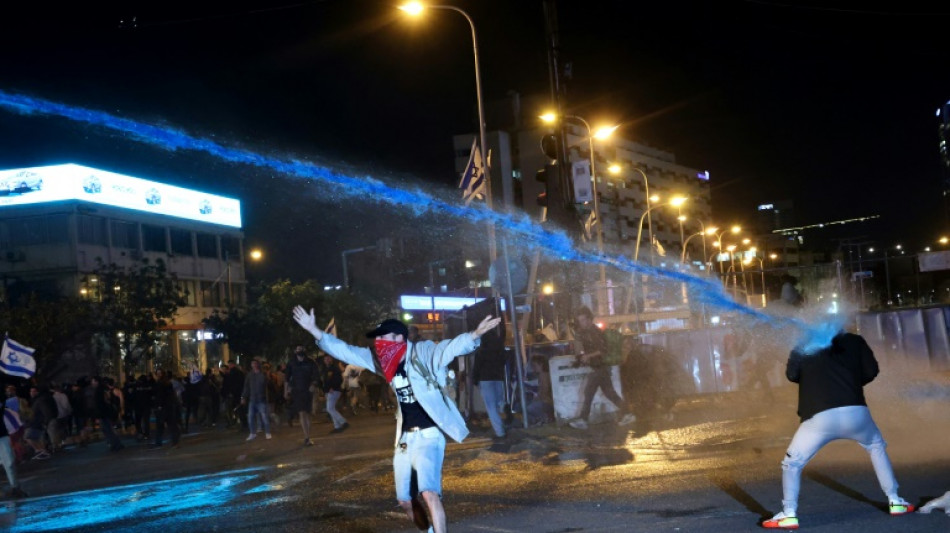
Israeli parties hold talks on justice reforms / Photo: © AFP

 South African election results renew debate over identity-based voting

 South African voters report smoother local election but declining IEC trust

 Dolly Parton museum and Nashville hotel open after singer’s death

 George and Amal Clooney attend New York political-comedy reading

 British buyers pay substantial premiums for period-home appearance

 Thomas Markle released to house arrest after child-abuse-image charge

 Dawn of War 4 developers chose Adeptus Mechanicus for tactical variety

 Italy face unbeaten South Africa in Turin Nations Championship match

 ChatGPT interactive interface feature tested across six custom tools

 Freshways milk-price cut deepens pressure on UK dairy farms

 Labour and National remain virtually tied as New Zealand vote count advances

 The Good Daughter adapts Karin Slaughter thriller with Rose Byrne and Meghann Fahy

 Heavy-lift drone evacuates wounded Ukrainian soldier from frontline kill zone

 Morrison says West Brom recovered after pressure from successive derby losses

 Britain considers 2027 state visit for Ukraine’s Zelensky

 Arizona Democrats Secure Historic Trifecta with New Legislative Leadership

 Carney Welcomes U.S. Trade Reversal After Democratic Midterm Victory

 Armenian FM Discusses EU Accountability for Palestinian Rights in Madrid

 Trump and Vance Pursue Secret Diplomacy with Iran Amid Military Pressure

Israel's far-right government and opposition parties Tuesday ended a "positive" first meeting on controversial judiciary reforms that sparked a general strike and mass protests, in the country's most severe domestic crisis in years.
Scepticism remained high over the negotiations on the judicial overhaul that would curtail authority of the Supreme Court and give politicians greater powers over the selection of judges.
"After about an hour and a half, the meeting, which took place in a positive spirit, came to an end," President Isaac Herzog's office said late Tuesday.
"Tomorrow, President Isaac Herzog will continue the series of meetings," it added.
His office earlier described talks between working teams representing the ruling coalition, Yesh Atid and the National Unity Party -- two centrist parties -- as "a first dialogue meeting".
"We thank the president for opening his house to the negotiation procress for the benefit of the citizens of Israel," Yesh Atid tweeted.
After three months of increasing tensions that split the nation and raised concerns among the United States and other allies, Prime Minister Benjamin Netanyahu bowed to pressure in the face of a nationwide walkout Monday.
The strike hit airports, hospitals and more, while tens of thousands of reform opponents rallied outside parliament in Jerusalem.
"Out of a will to prevent a rupture among our people, I have decided to pause the second and third readings of the bill" to allow time for dialogue, the prime minister said in a broadcast.
The decision to halt the legislative process marked a dramatic U-turn for the premier, who just a day earlier announced he was sacking his defence minister who had called for the very same step.
The move was greeted with suspicion in Israel, with the president of the Israel Democracy Institute think-tank remarking it does not amount to a peace deal.
"Rather, it's a ceasefire perhaps for regrouping, reorganising, reorienting and then charging -- potentially -- charging ahead," Yohanan Plesner told journalists.
- 'Ruse or bluff' -
Opposition leader Yair Lapid reacted warily, saying Monday he wanted to be sure "that there is no ruse or bluff".
A joint statement Tuesday from Lapid's party and that of Benny Gantz, a former defence minister, said such talks will stop immediately "if the law is put on the Knesset's (parliament's) agenda".
The opposition had previously refused to negotiate about the reforms -- which would hand politicians more power over the judiciary -- until the legislative process was stopped.
"The goal is to reach an agreement," Netanyahu said in a statement Tuesday.
Activists vowed to continue their rallies, which have continued routinely for weeks, sometimes drawing tens of thousands of protesters.
"We will not stop the protest until the judicial coup is completely stopped," the Umbrella Movement of demonstrators said.
- 'No turning back' -
The crisis has revealed deep rifts within Netanyahu's fledgling coalition, an alliance with far-right and ultra-Orthodox parties.
Finance Minister Bezalel Smotrich, in a tweet Monday, asserted "there will be no turning back" on the judicial overhaul.
Fellow far-right cabinet member, National Security Minister Itamar Ben-Gvir, had pressed his supporters to rally in favour of the reforms.
Ben-Gvir's Jewish Power party revealed on Monday that the decision to delay the legislation involved an agreement to expand the minister's portfolio after he threatened to quit if the overhaul was put on hold.
The affair has hit the coalition's standing among the Israeli public, just three months after it took office.
Netanyahu's Likud party has dipped seven points, according to a poll by Israel's Channel 12 which predicted the government would lose its majority in the 120-seat parliament if elections were held.
The fate of the ousted defence minister, Yoav Gallant, was unknown on Tuesday with speculation in Israeli media that he could be reinstated.
Gallant, who had warned the crisis threatened national security, on Monday welcomed "the decision to stop the legislative process in order to conduct dialogue," his team said.
N.Fournier--BTB