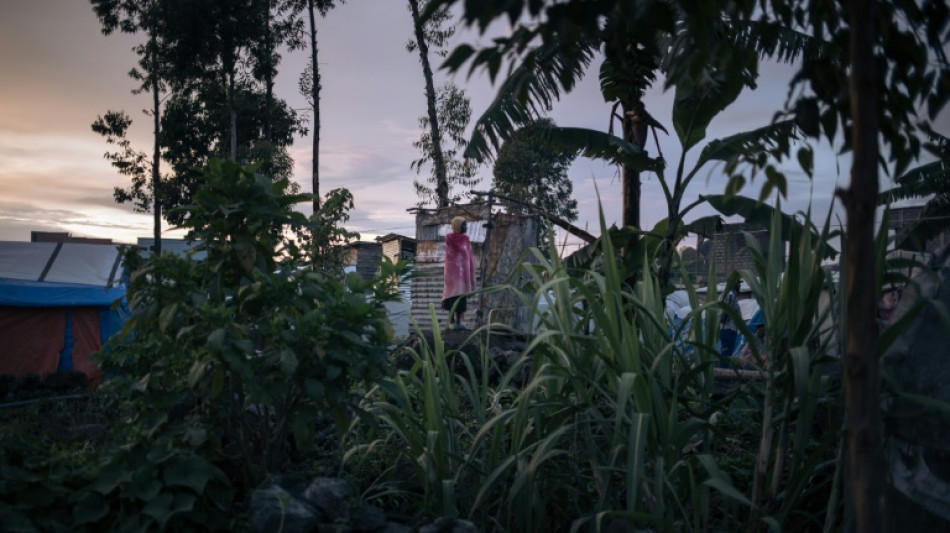
In east DR Congo, displaced Muslims celebrate bleak Ramadan / Photo: © AFP

 South African election results renew debate over identity-based voting

 South African voters report smoother local election but declining IEC trust

 Dolly Parton museum and Nashville hotel open after singer’s death

 George and Amal Clooney attend New York political-comedy reading

 British buyers pay substantial premiums for period-home appearance

 Thomas Markle released to house arrest after child-abuse-image charge

 Dawn of War 4 developers chose Adeptus Mechanicus for tactical variety

 Italy face unbeaten South Africa in Turin Nations Championship match

 ChatGPT interactive interface feature tested across six custom tools

 Freshways milk-price cut deepens pressure on UK dairy farms

 Labour and National remain virtually tied as New Zealand vote count advances

 The Good Daughter adapts Karin Slaughter thriller with Rose Byrne and Meghann Fahy

 Heavy-lift drone evacuates wounded Ukrainian soldier from frontline kill zone

 Morrison says West Brom recovered after pressure from successive derby losses

 Britain considers 2027 state visit for Ukraine’s Zelensky

 Arizona Democrats Secure Historic Trifecta with New Legislative Leadership

 Carney Welcomes U.S. Trade Reversal After Democratic Midterm Victory

 Armenian FM Discusses EU Accountability for Palestinian Rights in Madrid

 Trump and Vance Pursue Secret Diplomacy with Iran Amid Military Pressure

A brilliant setting sun illuminates the sky above the mosque of Munigi, a small clapboard building in troubled eastern DR Congo serving Muslims displaced by the M23 conflict.
Worshippers are preparing to break their Ramadan fast in the camp, on a lava-strewn field just 10 kilometres (six miles) from the front lines.
Their circumstances -- cramped together in makeshift huts -- are far bleaker than the dazzling sunset behind them.
Some 500 Muslims live in the Munigi displaced persons' camp, where access to food and water is severely limited.
"The first ones arrived nearly a year ago," said Ali Assani Mukamba, the local imam, speaking of Muslim displaced people.
Walking through the mass of tiny huts, built hastily on the field of volcanic rock, he explains that one of the biggest problems is a lack of fresh water.
"To wash before prayer, we're sometimes forced to rub ourselves with dust or mud," Mukamba said.
As night falls, Muslim worshippers pass around a platter of rice and beans, while a pale bulb comes on to light up their mosque.
- 'Killed by the M23' -
Abda Juma Buranga, one of the Muslim elders in the camp, said they are only able eat their iftar meal -- which breaks the fast -- because of charitable donations.
He fled his native village of Kibumba, less than 20 kilometres (12 miles) from the camp, when M23 fighters launched an attack in November.
"I lost 25 members of my family, cousins, aunts, nephews," the 65-year-old said.
"They were all killed by the M23".
The Muslim community in Munigi makes up a tiny part of the huge number of people who have fled the M23 in North Kivu province.
This month, the International Organization for Migration said the crisis has displaced almost 900,000 people.
A Tutsi-led group, the M23 first came to international prominence when it briefly captured North Kivu's capital Goma in 2012 before being driven out.
The rebels took up arms again in late 2021 after years of dormancy, on claims that the government had ignored a pledge to integrate its fighters into the military.
The M23 has since captured swathes of territory in North Kivu, and is now threatening to cut off the roads leading to Goma, a trade hub of over one million people.
- 'We're suffering' -
"In 2012, I didn't flee when the M23 arrived," said Aisha Furaha, sitting on a rock in Munigi camp with her head bent low.
The M23 returned "with more brutality" during its second campaign, according to the 40-year-old woman.
The rebels had threatened to loot and kill, Furaha said, adding that she and her 10 children had fled their home under a hail of gunfire.
Now, she and her family sleep on the ground in a hut in Munigi, where she said there isn't enough room for everyone.
M23 fighters are still in position across North Kivu, and on hilltops near Goma.
According to reports by independent experts for the United Nations Security Council, Rwanda is backing and equipping the rebels. Kigali denies the claim.
Abda Juma, the Muslim elder in Munigi, said he wanted the international community to force Rwandan President Paul Kagame to withdraw the M23.
"We're suffering a lot," he said.
L.Janezki--BTB