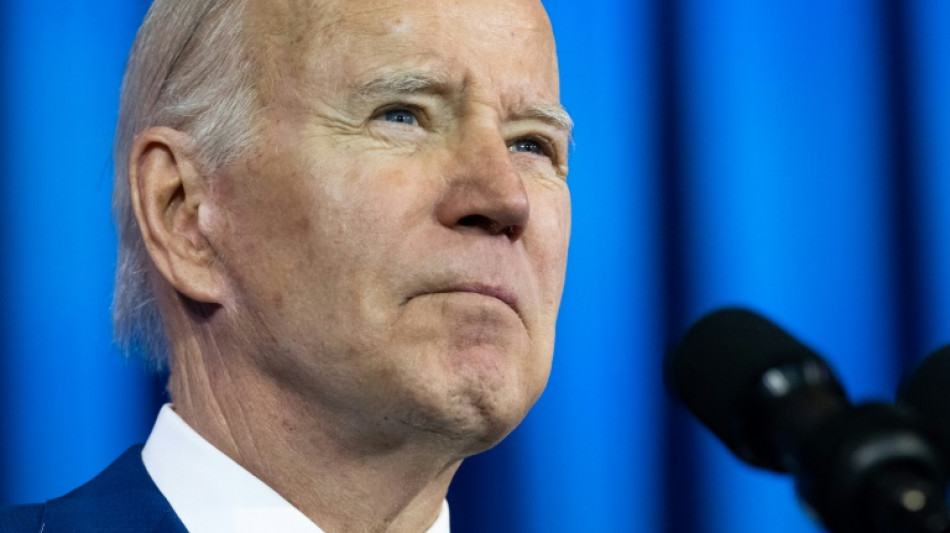
Biden bans US govt use of malicious commercial spyware / Photo: © AFP/File

 South African election results renew debate over identity-based voting

 South African voters report smoother local election but declining IEC trust

 Dolly Parton museum and Nashville hotel open after singer’s death

 George and Amal Clooney attend New York political-comedy reading

 British buyers pay substantial premiums for period-home appearance

 Thomas Markle released to house arrest after child-abuse-image charge

 Dawn of War 4 developers chose Adeptus Mechanicus for tactical variety

 Italy face unbeaten South Africa in Turin Nations Championship match

 ChatGPT interactive interface feature tested across six custom tools

 Freshways milk-price cut deepens pressure on UK dairy farms

 Labour and National remain virtually tied as New Zealand vote count advances

 The Good Daughter adapts Karin Slaughter thriller with Rose Byrne and Meghann Fahy

 Heavy-lift drone evacuates wounded Ukrainian soldier from frontline kill zone

 Morrison says West Brom recovered after pressure from successive derby losses

 Britain considers 2027 state visit for Ukraine’s Zelensky

 Arizona Democrats Secure Historic Trifecta with New Legislative Leadership

 Carney Welcomes U.S. Trade Reversal After Democratic Midterm Victory

 Armenian FM Discusses EU Accountability for Palestinian Rights in Madrid

 Trump and Vance Pursue Secret Diplomacy with Iran Amid Military Pressure

US President Joe Biden signed a ban Monday on government use of commercial spyware technology like the controversial Pegasus program, citing its use for political oppression in countries around the world.
The White House said commercial spyware poses a distinct intelligence threat to the United States and has been found on the phones of 50 US officials overseas.
In addition, a number of foreign governments have used it "to facilitate repression and enable human rights abuses."
"Misuse of these powerful surveillance tools has not been limited to authoritarian regimes," the White House said in a statement.
"Democratic governments also have confronted revelations that actors within their systems have used commercial spyware to target their citizens without proper legal authorization, safeguards, and oversight."
Biden's order was not a full ban on commercial spyware, but would apply to any program deemed a US security risk, or that is used for political abuse by other governments.
It also did not restrict spyware developed by US government agencies themselves, like the CIA or National Security Agency, the leading electronic intelligence body.
The most threatening software can scrape up all data from targeted devices with remote direction and control, according to a senior Biden administration official.
Last year the administration warned that it was planning tight restrictions on privately developed surveillance software after numerous cases surfaced of its use for political purposes in numerous countries around the world.
No specific names were cited in Monday's announcement, but the US government has already taken action to prevent the use of several programs and companies seen as threatening.
In November the Commerce Department placed four spyware developers on its blacklist: Israeli firms NRO Group and Candiru, Positive Technologies of Russia, and Singapore's Computer Security Initiative Consultancy.
Pegasus, created by NRO Group, was used by governments and other entities in Mexico, Poland, Spain, Hungary, Bahrain, India and elsewhere.
"There was an effort by commercial spyware vendors, like in other countries, to try to make inroads across the US federal government, and to market and to sell their tools across the federal government," the senior official told reporters.
"So we purposely announced publicly that we would be pursuing this sort of ban."
The ban was announced one day before Biden hosts his second Summit for Democracy, with leaders from 121 countries invited to join the three-day event.
The White House called the commercial spyware ban a "cornerstone" initiative for the summit.
The order "demonstrates the United States' leadership in, and commitment to, advancing technology for democracy," it said.
E.Schubert--BTB