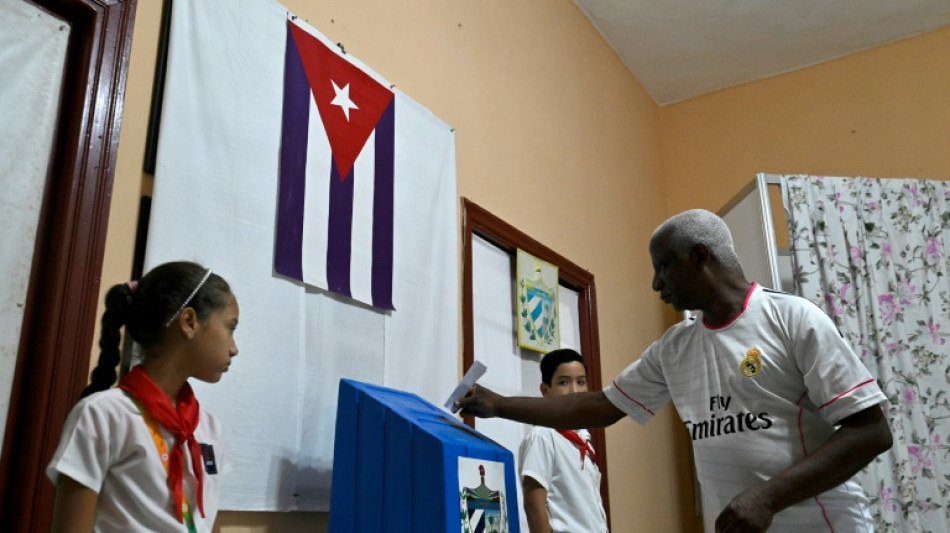
Cuba says voter turnout ticked up in legislative elections / Photo: © AFP

 South African election results renew debate over identity-based voting

 South African voters report smoother local election but declining IEC trust

 Dolly Parton museum and Nashville hotel open after singer’s death

 George and Amal Clooney attend New York political-comedy reading

 British buyers pay substantial premiums for period-home appearance

 Thomas Markle released to house arrest after child-abuse-image charge

 Dawn of War 4 developers chose Adeptus Mechanicus for tactical variety

 Italy face unbeaten South Africa in Turin Nations Championship match

 ChatGPT interactive interface feature tested across six custom tools

 Freshways milk-price cut deepens pressure on UK dairy farms

 Labour and National remain virtually tied as New Zealand vote count advances

 The Good Daughter adapts Karin Slaughter thriller with Rose Byrne and Meghann Fahy

 Heavy-lift drone evacuates wounded Ukrainian soldier from frontline kill zone

 Morrison says West Brom recovered after pressure from successive derby losses

 Britain considers 2027 state visit for Ukraine’s Zelensky

 Arizona Democrats Secure Historic Trifecta with New Legislative Leadership

 Carney Welcomes U.S. Trade Reversal After Democratic Midterm Victory

 Armenian FM Discusses EU Accountability for Palestinian Rights in Madrid

 Trump and Vance Pursue Secret Diplomacy with Iran Amid Military Pressure

Cuba's government managed to mobilize voters on Sunday for National Assembly elections, the results of which were a foregone conclusion, as it pushed back against a recent abstentionist trend in the communist-ruled nation.
As many as eight million eligible voters selected from the 470 candidates on the ballot -- 263 women and 207 men -- are vying for the 470 seats in the congress.
But what was really in play was the number of Cubans refusing to vote.
The opposition had called on citizens to abstain, with one opposition Twitter account branding the vote a farce.
Voting is not obligatory and abstention has risen steadily in recent years.
On Sunday the nation's 23,648 polling stations closed at 7:00 pm (2300 GMT), an hour later than initially announced by authorities.
According to the latest provisional figures released by the National Election Council, as of 5:00 pm turnout stood at 70.33 percent.
That marked a modest increase from the 68.5 percent who voted in last November's municipal elections, the lowest turnout since the island's current electoral system was set up in 1976.
Last September about 74 percent of eligible Cubans voted in a referendum on a new family code, down from the 90 percent turnout in the 2019 referendum on a new constitution.
Cuba's communist government does not allow opposition, so most parliamentary candidates are members of the Communist Party of Cuba (PCC).
Candidates still must receive 50 percent of votes to be elected.
Voters had two choices: they could tick the names of any number of individual candidates, or they could select the "vote for all" option.
"I voted for the unified vote because, despite the needs, the difficulties that this country can have, I could not imagine" abstaining, Carlos Diego Herrera, a 54-year-old blacksmith in Havana, told AFP.
He said abstaining would be like voting "for those that want to crush us, the Yankees."
- Dissidents skeptical -
Washington has imposed sanctions on the island nation since 1962, three years after the communist revolution that saw Fidel Castro take power after overthrowing US-backed dictator Fulgencio Batista.
Student Rachel Vega, 19, also said she voted for all candidates, considering it "a step forward right now" that would "improve the situation in the country."
President Miguel Diaz-Canel is among the candidates, as is his predecessor, 91-year-old Raul Castro.
"With the united vote we defend the unity of the country, the unity of the revolution, our future, our socialist constitution," said Diaz-Canel, 62, after voting in Santa Clara, 175 miles (280 kilometers) southeast of Havana.
The opposition scoffed at the turnout figures, with dissident Manuel Cuesta Morua of the Council for the Democratic Transition in Cuba warning about "the government's electoral mathematics."
"At 9am it reports that 18.2 percent of the electorate has voted. At 11am it says 41.66 percent -- that is, in less than two hours the turnout increased by 23.46" points, he said on Twitter. "Impossible!!! The polling stations are empty."
Final figures will be released Monday.
R.Adler--BTB