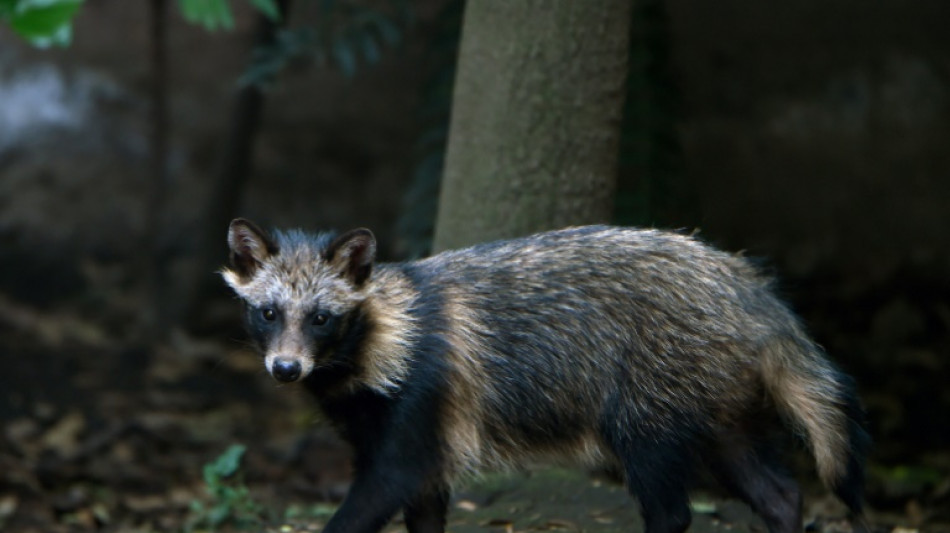
Raccoon dog data sparks new debate about Covid origins / Photo: © AE/AFP/File

 South African election results renew debate over identity-based voting

 South African voters report smoother local election but declining IEC trust

 Dolly Parton museum and Nashville hotel open after singer’s death

 George and Amal Clooney attend New York political-comedy reading

 British buyers pay substantial premiums for period-home appearance

 Thomas Markle released to house arrest after child-abuse-image charge

 Dawn of War 4 developers chose Adeptus Mechanicus for tactical variety

 Italy face unbeaten South Africa in Turin Nations Championship match

 ChatGPT interactive interface feature tested across six custom tools

 Freshways milk-price cut deepens pressure on UK dairy farms

 Labour and National remain virtually tied as New Zealand vote count advances

 The Good Daughter adapts Karin Slaughter thriller with Rose Byrne and Meghann Fahy

 Heavy-lift drone evacuates wounded Ukrainian soldier from frontline kill zone

 Morrison says West Brom recovered after pressure from successive derby losses

 Britain considers 2027 state visit for Ukraine’s Zelensky

 Arizona Democrats Secure Historic Trifecta with New Legislative Leadership

 Carney Welcomes U.S. Trade Reversal After Democratic Midterm Victory

 Armenian FM Discusses EU Accountability for Palestinian Rights in Madrid

 Trump and Vance Pursue Secret Diplomacy with Iran Amid Military Pressure

New evidence that raccoon dogs were at the Chinese market where Covid is suspected to have first infected humans has reignited debate over the origin of the pandemic.
The researchers who unexpectedly stumbled over the genetic data say that it supports -- but cannot definitively prove -- the theory that the virus originated in animals, possibly first jumping over to humans at the market in the city of Wuhan.
The issue has proved divisive for the scientific community and even different US government agencies, with some maintaining that the virus likely leaked from a Wuhan lab -- a claim that China has angrily denied.
Maria Van Kerkhove, the World Health Organization's technical lead on Covid, said the new data "doesn't give us the answer of how the pandemic began, but it does provide more clues".
The data comes from swabs collected by a Chinese team in January and February 2020 at the Huanan Seafood Market, the site of one of the earliest Covid clusters, before it was shut down and cleared of animals.
International researchers including Florence Debarre, an evolutionary biologist at France's CNRS research agency, were surprised to come across the data on the GISAID global science database earlier this month.
They managed to download the data before it was removed from GISAID at the request of the Chinese researchers who first posted it.
Debarre and colleagues informed the WHO about their discovery last week, when some media outlets started reporting on the data's existence.
- 'Piece of the puzzle' -
This week the researchers published a report, which has not been peer-reviewed, saying that DNA from the samples shows that raccoon dogs, palm civets, Amur hedgehogs and bamboo rats were present at the market.
Raccoon dogs, whose closest relatives are foxes, are in particular known to be able to carry and transmit viruses similar to SARS-CoV-2, which causes the Covid disease.
That means they could have acted as an intermediary host between humans and bats, in which Covid is suspected to have originated.
Some of the samples containing raccoon dog DNA were also positive for SARS-CoV-2.
However because the samples were taken from sites at the market and not directly from the animals, it was not possible to prove the raccoon dogs had Covid.
Notably, there was very little human DNA in one of the positive samples, raising the likelihood that it was the raccoon dog that had the virus.
"We cannot rigorously demonstrate that the animal was infected, but it is a plausible explanation," Debarre told AFP.
Even if it could be proved that the raccoon dogs were infected, it would be difficult to show they gave Covid to humans -- and not the other way around.
The data is "one additional piece of the puzzle that supports an origin of the pandemic linked to Wuhan's animal trade," said virologist Connor Bamford of Queen's University Belfast.
But "it is unlikely to provide irrefutable evidence," he said on The Conversation website.
- Data still missing -
There have been increasing calls for all information on the origins of Covid to be publicly released.
US President Joe Biden signed a law earlier this week declassifying intelligence material on the subject, after his energy department concluded with "low confidence" that the virus probably came from a lab.
That assessment contradicted the conclusion of several other US agencies -- but not the FBI.
After being informed of the new Huanan samples, the WHO again called on China to release all its data from the early days of the pandemic.
"These data could have -- and should have -- been shared three years ago," WHO chief Tedros Adhanom Ghebreyesus said late last week.
Alice Hughes, an expert in biodiversity analytics at the University of Hong Kong, said that some researchers in China had known about the existence of the samples since April 2020.
Hughes told AFP this "critically important" information should have been made public earlier, adding that she believed it was "very likely that this is the source of spillover of SARS-CoV-2".
The authors of the new report said that more data was still missing.
There is "absolutely crucial data which sheds light on the start of the pandemic" that the researchers "cannot share because it's not ours," Debarre said.
"The more people who look into it, the more we will be able to extract information," she added.
P.Anderson--BTB