'Noose around your neck': Colombia's biggest drug cartel rules with fear / Photo: © AFP

 Venezuela transition talks to start in person next week: govt

 Colombia truck bomb wounds 14 ahead of presidential inauguration

 Eala stuns Osaka to book Washington final against Pegula

 13 dead after small tourist plane crashes in Peru
 France's devastating fires now 'under control', says PM
 Noh leads by three at women's British Open as Ryu falters
 CONCACAF calls for 'comprehensive reckoning with' Infantino's FIFA leadership

 Wiebes claims Tour de France Femmes yellow jersey with opening stage win

 US embassies urge citizens to consider departing Middle East

 Moroccans ejected from Spain's Ceuta lament 'broken dreams'
 Gaza's civil defence, medical sources say Israeli strikes kill two
 Bournemouth sign Portugal defender Silva from Benfica

 11 injured in Colombia bombing days before presidential inauguration
 In Spain's Ceuta, exhausted migrants end short trip with little hope

 German FA calls for 'full investigation' into FIFA proposal
 Richarlison, Tonali fire 10-man Spurs to 2-1 Sydney win over Chelsea
 Deadly strikes rock Kyiv, as Ukraine sinks Russian cargo ship

 UEFA target Infantino after FIFA shelve World Cup private investment plan
 Infantino has lost UEFA's 'confidence' despite withdrawal of 'shabby deal'
 Spain's N. Africa enclave returns to normal as migrants depart
 Iranian pilgrims flood Iraq for first Arbaeen since war
 Migrants depart Spain's N. Africa enclave as EU tightens borders
 Timeline: How FIFA's World Cup private investment plan imploded
 Search resumes for missing climbers from Pakistan avalanche
 Warsaw and Kyiv exhume Volyn victims at centre of diplomatic quarrel
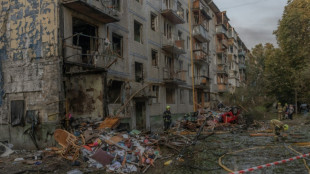
In the cities and towns of northwest Colombia, the ubiquitous graffiti "AGC" signals the ominous presence of the powerful Gulf Clan drug cartel.
Spray painted onto walls, it is meant to instill fear in residents, and keep them mum, as the Clan embarks on a fast-escalating confrontation with the government in an area critical for its bustling cocaine trade, illegal mining and other lucrative criminal ventures.
"To speak about the Clan is to put the noose around your neck," said a resident of Taraza, a town that has recently found itself at the cartel's mercy.
Like many interviewed by AFP in the region, the resident would not divulge their name for fear of reprisal.
Also known as the Autodefensas Gaitanistas of Colombia or AGC, the Gulf Clan is the biggest drug cartel in the world's largest cocaine producer.
It has a long history of violence in an area dubbed the "Bermuda triangle" by locals because of the many people who have gone missing there, only to be found dead in the river nearby.
Authorities accuse it of fomenting violence and vandalism by illegal gold miners in the northwest region protesting a clampdown on their operations and the destruction of their dredging machinery.
In so doing, the Clan breached the terms of a ceasefire not even three months in, according to the government.
The miners have set up roadblocks, attacked government buildings, a bank and civilians -- severely disrupting daily life and livelihoods.
On Sunday, a dozen assailants on motorcycles set fire to two buses and four trucks on the National Route 25 -- a critical link between the Caribbean coast in Colombia's north and the second city of Medellin in the east.
That prompted President Gustavo Petro to announce the "reactivation" of military operations against the cartel.
The military and police deployed 10,000 armed personnel to the region, and the N25 roadblocks have been cleared.
But a local journalist, also speaking on condition of anonymity, told AFP that for all intents and purposes, "the road remains under the control of the Gulf Clan."
- 'Hostage' population -
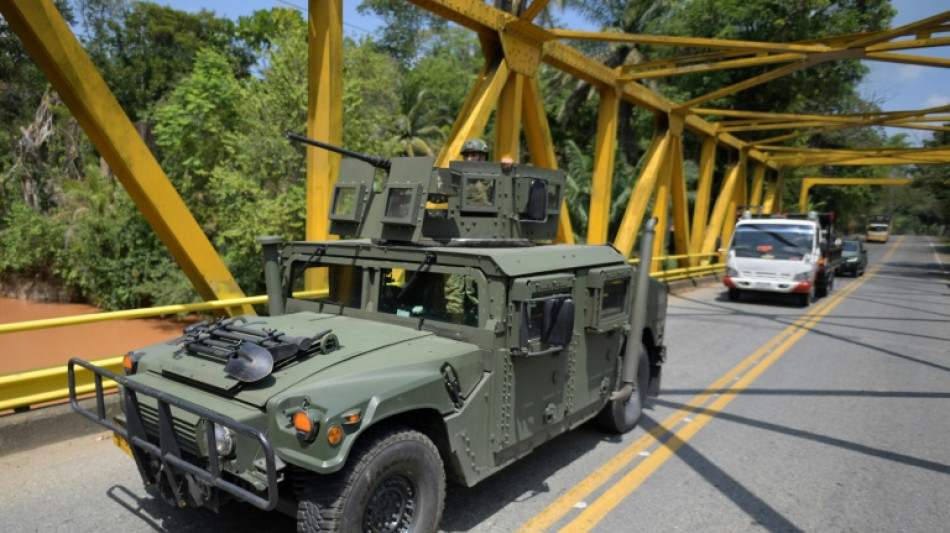
The big trucks ferrying critical consumer products that usually bustle along the N25 now travel in convoys of dozens of vehicles.
They are escorted by heavily-armed members of the security forces past the carcasses of the burnt vehicles still lying there.
"The situation is under control," declared a soldier as he jumped onto a Humvee to join one of the elaborate security convoys whizzing past under the seemingly placid gaze of villagers.
Not everyone is convinced.
"Diana," who runs a modest truck stop restaurant along the route, was a witness to Sunday's attack.
She was keen to show a video on her mobile phone of the two buses in flames, but refused to describe the events.
According to the local journalist, the miners' protest started by targeting the government, but "ended up holding the population hostage."
Gumercindo Castillo Bolario, a leader of the Taraza miners' group, insisted there were no links with the Clan, and accused the government of "stigmatizing accusations."
Economic activity in Taraza has partly resumed since the military deployment there, with shops open at least in the mornings, and some bars pumping music.
"People could no longer move around, go out and buy food," said driver "Faber."
"Twenty days without work -- it was like the pandemic all over again."
Andres, who manages a motel and restaurant attached to a gas station, told AFP "they" had "allowed us to open" in recent days.
"Here, we do what we're told," added a grocery store owner, citing orders and threats relayed by the Clan via WhatsApp.
- 'Total uncertainty' -
Despite a 2016 peace deal that saw the FARC guerrilla group disarm, fighting has continued as the Clan and other armed groups vie for control of illegal resources and trafficking routes.
Petro declared a unilateral ceasefire with armed groups on New Year's Eve in pursuit of his ambitious plan for "total peace" after decades of violence.
The truce remains in place with groups other than the Clan.
"We don't know what will happen," a Taraza hotelier told AFP.
"It is total uncertainty."
N.Fournier--BTB