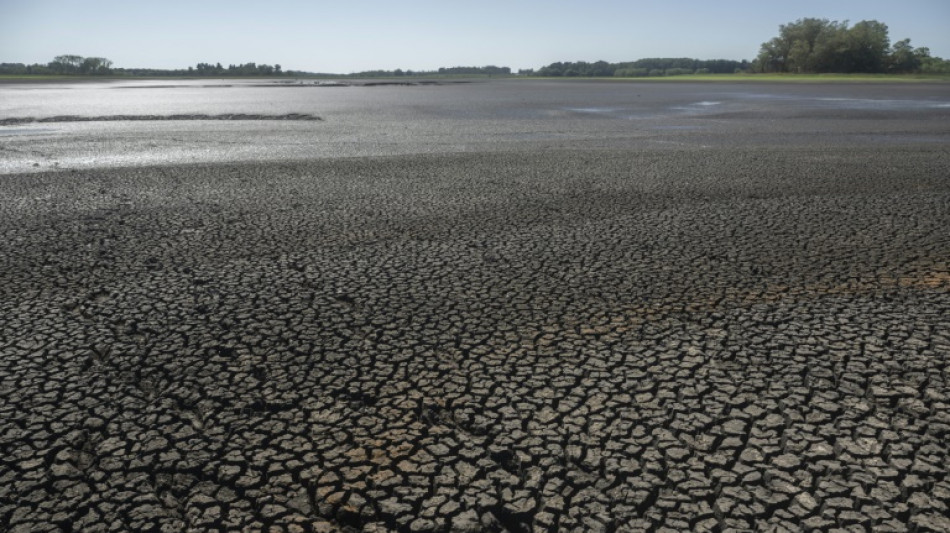
'Vampiric' water use leading to 'imminent' global crisis, UN warns / Photo: © AFP/File

 South African voters report smoother local election but declining IEC trust

 Dolly Parton museum and Nashville hotel open after singer’s death

 George and Amal Clooney attend New York political-comedy reading

 British buyers pay substantial premiums for period-home appearance

 Thomas Markle released to house arrest after child-abuse-image charge

 Dawn of War 4 developers chose Adeptus Mechanicus for tactical variety

 Italy face unbeaten South Africa in Turin Nations Championship match

 ChatGPT interactive interface feature tested across six custom tools

 Freshways milk-price cut deepens pressure on UK dairy farms

 Labour and National remain virtually tied as New Zealand vote count advances

 The Good Daughter adapts Karin Slaughter thriller with Rose Byrne and Meghann Fahy

 Heavy-lift drone evacuates wounded Ukrainian soldier from frontline kill zone

 Morrison says West Brom recovered after pressure from successive derby losses

 Britain considers 2027 state visit for Ukraine’s Zelensky

 Arizona Democrats Secure Historic Trifecta with New Legislative Leadership

 Carney Welcomes U.S. Trade Reversal After Democratic Midterm Victory

 Armenian FM Discusses EU Accountability for Palestinian Rights in Madrid

 Trump and Vance Pursue Secret Diplomacy with Iran Amid Military Pressure

 Classic Car Values Surge: De Tomaso Vallelunga Leads 190% Gain

 Microsoft Ends Oracle AI Computing Rental Deal Amid Cloud Strategy Shift
Humanity's "lifeblood" -- water -- is increasingly at risk around the world due to "vampiric overconsumption and overdevelopment," the UN warned in a report, published hours ahead of a major summit on the issue was set to begin Wednesday.
The world is "blindly travelling a dangerous path" as "unsustainable water use, pollution and unchecked global warming are draining humanity's lifeblood," United Nations Secretary General Antonio Guterres said in a foreword to the report, released hours ahead of the first major UN meeting on water resources in nearly half a century.
Co-hosted by the governments of Tajikistan and the Netherlands, the UN Water Conference will gather some 6,500 participants, including a hundred ministers and a dozen heads of state and government Wednesday through Friday in New York.
Richard Connor, lead author of report, told AFP that the impact of the "world water crisis" will be a "matter of scenarios."
"If nothing is done, it will be a business-as-usual scenario -- it will keep on being between 40 percent and 50 percent of the population of the world that does not have access to sanitation and roughly 20-25 percent of the world will not have access to safe water supply."
With the global population increasing every day, "in absolute numbers, there'll be more and more people that don't have access to these services," he said.
At the UN conference, governments and actors in the public and private sectors are invited to present proposals for a so-called water action agenda to reverse that trend and help meet the development goal, set in 2015, of ensuring "access to water and sanitation for all by 2030."
The last conference at this high level on the issue, which lacks a global treaty or a dedicated UN agency, was held in 1977 in Mar del Plata, Argentina.
Some observers have already voiced concerns about the scope of these commitments and the availability of funding to implement them.
"There is much to do and time is not on our side," said Gilbert Houngbo, chair of UN-Water, a forum for coordinating work on the topic.
The report, published by UN-Water and UNESCO, warns that "scarcity is becoming endemic" due to overconsumption and pollution, while global warming will increase seasonal water shortages in both areas with abundant water as well as those already strained.
- 'Now or never' -
"About 10% of the world's population lives in a country where water stress has reached a high or critical level," the report says.
According to the most recent UN climate report, published Monday by the IPCC expert panel, "roughly half of the world’s population currently experience severe water scarcity for at least part of the year."
Those shortages have the most significant impact on the poor, Connor told AFP.
"No matter where you are, if you are rich enough, you will manage to get water," he said.
The report notes the particular impact of existing water supplies becoming contaminated due to underperforming or nonexistent sanitation systems.
"At least 2 billion people (globally) use a drinking water source contaminated with feces, putting them at risk of contracting cholera, dysentery, typhoid and polio," it said.
That high number does not even take into account pollution from pharmaceuticals, chemicals, pesticides, microplastics and nanomaterials.
To ensure access to safe drinking water for all by 2030, current levels of investment would have to be tripled, the report says.
Freshwater ecosystems -- which in addition to water, provide life-sustaining economic resources and help combat global warming -- "are among the most threatened in the world," the report warns.
"We have to act now because water insecurity is undermining food security, health security, energy security or urban development and societal issues," Henk Ovink, the Dutch special envoy for water, told AFP.
"It's now or never as we say -- a once in a generation opportunity."
M.Furrer--BTB

