UN 'survival guide' report a stark warning on climate / Photo: © AFP/File

 De Zerbi unsure over Richarlison's future at Spurs

 Tottenham manager De Zerbi 'happy' with pre-season progress

 Brazil's Lula launches fourth term bid as Trump looms over campaign

 Alonso welcomes Mudryk's Chelsea return after doping ban

 'Damn hot': Last summer for Japan cosplay extravaganza
 Auger-Aliassime playing for hometown pride at Montreal Masters

 Commonwealth Games poster boy Kerr delivers mile gold in Glasgow

 Pegula defeats Shnaider to reach Washington Open final
 Gaza officials say Israeli strikes kill seven day after deal

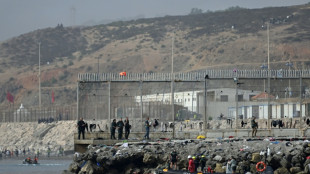 Hundreds of minors sleep rough in Ceuta migrant crisis

 Ex-British champion jockey Crowley takes 'hardest decision' to retire

 Brentford sign Mali midfielder Sangare in club record deal

 Chelsea sign Brighton striker Welbeck

 Mountaineer Nirmal Purja, team killed in Pakistan avalanche
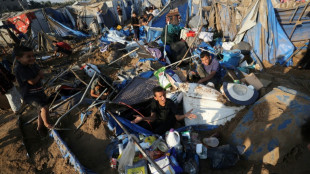
 Pride march draws hundreds of thousands in Germany week after attack

 Maresca 'happy' after first Man City game despite Inter shootout defeat
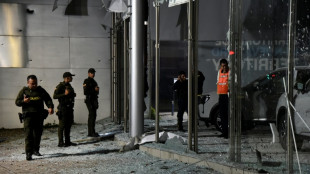
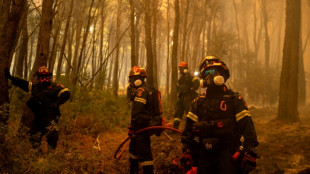 Firefighters in Greece 'pushed to the limit' as winds rage

 Maresca's first Man City outing ends in shootout defeat to Inter

 Nirmal Purja, who redefined climbing, confirmed dead in Pakistan

 Climbing company confirms mountaineer Nirmal Purja killed in Pakistan avalanche

 Ten-man Tottenham beat Chelsea 2-1 in Sydney

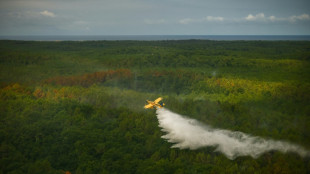 France's largest wildfire in decades 'under control', says minister

 Russia fired record number of missiles at Ukraine in July: AFP analysis

 Search ended at mall wrecked by Japan quake blast

 Deadly strikes rock Kyiv as Zelensky appeals for air defences
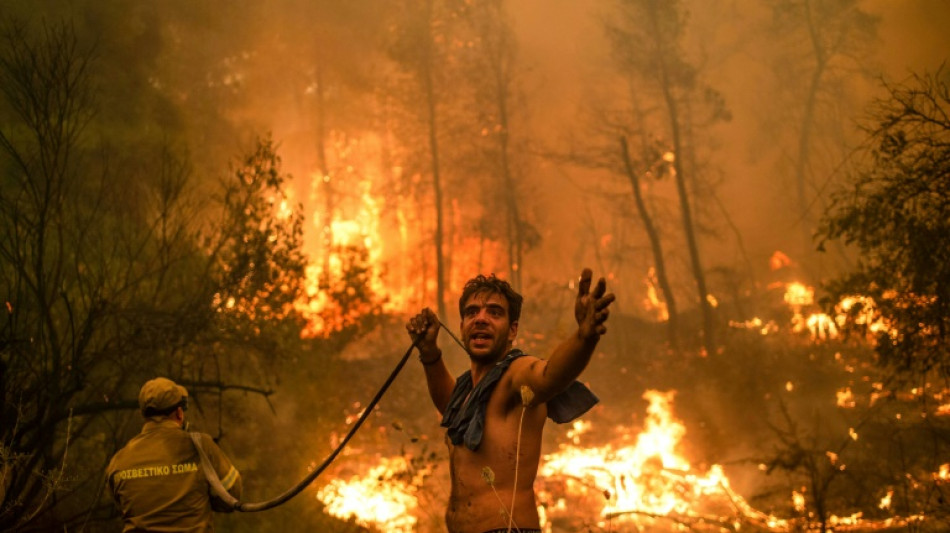
Devastating climate impacts are hitting faster than expected as the world teeters on reaching the 1.5 degree Celsius warming limit in a little over a decade, the UN said Monday.
Temperatures seen in recent years have stoked destructive storms and flooding, crop-wilting heatwaves and deadly droughts.
But generations to come will look back on the hottest years of the 2020s as relatively cool, even if planet-warming fossil fuel emissions drop quickly, the UN's climate advisory panel said in a key report.
The 36-page "summary for policymakers" -- a synthesis of six major reports since 2018 from the Intergovernmental Panel on Climate Change (IPCC) -- is a brutal reminder that while humanity has the tools to prevent climate catastrophe, it is still not putting them to use.
The world is currently set to reach 1.5C above pre-industrial levels -- considered a safer limit to warming -- in the early 2030s, which will ratchet up the severity of impacts in the near future.
But it's not too late to turn things around, the head of the IPCC told AFP, describing the report as a "message of hope".
"We have know-how, technology, tools, financial resources -- everything needed to overcome the climate problems we have known about for so long," Hoesung Lee said in a video interview.
"What's lacking at this point is a strong political will to resolve this issues once and for all."
- 'Humanity on thin ice' -
In response to the report, UN Secretary General Antonio Guterres said wealthy countries aiming for carbon neutrality in 2050 or beyond should speed up their goal to as close as possible to 2040 in order to "defuse the climate time bomb."
"Humanity is on thin ice -- and that ice is melting fast," the United Nations chief said in a video message as the IPCC experts group issued its latest report, which he likened to "a survival guide for humanity."
The IPCC made clear that the benefits to society and the world economy of capping global warming under two degrees Celsius outweigh economic costs.
This is true even without accounting for all the rewards of avoiding climate damages, which range from the health impacts of air pollution to reduced crop yields.
Week-long negotiations in Interlaken, Switzerland -- which went two full days into overtime -- were bogged down by fights over language about fossil fuels, by far the main driver of warming.
The report comes as the world has scrambled to shore up energy security following Russia's invasion of Ukraine, with countries in Europe and Asia turning to heavily polluting coal.
Greenhouse gas emissions from existing fossil fuel infrastructure will be enough to push the world beyond 1.5C, without the use of emerging technology to capture and store the carbon pollution, the IPCC said.
The level of greenhouse gas emission reductions this decade will "largely determine" whether humanity can limit global warming to two degrees Celsius since preindustrial times, or the safer 1.5C, the UN expert report said.
But estimates of future carbon dioxide pollution from existing oil, gas and coal infrastructure -- if no new technology is added to capture the emissions -- "already exceed the remaining carbon budget for limiting warming to 1.5C".
Among the starkest warnings is on the looming threat of deadly heat.
Even if warming is capped at 1.8C -- an optimistic scenario, according to some scientists -- half of humanity could, by 2100, be exposed to periods of life-threatening climate conditions arising from the coupled impacts of extreme heat and humidity, according to research.
In the synthesis report, these findings are reflected in a world map of projected deadly impacts of humid heat across the tropics, especially in Southeast Asia, parts of Brazil and West Africa.
There are similarly dire projections for health, the global food system and economic productivity.
F.Pavlenko--BTB