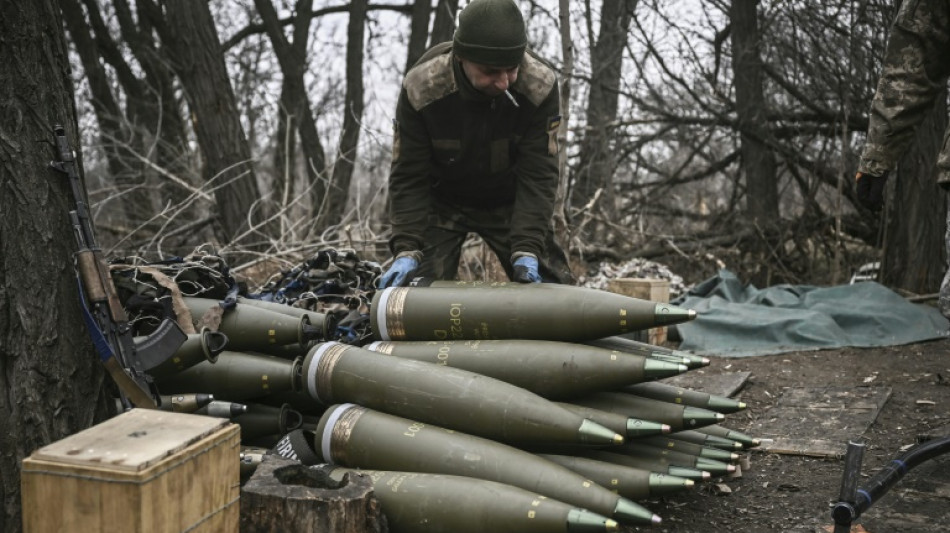
EU hammers out 2-bn-euro ammunition plan for Ukraine / Photo: © AFP

 South African voters report smoother local election but declining IEC trust

 Dolly Parton museum and Nashville hotel open after singer’s death

 George and Amal Clooney attend New York political-comedy reading

 British buyers pay substantial premiums for period-home appearance

 Thomas Markle released to house arrest after child-abuse-image charge

 Dawn of War 4 developers chose Adeptus Mechanicus for tactical variety

 Italy face unbeaten South Africa in Turin Nations Championship match

 ChatGPT interactive interface feature tested across six custom tools

 Freshways milk-price cut deepens pressure on UK dairy farms

 Labour and National remain virtually tied as New Zealand vote count advances

 The Good Daughter adapts Karin Slaughter thriller with Rose Byrne and Meghann Fahy

 Heavy-lift drone evacuates wounded Ukrainian soldier from frontline kill zone

 Morrison says West Brom recovered after pressure from successive derby losses

 Britain considers 2027 state visit for Ukraine’s Zelensky

 Arizona Democrats Secure Historic Trifecta with New Legislative Leadership

 Carney Welcomes U.S. Trade Reversal After Democratic Midterm Victory

 Armenian FM Discusses EU Accountability for Palestinian Rights in Madrid

 Trump and Vance Pursue Secret Diplomacy with Iran Amid Military Pressure

 Classic Car Values Surge: De Tomaso Vallelunga Leads 190% Gain

 Microsoft Ends Oracle AI Computing Rental Deal Amid Cloud Strategy Shift
European Union ministers on Monday will look to sign off on a 2-billion-euro plan to raid their stockpiles and jointly purchase desperately needed artillery shells for Ukraine.
Kyiv has complained that its forces are having to ration their firepower as Russia's year-long invasion has turned into a grinding war of attrition.
Ukraine has told the EU it wants 350,000 shells a month to help its troops hold back Moscow's onslaught and allow them to launch fresh counter-offensives later in the year.
Foreign and defence ministers from the bloc's 27-nations meeting in Brussels are seeking to agree on a multipronged initiative aimed at speeding up supplies and bolstering their defence industries.
"Time is of the essence: we need to deliver more artillery ammunition and we need to deliver faster," EU foreign policy chief Josep Borrell has said.
The first part of the plan involves committing a further one billion euros ($1.06 billion) of shared funding to try to get EU states to tap their already stretched stocks for ammunition that can be sent quickly.
The second part would see the bloc use another one billion euros to order 155-millimetre shells for Ukraine as part of a massive joint procurement push intended to spur firms to ramp up production.
Buying weaponry together on this scale is a major new step by the EU, which has seen long-standing efforts to work more in unison on defence propelled by Russia's war.
Countries have been wrangling over details, like whether the EU's defence agency or member states would negotiate the orders and if they should buy only from producers in Europe.
EU ambassadors on Sunday hammered out the remaining issues and it was hoped ministers would give their stamp of approval at their talks, diplomats said.
Estonia -- which originally pitched spending 4 billion euros on shells -- pushed for a clear target that 1 million rounds will be provided.
But others were reluctant to commit to a specific number out of fear they won't hit it.
- How much in stocks? -
After 12 months of eating into their stockpiles, there are questions over how much EU countries can share immediately without leaving themselves vulnerable.
"We don't know, member state by member states, the state of their stocks but we think that there is still some ammunition" available, an EU official said.
EU countries have already committed a wide range of military support worth 12 billion euros to Ukraine, with 3.6 billion euros from a joint fund used to help cover the costs.
Officials say that since the invasion last February 450 million euros from the fund have gone on supplying 350,000 shells to Ukraine.
Key to getting countries to deplete their stocks is convincing them that European industry can step up to produce more.
Ukraine's consumption of ammunition currently far outstrips the amounts its Western backers are manufacturing.
Brussels says EU firms need to switch to "war economy mode" after scaling back in the years following the end of the Cold War.
The industry complains that governments haven't yet signed the long-term contracts they need to invest in more production lines.
The EU is hoping that placing a mammoth joint order for 155-mm shells will incentivise companies to ramp up their output.
It has begun reaching out to 15 firms in 11 EU countries that make the ammunition to urge them to push ahead.
Brussels has said it is looking to iron out regulatory bottlenecks, ease access to financing and even provide central EU funds to help boost capacity.
But several European diplomats say the details of these proposals remain vague and they need more reassurances that they will have an impact.
C.Meier--BTB

