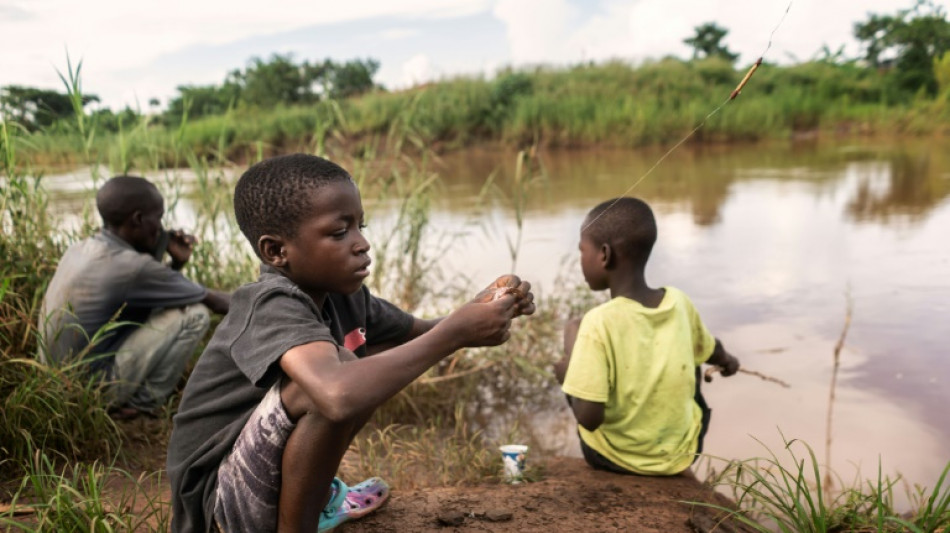
UN holds rare conference on global water crisis / Photo: © AFP

 South African voters report smoother local election but declining IEC trust

 Dolly Parton museum and Nashville hotel open after singer’s death

 George and Amal Clooney attend New York political-comedy reading

 British buyers pay substantial premiums for period-home appearance

 Thomas Markle released to house arrest after child-abuse-image charge

 Dawn of War 4 developers chose Adeptus Mechanicus for tactical variety

 Italy face unbeaten South Africa in Turin Nations Championship match

 ChatGPT interactive interface feature tested across six custom tools

 Freshways milk-price cut deepens pressure on UK dairy farms

 Labour and National remain virtually tied as New Zealand vote count advances

 The Good Daughter adapts Karin Slaughter thriller with Rose Byrne and Meghann Fahy

 Heavy-lift drone evacuates wounded Ukrainian soldier from frontline kill zone

 Morrison says West Brom recovered after pressure from successive derby losses

 Britain considers 2027 state visit for Ukraine’s Zelensky

 Arizona Democrats Secure Historic Trifecta with New Legislative Leadership

 Carney Welcomes U.S. Trade Reversal After Democratic Midterm Victory

 Armenian FM Discusses EU Accountability for Palestinian Rights in Madrid

 Trump and Vance Pursue Secret Diplomacy with Iran Amid Military Pressure

 Classic Car Values Surge: De Tomaso Vallelunga Leads 190% Gain

 Microsoft Ends Oracle AI Computing Rental Deal Amid Cloud Strategy Shift
With water scarce in some places, in excess elsewhere, polluted or otherwise problematic, the United Nations addresses this week a global crisis that has been long overlooked even as the welfare of billions of people is at stake.
"It's the first time in 46 years that the world comes together on the issue of water," said Henk Ovink, water issues special envoy for the Netherlands, which is co-organizing the UN Water Summit Wednesday through Friday along with Tajikistan.
"It's now or never, as we say, a once in a generation opportunity," he told AFP.
The last conference at this high level on the issue, which lacks a global treaty or a dedicated UN agency, was held in 1997 in Mar del Plata, Argentina.
And the situation is dire.
"We wrecked the hydrological cycle," said Ovink, adding that he has never been more worried.
"We take too much water from our ground. We pollute the water that is left and there is now so much water in the air that it is impacting our environment, our economies, our communities, through climate change," he added.
This means there is drought in some places and flooding in others, in a cycle that is worsening around the world because of global warming triggered by human activity.
The UN says 2.3 billion people today live in countries with water stress.
In 2020, two billion people did not have access to drinking water, 3.6 billion had no toilets at home and 2.3 billion had no way to wash their hands at home -- poor sanitary conditions that lead to disease.
These circumstances are a far cry from the sustainable development goals set by the UN in 2015; one was to "ensure access to water and sanitation for all by 2030."
- 'Drop by drop' -
"We need to develop a new economics of water that will help us reduce water waste, improve water efficiency, and provide opportunities for greater water equity," said Ngozi Okonjo-Iweala, director-general of the World Trade Organization and co-author of a recent report that decried a "systemic crisis that results from decades-long human mismanagement of water."
At the UN conference this week, governments and actors in the public and private sectors are invited to present proposals for a so-called water action agenda.
"The Water Summit must result in a bold Water Action Agenda that gives our world's lifeblood the commitment it deserves," UN Secretary-General Antonio Guterres said.
Some 6,500 people are expected to attend the conference with its more than 500 related events. They include 20 heads of state or government, dozens of ministers and hundreds of representatives of civil society and the business world.
Ahead of the conference, hundreds of projects have already been registered on its website.
The ideas range from building cheap toilets for millions of people around the world to improving farm irrigation techniques in Australia and enhancing access to drinking water in Fiji.
Organizers expect participants to make commitments, be they large or small, during the conference.
"Every commitment is of significant importance as it may bring... change for even one household, one school, one village, one city. As we say, drop by drop it becomes an ocean," Sulton Rahimzoda, special envoy on water for the president of Tajikistan, told a press conference.
Ani Dasgupta, president and CEO of the think tank World Resources Institute, said: "We cannot have only incremental progress, but a plan to fundamentally transform how we manage water for the new climate reality."
Solutions do exist, he added, and "the price is a bargain."
"Securing water for our societies by 2030 could cost just over one percent of global GDP," said Dasgupta.
"And the return on these investments would be immense, from growing our economies to boosting farmers' crop yields to improving the lives of poor and vulnerable," he added.
T.Bondarenko--BTB

