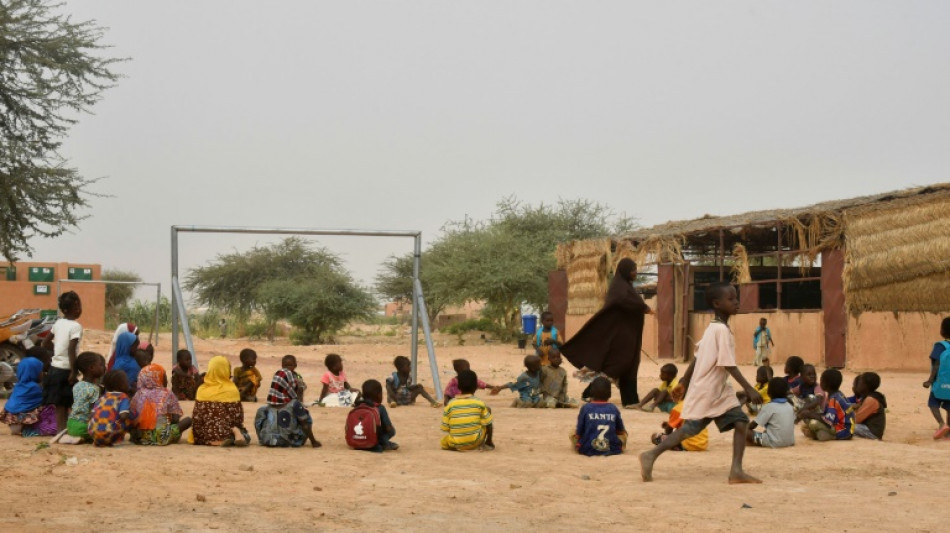
Ten million children in Sahel face 'extreme jeopardy': UN / Photo: © AFP/File

 South African voters report smoother local election but declining IEC trust

 Dolly Parton museum and Nashville hotel open after singer’s death

 George and Amal Clooney attend New York political-comedy reading

 British buyers pay substantial premiums for period-home appearance

 Thomas Markle released to house arrest after child-abuse-image charge

 Dawn of War 4 developers chose Adeptus Mechanicus for tactical variety

 Italy face unbeaten South Africa in Turin Nations Championship match

 ChatGPT interactive interface feature tested across six custom tools

 Freshways milk-price cut deepens pressure on UK dairy farms

 Labour and National remain virtually tied as New Zealand vote count advances

 The Good Daughter adapts Karin Slaughter thriller with Rose Byrne and Meghann Fahy

 Heavy-lift drone evacuates wounded Ukrainian soldier from frontline kill zone

 Morrison says West Brom recovered after pressure from successive derby losses

 Britain considers 2027 state visit for Ukraine’s Zelensky

 Arizona Democrats Secure Historic Trifecta with New Legislative Leadership

 Carney Welcomes U.S. Trade Reversal After Democratic Midterm Victory

 Armenian FM Discusses EU Accountability for Palestinian Rights in Madrid

 Trump and Vance Pursue Secret Diplomacy with Iran Amid Military Pressure

 Classic Car Values Surge: De Tomaso Vallelunga Leads 190% Gain

 Microsoft Ends Oracle AI Computing Rental Deal Amid Cloud Strategy Shift
Ten million children in west Africa's central Sahel region are now in "extreme jeopardy" and desperately need humanitarian help due to worsening violence, the United Nations warned Friday.
The number of children in dire need of aid in Burkina Faso, Mali and Niger is twice as many as in 2020, the children's agency UNICEF said.
Meanwhile a further four million children are at risk in neighbouring countries as battles between armed groups and security forces spill across the borders.
"Children are increasingly caught up in the armed conflict, as victims of intensifying military clashes, or targeted by non-state armed groups," Marie-Pierre Poirier, UNICEF's regional director for west and central Africa, said.
"The year 2022 was particularly violent for children in the central Sahel. All parties to the conflict need to urgently stop attacks both on children, and their schools, health centres, and homes."
The region has been caught in a spiral of jihadist violence for years, with Mali struggling with an 11-year-old insurgency that has claimed thousands of lives and forced hundreds of thousands from their homes.
Meanwhile Burkina Faso, one of the world's most volatile and impoverished countries, witnessed two military coups in 2022.
UNICEF said the armed conflict engulfing the region had become increasingly brutal, with some groups that operate across vast swathes of territory blockading towns and sabotaging water networks.
- Schools burned, looted -
In Burkina Faso, three times as many children were verified as killed during the first nine months of 2022 as in the same period in 2021, according to UN data.
Most died from gunshot wounds during attacks on their villages or as a result of improvised explosive devices or explosive remnants of war.
Armed groups which oppose state education "systematically burn and loot schools, and threaten, abduct or kill teachers", said UNICEF.
More than 8,300 schools have shut down across the three countries: more than one in five in Burkina Faso, while nearly a third of schools in Niger's Tillaberi region are no longer functional.
James Jones, UNICEF spokesman for the region, detailed "the extreme jeopardy facing the lives and futures of children in the central Sahel".
"Things have been accelerating downhill at an alarming pace," he told reporters in Geneva.
"Slowly and surely it has been spreading, and children -- millions of them -- are increasingly in the middle of it."
He said there were several factors behind the worsening trends, including higher food prices, chronic underfunding of humanitarian and development work, a lack of national commitment to child services, and climate change, with temperatures rising in the Sahel 1.5 times faster than the global average.
UNICEF called on all parties to the conflict to fulfil their "moral and legal obligations" towards children under international law, including ending attacks on youngsters and schools.
- Spreading southwards -
UNICEF said the violence was spreading from the central Sahel into the northern regions of Benin, Ivory Coast, Ghana and Togo, which are remote communities where children have very limited access to protection and services.
"Insecurity is growing in these coastal countries, linked to similar activities by non-state armed groups," said Jones.
In 2022, UNICEF received only a third of the $391 million sought for the central Sahel appeal.
In 2023, it has appealed for $473.8 million for the humanitarian response plan in the central Sahel and neighbouring coastal countries.
The crisis needs long-term investment to foster "social cohesion, sustainable development, and a better future for children," Poirier said.
N.Fournier--BTB

