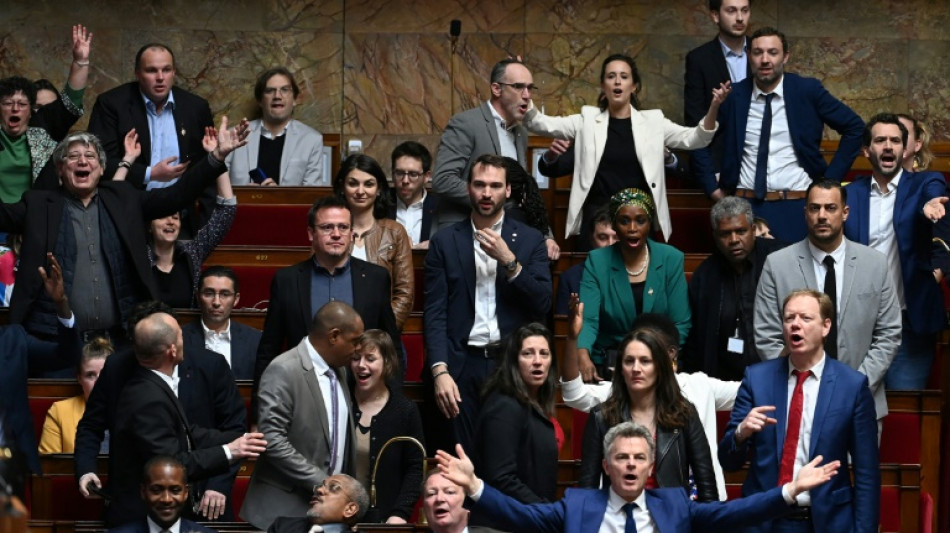
How did France's government impose its pension reform? / Photo: © AFP

 South African voters report smoother local election but declining IEC trust

 Dolly Parton museum and Nashville hotel open after singer’s death

 George and Amal Clooney attend New York political-comedy reading

 British buyers pay substantial premiums for period-home appearance

 Thomas Markle released to house arrest after child-abuse-image charge

 Dawn of War 4 developers chose Adeptus Mechanicus for tactical variety

 Italy face unbeaten South Africa in Turin Nations Championship match

 ChatGPT interactive interface feature tested across six custom tools

 Freshways milk-price cut deepens pressure on UK dairy farms

 Labour and National remain virtually tied as New Zealand vote count advances

 The Good Daughter adapts Karin Slaughter thriller with Rose Byrne and Meghann Fahy

 Heavy-lift drone evacuates wounded Ukrainian soldier from frontline kill zone

 Morrison says West Brom recovered after pressure from successive derby losses

 Britain considers 2027 state visit for Ukraine’s Zelensky

 Arizona Democrats Secure Historic Trifecta with New Legislative Leadership

 Carney Welcomes U.S. Trade Reversal After Democratic Midterm Victory

 Armenian FM Discusses EU Accountability for Palestinian Rights in Madrid

 Trump and Vance Pursue Secret Diplomacy with Iran Amid Military Pressure

 Classic Car Values Surge: De Tomaso Vallelunga Leads 190% Gain

 Microsoft Ends Oracle AI Computing Rental Deal Amid Cloud Strategy Shift
The constitutional power used by the French government on Thursday to ram through parliament a hotly contested pension reform is deeply controversial and seen as undemocratic by critics.
Article 49.3 of the constitution, widely referred to as "the 49.3" in France, allows a prime minister to push draft legislation through the National Assembly without a vote by lawmakers.
A bill is then considered adopted, although opposition lawmakers are able to call a vote of no-confidence in the government within the following 24 hours which could reverse the move if passed.
"In the eyes of French people, the 49.3 is associated with brutality," Antoine Bristielle, a public opinion expert at the Fondation Jean-Jaures, a Paris think-tank, told AFP.
President Emmanuel Macron's government chose to deploy the article on Thursday to pass the pensions overhaul after two months of heated debate in parliament, as well as strikes and mass protests in the streets.
The upper-chamber Senate, which is dominated by conservatives, approved the bill on Thursday morning.
"When you don't have a majority or at least no guaranteed majority in the National Assembly, you invoke the 49.3," explained constitutional expert Dominique Rousseau.
You do this "either to bring it to heel... or because you are not certain you will secure enough votes," Rousseau said.
Thursday saw the article used for the 100th time under France's modern constitution, which created an all-powerful president in 1958, overturning the previous one and its parliamentary system.
Under the modern fifth republic, 16 prime ministers have used the article and have managed to stay in power.
Macron's government is expected to survive a no-confidence vote after the head of the opposition Republicans party said it would vote with the president's allies, which are 39 seats short of a majority in the 577-seat assembly.
Michel Rocard, who was prime minister from 1988 to 1991, holds the record for using the 49.3, having deployed it 28 times.
Borne holds second place in the ranking, despite only becoming head of government following Macron's re-election for a second term in May last year.
She has invoked it 11 times.
In just two months late last year, she used it 10 times, including to push through the 2023 state and social security budgets.
In recent decades, the measure has proven useful for even those presidents who initially disapproved of it.
When Francois Hollande was still a member of parliament, he criticised then prime minister Dominique de Villepin for using the article, calling it "anti-democratic".
But a decade later, when he was president, his head of government Manuel Valls rolled out the 49.3 six times.
R.Adler--BTB

