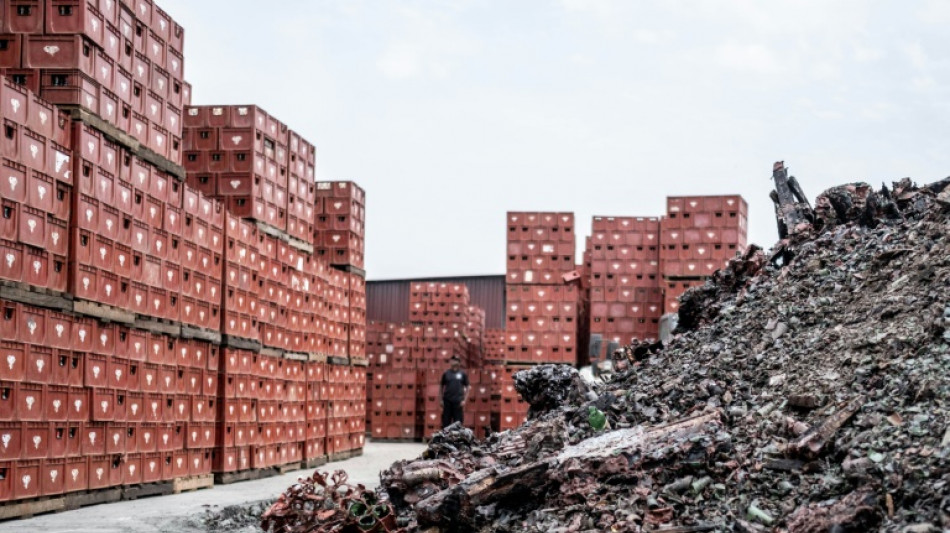
French brewery attack flags Russia's tussle for influence in Africa / Photo: © AFP

 South African voters report smoother local election but declining IEC trust

 Dolly Parton museum and Nashville hotel open after singer’s death

 George and Amal Clooney attend New York political-comedy reading

 British buyers pay substantial premiums for period-home appearance

 Thomas Markle released to house arrest after child-abuse-image charge

 Dawn of War 4 developers chose Adeptus Mechanicus for tactical variety

 Italy face unbeaten South Africa in Turin Nations Championship match

 ChatGPT interactive interface feature tested across six custom tools

 Freshways milk-price cut deepens pressure on UK dairy farms

 Labour and National remain virtually tied as New Zealand vote count advances

 The Good Daughter adapts Karin Slaughter thriller with Rose Byrne and Meghann Fahy

 Heavy-lift drone evacuates wounded Ukrainian soldier from frontline kill zone

 Morrison says West Brom recovered after pressure from successive derby losses

 Britain considers 2027 state visit for Ukraine’s Zelensky

 Arizona Democrats Secure Historic Trifecta with New Legislative Leadership

 Carney Welcomes U.S. Trade Reversal After Democratic Midterm Victory

 Armenian FM Discusses EU Accountability for Palestinian Rights in Madrid

 Trump and Vance Pursue Secret Diplomacy with Iran Amid Military Pressure

 Classic Car Values Surge: De Tomaso Vallelunga Leads 190% Gain

 Microsoft Ends Oracle AI Computing Rental Deal Amid Cloud Strategy Shift
On a night in early March, arsonists attacked a brewery owned by the French drinks giant Castel in Bangui, the capital of the Central African Republic.
Hurling petrol bombs, they set fire to beer crates stacked inside the MOCAF brewery's fortified storage yard.
But this was not some random assault by firebugs.
Footage from security cameras, say sources familiar with the incident, shows a planned operation by four men wearing fatigues resembling those of the Russian mercenary group Wagner.
The attack, they say, bears the hallmarks of a ruthless campaign to carve out Russian influence in the CAR, a country poor but replete with valuable forests, gold and commercial minerals.
France and Russia have long been wrestling for influence in CAR, a country wracked by poverty and plagued by a nearly decade-long civil conflict.
But until this physical attack on French interests, the confrontation had been largely limited to anti-French trolling, seeking to poison relations between the CAR and its former colonial power.
In December 2020, Facebook removed troll "factories" and other sources of fake news allegedly controlled by entities linked to Wagner chief Yevgeny Prigozhin, as well as accounts reportedly linked to the French military.
Last December, France pulled its last troops out of CAR.
It ended a deployment that had continued since the country's independence in 1960 and helped to stabilise it after a civil war erupted along sectarian lines in 2013.
The pullout came on the heels of a French withdrawal from the Sahel state of Mali after its junta forged a close alliance with the Kremlin and brought in paramilitaries described by France as Wagner men.
But in an apparent sign of warming relations, CAR's President Faustin Archange Touadera met this month with Emmanuel Macron in Gabon during the French president's most recent Africa trip.
That meeting occurred just days before the Castel brewery attack on the night of March 5.
"The Russians are concerned about a possible rapprochement between Touadera and the West, and are going to do whatever they can to stop it," said Roland Marchal, an Africa specialist at Sciences Po university in Paris.
- Brewery target -
Earlier this year, Castel and MOCAF, a major local employer, were hit by smear campaigns on social media and in the streets.
Castel presented a favourable target.
French anti-terrorism prosecutors had opened a preliminary inquiry into "complicity in war crimes" over a suspected financial deal with CAR rebels to secure production sites of the firm's sugar refinery SUCAF.
Signs saying "Castel = Terrorism" or "If you buy Castel, you're paying your own murder" were carried by a few dozen protesters outside the brewery in mid-January.
A senior Castel executive in France, who requested anonymity to discuss the security risks, said there was an attempted intrusion before the March 5 attack.
"On January 30, during a curfew, three white men got out of an unmarked car and approached (the brewery) carrying a ladder before fleeing when security personnel approached."
"The same night, a drone flew over the brewery," the executive said.
- Lightning attack -
Video footage of the March 5 attack went viral on social media, and was confirmed to AFP by MOCAF, the French group's local subsidiary.
Ben Wilson Ngassan, a communications consultant for MOCAF, said "around 30" petrol bombs were thrown in "a premeditated operation, a lightning attack (that lasted) five minutes, tops."
A well-informed European source said the footage bore clear signs that the assailants were Wagner.
They had "quite an athletic build," had a military comportment, wore military fatigues -- a familiar sight in Bangui -- and had Kalashnikov assault rifles slung over their shoulders, the source said.
Russian paramilitaries have been in the country since 2018, when they were brought in to buttress CAR's beleaguered military.
Their numbers were increased by hundreds in 2020 to thwart rebels who advancing on the capital as a presidential election unfolded.
A UN rights expert as well as NGOs and Western capitals have accused Wagner mercenaries of carrying out crimes against civilians. The group also operates in Mali.
But France also suspects Touadera of buying Wagner's support against rebel insurgencies by providing it access to diamonds and the country's other natural riches.
- Intimidation? -
A diplomat in Bangui called the brewery bombing the latest attempt to intimidate Western businesses in the CAR.
It came as a rival beer called Africa Ti L'Or appeared in markets and bars across Bangui.
The new brand is brewed by a firm called the First Industrial Company, owned by Russia's cultural attache in Bangui, Dmitry Syty, according to the weekly Jeune Africa.
Syty is "one of the pillars of the Wagner network in CAR," according to the All Eyes on Wagner investigative consortium.
He was reportedly injured last year by a letter bomb, which Prigozhin blamed on France -- a claim that France dismissed as Russian "propaganda."
- Blame game -
Social networks and pro-Russia media outlets have attributed the brewery attack to Central Africans or disguised "mercenaries" paid by France to make it look like a Wagner attack.
The Ndjoni Sango news site, a staunch supporter of Russia's presence in the country, even announced the arrest of seven "suspects" and attributed the attack to the Fulani ethnic group.
The claim "is fake news," an official in CAR's security forces told AFP.
On March 9, police detained eight foreigners, including four French nationals, at a popular restaurant and hotel in Bangui while purportedly searching for the "inflammable liquid" used in the brewery attack.
All were released without charges a few hours later.
There are no signs of any progress in the inquiry into the brewery attack.
"We are examining all documents before making any arrest," Bangui's chief prosecutor Benoit Narcisse Foukpio told AFP on Tuesday.
L.Janezki--BTB

