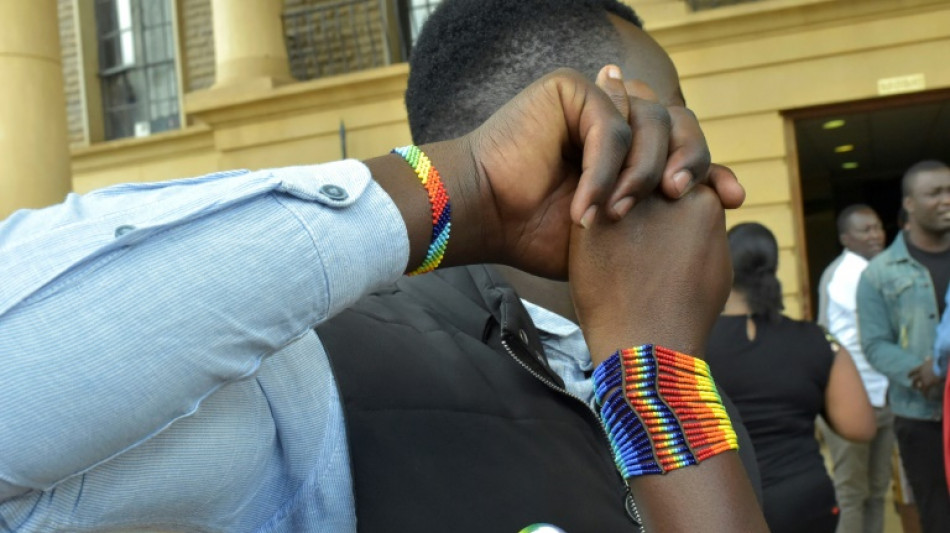
'Nowhere to hide': Anti-gay crackdown grips East Africa / Photo: © AFP/File

 South African voters report smoother local election but declining IEC trust

 Dolly Parton museum and Nashville hotel open after singer’s death

 George and Amal Clooney attend New York political-comedy reading

 British buyers pay substantial premiums for period-home appearance

 Thomas Markle released to house arrest after child-abuse-image charge

 Dawn of War 4 developers chose Adeptus Mechanicus for tactical variety

 Italy face unbeaten South Africa in Turin Nations Championship match

 ChatGPT interactive interface feature tested across six custom tools

 Freshways milk-price cut deepens pressure on UK dairy farms

 Labour and National remain virtually tied as New Zealand vote count advances

 The Good Daughter adapts Karin Slaughter thriller with Rose Byrne and Meghann Fahy

 Heavy-lift drone evacuates wounded Ukrainian soldier from frontline kill zone

 Morrison says West Brom recovered after pressure from successive derby losses

 Britain considers 2027 state visit for Ukraine’s Zelensky

 Arizona Democrats Secure Historic Trifecta with New Legislative Leadership

 Carney Welcomes U.S. Trade Reversal After Democratic Midterm Victory

 Armenian FM Discusses EU Accountability for Palestinian Rights in Madrid

 Trump and Vance Pursue Secret Diplomacy with Iran Amid Military Pressure

 Classic Car Values Surge: De Tomaso Vallelunga Leads 190% Gain
 Microsoft Ends Oracle AI Computing Rental Deal Amid Cloud Strategy Shift
Arnold came out as gay years ago, but last month, the Kenyan guitarist removed a rainbow flag from his Twitter profile, fearing for his safety as a new wave of virulent homophobia sweeps East Africa.
The 35-year-old musician, who asked not to be identified by his real name, told AFP he was worried the government might use social media to identify and round up LGBTQ citizens.
"Safe spaces are shrinking every day," he said. "Soon, we will have nowhere to hide."
Kenya, like its neighbours, is in the grip of a brutal cost-of-living crisis and faces its worst drought in four decades.
But activists say those issues have been pushed to the back-burner as leaders across the political spectrum unite to unleash a campaign of "state-sponsored homophobia".
"There is a concerted effort in peddling misinformation and disinformation," Njeri Gateru, executive director of the Nairobi-based National Gay and Lesbian Human Rights Commission (NGLHRC), a nonprofit advocacy group, told AFP.
"The sentiments that have been carried over in the public space inspire and justify violence against LGBTQ," she warned.
Homosexuality is illegal in many East African countries, which have a history of repression and stigmas against gays, often encouraged by conservative Muslims and Christians.
In Kenya and Tanzania, gay sex remains a crime under colonial-era laws with penalties including prison terms of up to 14 years.
Convictions are rare, however, and despite the legal threats against homosexuality, gay rights groups have been allowed to operate in Kenya, unlike in neighbouring nations such as Somalia.
But the laws have made the LGBTQ community in Kenya easy prey for police harassment and online attacks.
And conditions have worsened since the most recent wave of homophobia took hold.
NGLHRC recorded 117 attacks in Kenya against people perceived to be LGBTQ last month, up from 78 in January.
- 'Living in fear' -
The latest outburst erupted last month after Kenya's Supreme Court ruled against a petition seeking to bar LGBTQ lobbying groups, sparking a torrent of condemnation including from the attorney general, who vowed to challenge the verdict.
President William Ruto, a born-again Christian elected last August, declared that same-sex marriages could "happen in other countries but not in Kenya".
He said homosexuality was a Western import that Kenya's "customs, traditions, Christianity and Islam cannot allow".
His deputy, Rigathi Gachagua, went even further, calling the court's decision an example of "repugnant morality and injustice in our way of life."
In a rare show of unity, opposition leader Raila Odinga, who has spent months contesting Ruto's election victory, agreed with the government, accusing the court of overstepping its mandate.
Across Kenya's western border, lawmakers in Uganda introduced a bill in parliament last week that would punish anyone who identifies as homosexual or engages in consensual same-sex activity with a 10-year prison term.
Uganda has long been notorious for intolerance of homosexuality.
In 2014, strongman President Yoweri Museveni drew international condemnation after signing a law that imposed life imprisonment for homosexual relations.
It was struck down by Uganda's constitutional court on a technicality.
In recent months, online conspiracy theories accusing shadowy international forces of "promoting homosexuality" have flooded social media.
Frank Mugisha, executive director of Sexual Minorities Uganda, a leading gay rights organisation whose operations were suspended by the authorities last year, told AFP he had already been inundated with calls from LGBTQ people over the new bill.
"Community members are living in fear," he said.
- 'Easy target' -
Attacking gay rights while espousing evangelical Christian values is an easy win for politicians in many African nations, campaigners say.
"It is a very intentional and coordinated effort," said Oryem Nyeko, a researcher for Human Rights Watch.
Homosexuals are an "easy target", he told AFP. "They are a vulnerable group, they are a minority, they are misunderstood."
In Burundi, where homosexuality has been criminalised since 2009, 24 people were charged with "homosexual practices" last week after attending a seminar organised by a nonprofit focussing on HIV/AIDS prevention.
Earlier this month, President Evariste Ndayishimiye urged citizens to "curse those who indulge in homosexuality, because God cannot bear it".
"They must be banished, treated as pariahs in our country," he said.
The crackdown has expanded into schools, with the governments of Kenya, Uganda and Tanzania vowing to stop the alleged spread of LGBTQ awareness among students.
Tanzanian activist Fatma Karume said gay, lesbian and transgender people were scapegoats for political leaders struggling to address economic crises.
"It's unfortunate... they want to use this minority group to distract people," she told AFP.
The timing of the clampdown is not lost on gay rights campaigners.
"We are being taken for a ride," said NGLHRC's Gateru, adding that regardless of the motives behind the onslaught, the message was clear.
"Being an LGBTQ person is being a second-class citizen."
burs-ho/amu/js
O.Krause--BTB

