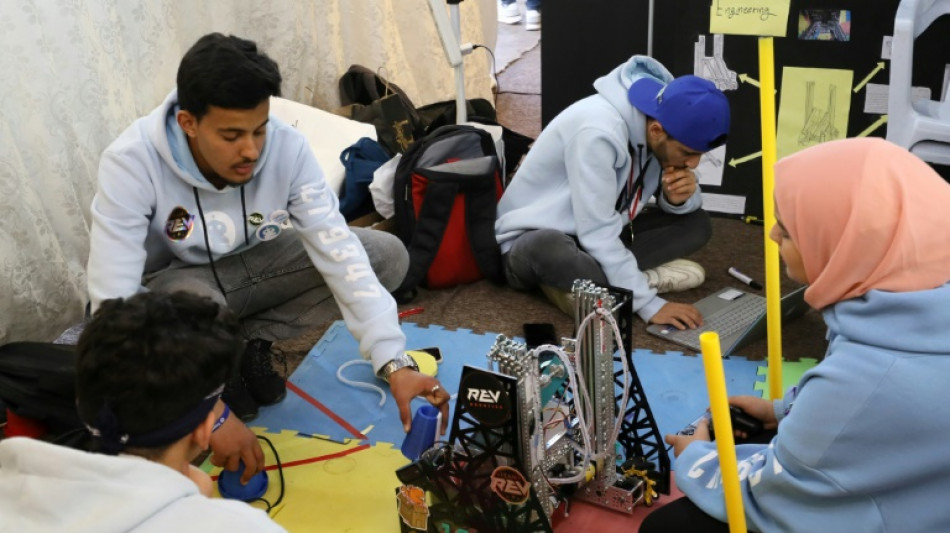
In troubled Libya, young robotics fans see hope in hi-tech
/ Photo: © AFP

 South African voters report smoother local election but declining IEC trust

 Dolly Parton museum and Nashville hotel open after singer’s death

 George and Amal Clooney attend New York political-comedy reading

 British buyers pay substantial premiums for period-home appearance

 Thomas Markle released to house arrest after child-abuse-image charge

 Dawn of War 4 developers chose Adeptus Mechanicus for tactical variety

 Italy face unbeaten South Africa in Turin Nations Championship match

 ChatGPT interactive interface feature tested across six custom tools

 Freshways milk-price cut deepens pressure on UK dairy farms

 Labour and National remain virtually tied as New Zealand vote count advances

 The Good Daughter adapts Karin Slaughter thriller with Rose Byrne and Meghann Fahy

 Heavy-lift drone evacuates wounded Ukrainian soldier from frontline kill zone

 Morrison says West Brom recovered after pressure from successive derby losses

 Britain considers 2027 state visit for Ukraine’s Zelensky

 Arizona Democrats Secure Historic Trifecta with New Legislative Leadership

 Carney Welcomes U.S. Trade Reversal After Democratic Midterm Victory

 Armenian FM Discusses EU Accountability for Palestinian Rights in Madrid

 Trump and Vance Pursue Secret Diplomacy with Iran Amid Military Pressure

 Classic Car Values Surge: De Tomaso Vallelunga Leads 190% Gain

 Microsoft Ends Oracle AI Computing Rental Deal Amid Cloud Strategy Shift
Youssef Jira, a fresh-faced 18-year-old in a hoodie, has big ambitions in a Libyan society where youthful creativity has long been sacrificed to dictatorship and violence.
He wants to encourage other young people to use hi-tech to help modernise the divided and conflict-scarred country.
Jira, with a bandana around his head, is one of a group of young tech fanatics who took part in a robotics competition in a suburb of Tripoli this month.
"We want to send a message to the whole of society, because what we've learned has changed us a lot," Jira said at the rare event.
Libya has seen more than a decade of stop-start conflict since a 2011 NATO-backed revolt toppled strongman Moamer Kadhafi, with myriad rival militias, foreign powers and multiple governments vying for influence.
The country remains split between a supposedly interim government in the western capital, Tripoli, and another in the east nominally backed by military chief Khalifa Haftar.
Unlike Libya's politicians, the young participants worked together at the school gymnasium where the competition took place.
Jira said he had gained new skills and learned about teamwork in pursuit of a common goal.
- 'New horizons' -
The event had the air of a high school sports competition, with fans cheering on their teams who worked in a pen on the gym floor, against a backdrop of banners promoting "Lybotics" and the "First Tech Challenge" as English pop music played.
The robots were nothing fancy: small wheeled contraptions, their electrical guts exposed. They made jerky movements as they manoeuvred around the pen.
But event coordinator Mohammed Zayed said such projects help "open new horizons" for young Libyans.
"This is not just about simple robots," he said. "These young people also had to manage their relationships and work towards inclusion, unity and peace."
Zayed said the event aimed to "prepare the workers of the future and make the country aware of the importance of technology and innovation".
Under Kadhafi's 42-year rule, the education and development of young people was not a priority and universities emphasised the leader's views on politics, the military and economics.
After years of violence, a period of relative calm since a 2020 ceasefire has allowed some to dream that Libya can start moving forward, despite the ongoing political split.
At the competition, family, friends and even government officials joined the effort to promote tech culture and the start-up spirit, particularly among youth.
The event, funded by an international school and private sponsors, had been envisaged since 2018 but repeatedly delayed because of unrest and then the Covid pandemic.
Around 20 teams competed, many of them with members of groups often marginalised in Libya's conservative society: women, migrants and the disabled.
- All-girl team -
Shadrawan Khalfallah, 17, a member of an all-girl team, said she believed technology could help address challenges from climate to health, but also help women get ahead.
"We set up our team to make our society evolve and show that we exist," she said, handing out stickers bearing the word "Change".
Libya is rich in oil, but decades of stagnation under Kadhafi and the years of fighting have shattered its corruption-plagued economy and left its population mired in poverty.
Little public money goes into science and technology, but Nagwa al-Ghani, a science teacher and mentor to one of the teams, said this needs to change and could help give Libya "a better image".
"We need it if we want our country to develop," she said, adding that education is the starting point.
They face numerous challenges, but authorities in the capital Tripoli talk of "new initiatives" for digital development, with a focus on young people.
"Libya lacks nothing, neither human resources, nor intelligence, nor the determination of the youth," government spokesman Mohammed Hamouda told AFP at the event.
"What's missing is long-term stability and a strategic vision to support young people".
C.Meier--BTB
