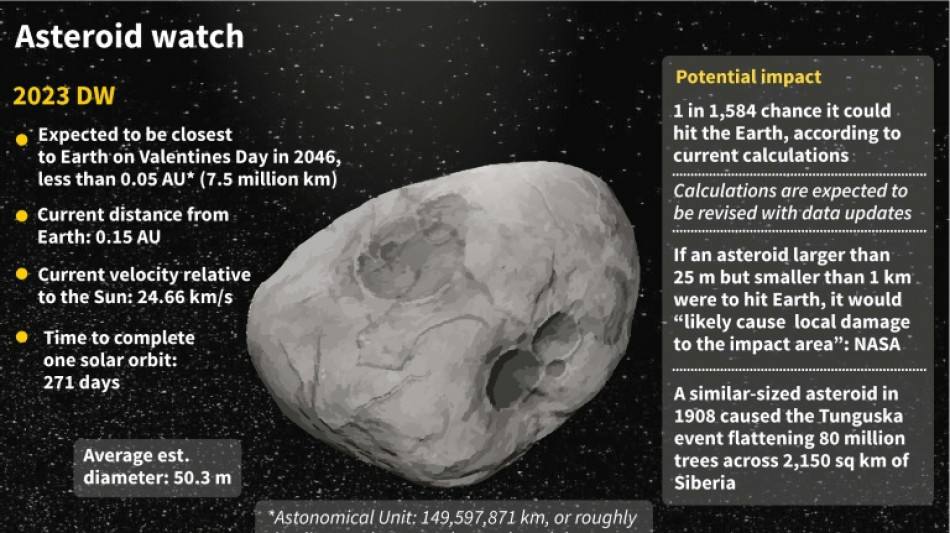
'No need to worry': Odds drop newly-found asteroid will hit Earth / Photo: © AFP

 At least 72 died in Spain's Ceuta migrant rush

 South Korea records its highest-ever temperature of 42.5C

 Trump says US, Israel to hold off on Iran strikes

 Messi returns as Inter Miami draw 2-2 against Columbus Crew

 Five of Cuba's 15 provinces without power as grid fails again

 Baltic startups take aim at deterring Russia on NATO's eastern flank

 Tourists chase high-octane thrill in China's trending biker capital

 Vincent Pastore, who played 'Big Pussy' on 'The Sopranos,' dead at 80

 Lula, Brazil's political titan, races against time

 When rogue AI launches a cyberattack, who is legally responsible?

 Venezuela transition talks to start in person next week: govt

 Colombia truck bomb wounds 14 ahead of presidential inauguration

 Eala stuns Osaka to book Washington final against Pegula

 13 dead after small tourist plane crashes in Peru

 France's devastating fires now 'under control', says PM

 Noh leads by three at women's British Open as Ryu falters

 CONCACAF calls for 'comprehensive reckoning with' Infantino's FIFA leadership

 Wiebes claims Tour de France Femmes yellow jersey with opening stage win

 US embassies urge citizens to consider departing Middle East

 Moroccans ejected from Spain's Ceuta lament 'broken dreams'

 Gaza's civil defence, medical sources say Israeli strikes kill two

 Bournemouth sign Portugal defender Silva from Benfica

 11 injured in Colombia bombing days before presidential inauguration

 In Spain's Ceuta, exhausted migrants end short trip with little hope

 German FA calls for 'full investigation' into FIFA proposal

The chances have plummeted that a newly-discovered asteroid with the potential to wipe out a city will hit Earth on Valentine's Day 2046, the European Space Agency said on Tuesday.
The asteroid, which is named 2023 DW and is estimated to be around the size of a 50-metre Olympic swimming pool, was first spotted by a small Chilean observatory on February 26.
It swiftly shot to the top of NASA and ESA lists of asteroids that pose a danger to Earth, leading to a raft of alarming news headlines, some warning lovers to cancel their Valentine's plans on February 14, 2046.
Late last month the asteroid was given a one in 847 chance of hitting Earth -- but the odds rose to one in 432 on Sunday, according to the ESA's risk list. NASA has had similar but not identical estimations.
However Richard Moissl, the head of the ESA's planetary defence office, told AFP on Tuesday that overnight the probability fell to one in 1,584.
"It will go down now with every observation until it reaches zero in a couple of days at the latest," he said.
"No one needs to be worried about this guy."
NASA's planetary defence officer Lindley Johnson agreed, telling AFP that "at this point, no one should be concerned at all".
He said it was normal for the impact odds of newly discovered asteroids to briefly rise before rapidly falling.
This is because new observations shrink the "uncertainty region" where the asteroid will travel to on its closest point to Earth, he said.
While the Earth is still inside that uncertainty region, the odds temporarily increase -- until further observations exclude Earth and the probability drops down to zero, as is expected to happen with 2023 DW.
- What if it does hit Earth? -
But what would happen in the increasingly unlikely event that the asteroid does strike Earth?
Davide Farnocchia, a scientist at NASA's Center for Near-Earth Object Studies, said a good comparison was the Tunguska event, in which a similarly-sized asteroid is believed to have exploded in the atmosphere above a sparsely populated area in Siberia in 1908.
"The resulting explosion flattened trees over an area of about 2,000 square kilometres," Farnocchia said. London covers an area of around 1,600 square kilometres.
Moissl said that an asteroid the size of 2023 DW would create "regionalised destruction" and not have a major effect on the rest of the world.
The asteroid, which is orbiting the Sun, came around nine million kilometres from Earth during its most recent closest approach on February 18 -- a week before it was discovered.
If it was to strike Earth in 2046, it would be speeding along at around 15 kilometres (nine miles) a second, according to estimations.
There would be a roughly 70 percent chance it lands in the Pacific Ocean, but the potential strike zone would also include the United States, Australia or Southeast Asia, Moissl said.
- Deflection plan -
Even if the asteroid is heading our way, the experts emphasised that the world is no longer defenceless against such a threat.
Last year, NASA's DART spacecraft deliberately slammed into the pyramid-sized asteroid Dimorphos, significantly knocking it off course in the first such test of our planetary defences.
Farnocchia said the "DART mission gives us confidence that such a mission would be successful" against 2023 DW, if required.
With 23 years to prepare, there is "ample time" for such a mission to be planned, Moissl said.
The ESA's Hera mission, scheduled to launch next year to inspect the damage DART had on Dimorphos, could even be repurposed for reconnaissance if necessary, he added.
Such plans would not be considered until the probability of an impact passes one in 100, when it would get the attention of UN-endorsed bodies like the International Asteroid Warning Network and the Space Mission Planning Advisory Group (SMPAG), Moissl said.
The aim of SMPAG is to "have everyone on the same page and avoid what happened in the movie 'Don't Look Up'," in which "stupid stuff" happened because nations did not coordinate with each other, Moissl added.
However such defence mechanisms look unlikely to be required for 2023 DW.
"Everyone should relax, ignore the sensationalist headlines and stories, and watch how this situation plays out," NASA's Johnson said, adding that any threat was likely to "evaporate" soon.
"Nevertheless, the planetary defence community will keep looking up!"
D.Schneider--BTB