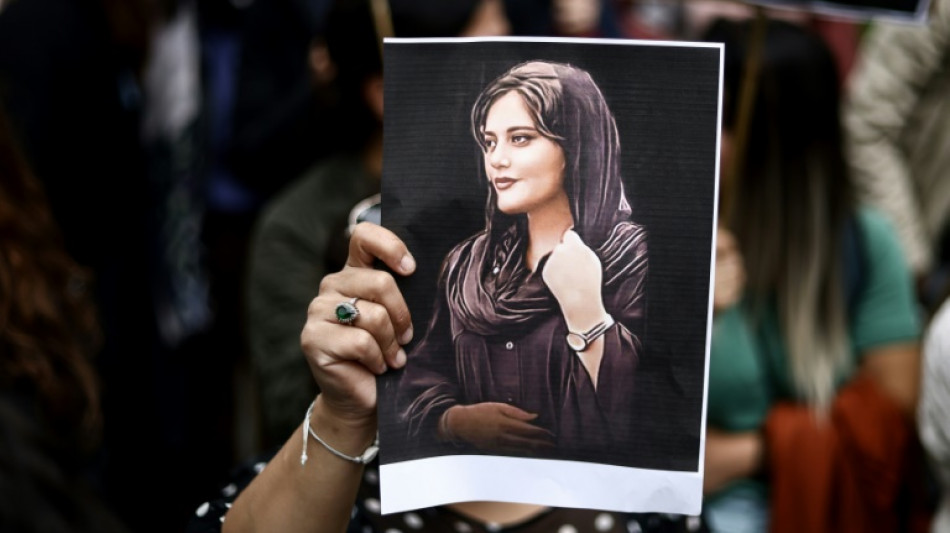
Mahsa Amini not forgotten in Iran six months after death / Photo: © AFP

 At least 72 died in Spain's Ceuta migrant rush
 South Korea records its highest-ever temperature of 42.5C
 Trump says US, Israel to hold off on Iran strikes
 Messi returns as Inter Miami draw 2-2 against Columbus Crew
 Five of Cuba's 15 provinces without power as grid fails again

 Baltic startups take aim at deterring Russia on NATO's eastern flank
 Tourists chase high-octane thrill in China's trending biker capital

 Vincent Pastore, who played 'Big Pussy' on 'The Sopranos,' dead at 80

 Lula, Brazil's political titan, races against time
 When rogue AI launches a cyberattack, who is legally responsible?

 Venezuela transition talks to start in person next week: govt

 Colombia truck bomb wounds 14 ahead of presidential inauguration

 Eala stuns Osaka to book Washington final against Pegula

 13 dead after small tourist plane crashes in Peru

 France's devastating fires now 'under control', says PM
 Noh leads by three at women's British Open as Ryu falters
 CONCACAF calls for 'comprehensive reckoning with' Infantino's FIFA leadership

 Wiebes claims Tour de France Femmes yellow jersey with opening stage win

 US embassies urge citizens to consider departing Middle East

 Moroccans ejected from Spain's Ceuta lament 'broken dreams'

 Gaza's civil defence, medical sources say Israeli strikes kill two
 Bournemouth sign Portugal defender Silva from Benfica

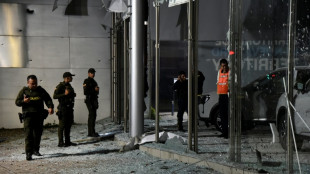 11 injured in Colombia bombing days before presidential inauguration
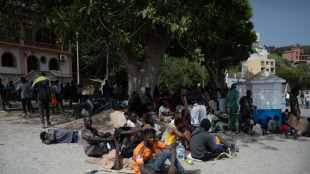 In Spain's Ceuta, exhausted migrants end short trip with little hope

 German FA calls for 'full investigation' into FIFA proposal
Six months ago this week, Mahsa Amini was arrested for allegedly flouting Iran's strict dress code for women. Within days she was dead, sparking the country's biggest protests in years.
The 22-year ethnic Kurd became a household name inside Iran, a rallying point for demands for change. Around the world, she became a hero for women's rights campaigners and a symbol for Western opponents of the Islamic republic.
Amini was visiting the capital Tehran with her brother and cousins when she was arrested as they were leaving a metro station in the city centre last September.
Accused of wearing "inappropriate" attire, she was taken to a police station by officers of the morality police.
There she collapsed after a quarrel with a policewoman, according to a short surveillance video released by the authorities.
She spent three days in hospital in a coma before her death on September 16, which the authorities blamed on underlying health issues.
For many, the young woman from the western city of Saqez personified the fight against the obligation to wear the headscarf. Her name became the rallying point for a protest movement that gripped the country for months.
The epitaph engraved on her tomb reads: "You are not dead Mahsa, your name has become a symbol".
Almost overnight, her portrait became ubiquitous in Iran's cities, fly-postered on walls and held aloft by protesters. It even made the cover of some magazines published inside Iran, including the March edition of the monthly Andisheh Pouya.
"Unknown before her death, Mahsa has become a symbol of oppression and her innocent face reinforces this image," said political scientist Ahmad Zeidabadi.
- Call for openness -
The protests over her death in custody, which began in the capital and in her native Kurdistan province, swiftly mushroomed into a nationwide movement for change.
Public anger over her death merged with "a series of problems, including the economic crisis, attitudes toward the morality police, or political issues such as the disqualification of candidates for election" by Iran's conservative-dominated vetting body the Guardian Council, said sociologist Abbas Abdi.
Spearheaded by young people demanding gender equality and greater openness without a leader or political programme, the street protests peaked late last year.
Hundreds of people were killed, including dozens of security force personnel. Thousands more were arrested for participating in what officials described as "riots" and blamed on hostile forces linked to the United States, Israel and their allies.
In February, after the protests abated and supreme leader Ayatollah Ali Khamenei decreed a partial amnesty, the authorities began to release thousands of people arrested in connection with the protests.
Some 22,600 people "linked to the riots" have so far been released, the head of the judiciary, Gholamhossein Mohseni Ejei said this week.
But Abdi said protesters could return to the streets again as the underlying grievances remained unaddressed.
"The demonstrations are over, but I doubt the protest has ended," he said, noting that "the main causes of the crisis remain.
"In the current situation, any incident can trigger new protests."
He cited as an example the public anger sparked by a spate of mystery poisonings that have affected thousands of pupils at more than 200 girls' schools over the past three months.
- Quiet change -
The mass demonstrations inside Iran, among the largest since the 1979 revolution, prompted some in the exiled opposition to talk of an imminent change of regime.
"Some people, especially in the diaspora, have mistakenly bet on the fall of the Islamic republic in the very near future," political scientist Zeidabadi said.
Zeidabadi argued that the emigres had misunderstood the nature of the protest movement which he said was more "civic" than political.
He stressed that, viewed in that fashion, the movement had produced "results", notably a quiet relaxation in enforcement of the dress code for women.
"A certain degree of freedom from the hijab is tolerated even if the law and the rules have not changed," Zeidabadi said.
He predicted similarly discreet and cautious reforms in other areas, notably the economy, which has been blighted by inflation of around 50 percent and a record depreciation of the rial against the dollar.
"It seems that the Islamic republic has realised the need for a change of policy, although there is no consensus within it on a lasting response to meet the challenge."
S.Keller--BTB