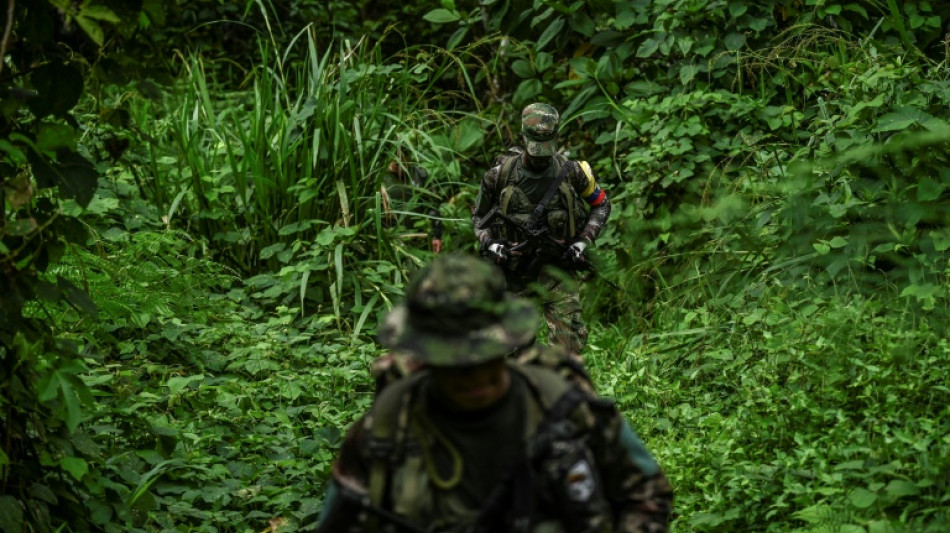
Colombia's Petro accuses Gulf Clan cartel of breaking ceasefire / Photo: © AFP

 South African voters report smoother local election but declining IEC trust

 Dolly Parton museum and Nashville hotel open after singer’s death

 George and Amal Clooney attend New York political-comedy reading

 British buyers pay substantial premiums for period-home appearance

 Thomas Markle released to house arrest after child-abuse-image charge

 Dawn of War 4 developers chose Adeptus Mechanicus for tactical variety

 Italy face unbeaten South Africa in Turin Nations Championship match

 ChatGPT interactive interface feature tested across six custom tools

 Freshways milk-price cut deepens pressure on UK dairy farms

 Labour and National remain virtually tied as New Zealand vote count advances

 The Good Daughter adapts Karin Slaughter thriller with Rose Byrne and Meghann Fahy

 Heavy-lift drone evacuates wounded Ukrainian soldier from frontline kill zone

 Morrison says West Brom recovered after pressure from successive derby losses

 Britain considers 2027 state visit for Ukraine’s Zelensky

 Arizona Democrats Secure Historic Trifecta with New Legislative Leadership

 Carney Welcomes U.S. Trade Reversal After Democratic Midterm Victory

 Armenian FM Discusses EU Accountability for Palestinian Rights in Madrid

 Trump and Vance Pursue Secret Diplomacy with Iran Amid Military Pressure

 Classic Car Values Surge: De Tomaso Vallelunga Leads 190% Gain

 Microsoft Ends Oracle AI Computing Rental Deal Amid Cloud Strategy Shift
Colombian President Gustavo Petro on Monday accused the country's largest drug trafficking group of breaking a ceasefire agreement by supporting attacks by illegal gold miners.
A group of miners destroyed an aqueduct, a toll and an ambulance in northwestern Colombia on Sunday.
Authorities believe they were carrying out the orders of the notorious Gulf Clan criminal group, which in December agreed a bilateral ceasefire with the government.
"Affecting a city's drinking water is putting at risk the lives of boys and girls, of all human beings," Petro said on Twitter.
"With its hostility against the population, the Gulf Clan has broken the ceasefire."
Workers in illegal mines have been protesting since March 2 against the government's destruction of the heavy machinery they use to dredge up soil to find gold.
Petro said the Clan was giving money to the miners "to cause damage and to pass off this violence as a social strike."
Just before the new year, Petro's government declared a bilateral ceasefire with a number of armed groups, including the Gulf Clan, National Liberation Army (ELN) rebels and dissidents of the former Revolutionary Armed Forces of Colombia (FARC) guerrillas.
It was a first step in leftist Petro's "total peace" plan to end decades of armed conflict through negotiation with criminal groups, as opposed to the hardline approach taken by his conservative predecessor Ivan Duque.
But almost immediately, the policy ran into problems.
The Marxist ELN denied having signed the deal, while the government claims there have been numerous violations of the pact by FARC dissidents.
- 'Second peace process' -
Even so, Petro has mostly continued his soft approach.
On Monday, the public prosecutor's office accepted his request to cancel 19 arrest warrants against FARC dissidents.
"I have decided to suspend the arrest warrants today," said Attorney General Francisco Barbosa.
He said those 19 individuals would be recognized as representatives of the "Estado Mayor Central", the largest group of FARC dissidents -- comprising about 2,000 fighters.
Petro responded on Twitter by saying the government would set up an official dialogue with the Estado Mayor Central, even calling it a "second peace process."
FARC guerrillas laid down their arms and formed a communist political party following a historic peace deal signed in 2016.
However, some dissidents refused to sign up and to this day have continued their fight against the state.
They are one element in a multi-faceted conflict involving radical left wing guerrillas, drug traffickers, right wing paramilitaries and the state's security forces.
Added into that mix are the illegal miners, who have been accused of deforestation and polluting local water sources with mercury, heaping ever more misery on the local populations already worst affected by the conflict.
Criminal groups in Colombia make almost as much money from illegal mining as they do from trafficking cocaine, according to authorities.
Gold can be made into jewelry, making it harder for authorities to trace its source.
The Gulf Clan is made up of former right-wing paramilitaries, who were broken up in a 2006 peace deal negotiated by former president Alvaro Uribe, an agreement Petro considers to have been a failure.
According to official estimates, the Clan is behind between 30 and 60 percent of the drugs exported from Colombia, the world's largest producer of cocaine.
F.Müller--BTB
