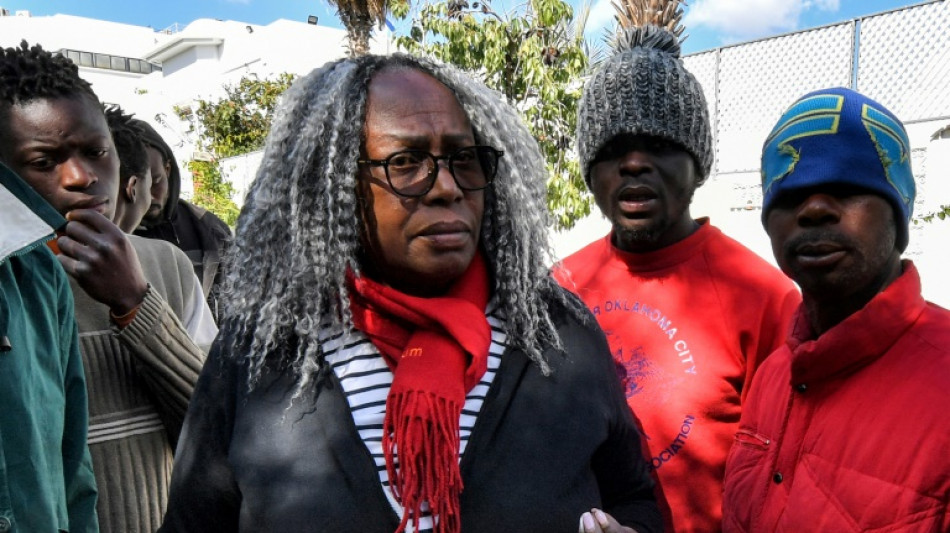
Black Tunisians hit by racism after anti-migrant rhetoric / Photo: © AFP

 South African voters report smoother local election but declining IEC trust

 Dolly Parton museum and Nashville hotel open after singer’s death

 George and Amal Clooney attend New York political-comedy reading

 British buyers pay substantial premiums for period-home appearance

 Thomas Markle released to house arrest after child-abuse-image charge

 Dawn of War 4 developers chose Adeptus Mechanicus for tactical variety

 Italy face unbeaten South Africa in Turin Nations Championship match

 ChatGPT interactive interface feature tested across six custom tools

 Freshways milk-price cut deepens pressure on UK dairy farms

 Labour and National remain virtually tied as New Zealand vote count advances

 The Good Daughter adapts Karin Slaughter thriller with Rose Byrne and Meghann Fahy

 Heavy-lift drone evacuates wounded Ukrainian soldier from frontline kill zone

 Morrison says West Brom recovered after pressure from successive derby losses

 Britain considers 2027 state visit for Ukraine’s Zelensky

 Arizona Democrats Secure Historic Trifecta with New Legislative Leadership

 Carney Welcomes U.S. Trade Reversal After Democratic Midterm Victory

 Armenian FM Discusses EU Accountability for Palestinian Rights in Madrid

 Trump and Vance Pursue Secret Diplomacy with Iran Amid Military Pressure

 Classic Car Values Surge: De Tomaso Vallelunga Leads 190% Gain
 Microsoft Ends Oracle AI Computing Rental Deal Amid Cloud Strategy Shift
Like many black Tunisians, 26-year-old Nebras Magnnah has been fearful since waves of racist attacks targeting sub-Saharan African migrants were unleashed after incendiary remarks by President Kais Saied.
Ever since Saied last month ordered "urgent measures" against sub-Saharan migrants over a purported "criminal plot" to change the North African country's demographic make-up, Magnnah said she was insulted on the street.
Magnnah, a college graduate working as a waitress, said the speech "incited physical and verbal violence" with openly racist actions taken without fear of reprisal.
"Leave, what are you still doing here?", she said people shouted at her in the street.
Saied's comments have fuelled attacks, evictions and other retaliation against migrants, international rights groups have said, and West African countries flew home hundreds of their fearful nationals.
Tunisia's already disadvantaged black minority has also been hit.
Black Tunisians make up some 10 to 15 percent of the country's 12 million people, many with centuries-old roots in Tunisia from ancestors who arrived during the slave trade.
- Racist 'green light' -
Saadia Mosbah, who heads the anti-racism campaign group Mnemty, pointed to "five or six attacks on black Tunisians" in recent weeks.
"After the speech, I noticed that black Tunisians were also afraid," said the 63-year-old former flight attendant, whose campaigning led to an anti-discrimination law being passed in 2018.
As well as online vitriol, Mosbah has also been insulted on the streets including with many telling her to "go home".
But that did not stop her from showing solidarity with the sub-Saharan migrants.
Mosbah helped provide necessities to the most vulnerable among the more than 21,000 sub-Saharans living in Tunisia, according to the latest official figures, many of whom recently found themselves without work or housing.
Mosbah had previously argued that the Tunisian state was neither "racist nor segregationist", but after the president's comments, racism that was "more or less hidden" has rapidly "risen to the surface".
Saied's speech was "like a green light from the political power to racists", she said.
Even more surprising, she found, was that among those who expressed racist comments were the country's so-called "intellectual elite".
Anthropologist Stephanie Pouessel said black Tunisians were "collateral damage" from Saied's speech, which she said targeted undocumented migrants and not skin colour.
But black Tunisians already faced "everyday racism" she added, describing it as "latent but systematic" and noting they faced "difficulty in accessing high-ranking posts".
Many live in poor areas in the impoverished south.
Most black Tunisians live in "disadvantaged areas and belong to the poorest strata," wrote researcher Maha Abdelhamid for the EuroMeSCo think tank in 2018.
Following Saied's "bombshell" comments, many black Tunisians remained silent over the issue of migrants, Pouessel added.
Many feared that speaking up over the rights of migrants would relegate them to a status of foreigners in their country "when they have always struggled to be considered fully Tunisians", she added.
- 'Demand respect' -
Former national football captain Radhi Jaidi, who is black, took to Twitter to support migrants.
"I am African not because I was born in Africa but because Africa was born in me," he wrote.
Jaidi said he was "troubled that individuals took the initiative to do the government's work against illegal immigration with aggression and outside the law".
But while he had hoped his message would generate support from other celebrities, apart from tennis star Ons Jabeur, there was little by way of solidarity.
"My post sought to demand respect for the rights" of migrants, he told AFP, deploring the attacks that "marred Tunisia's image".
Jaidi continues to promote Tunisia as "a country of freedom and hospitality" but fears lasting damage.
He pointed to the "very political gesture" by players in Senegal's under-20s football team -- when they celebrated a recent victory against Tunisia by showing off their black skin.
M.Ouellet--BTB