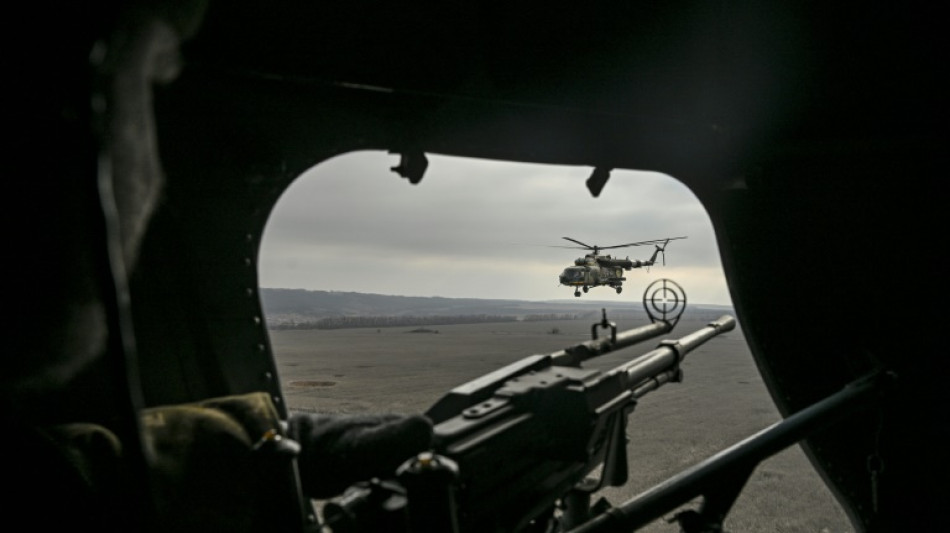
Ukrainian gunships rain rockets on Russian targets near Bakhmut / Photo: © AFP

 Power returns to Cuba's west after grid failure

 At least 72 died in Spain's Ceuta migrant rush
 South Korea records its highest-ever temperature of 42.5C
 Trump says US, Israel to hold off on Iran strikes

 Messi returns as Inter Miami draw 2-2 against Columbus Crew

 Five of Cuba's 15 provinces without power as grid fails again

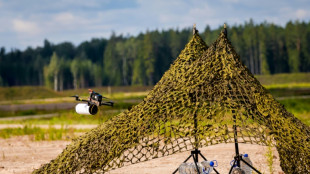 Baltic startups take aim at deterring Russia on NATO's eastern flank
 Tourists chase high-octane thrill in China's trending biker capital

 Vincent Pastore, who played 'Big Pussy' on 'The Sopranos,' dead at 80

 Lula, Brazil's political titan, races against time

 When rogue AI launches a cyberattack, who is legally responsible?

 Venezuela transition talks to start in person next week: govt

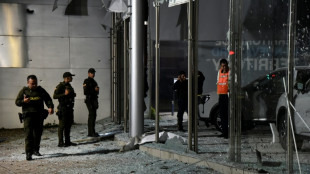 Colombia truck bomb wounds 14 ahead of presidential inauguration

 Eala stuns Osaka to book Washington final against Pegula

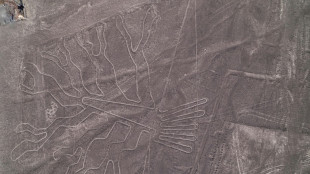 13 dead after small tourist plane crashes in Peru

 France's devastating fires now 'under control', says PM
 Noh leads by three at women's British Open as Ryu falters
 CONCACAF calls for 'comprehensive reckoning with' Infantino's FIFA leadership

 Wiebes claims Tour de France Femmes yellow jersey with opening stage win

 US embassies urge citizens to consider departing Middle East

 Moroccans ejected from Spain's Ceuta lament 'broken dreams'

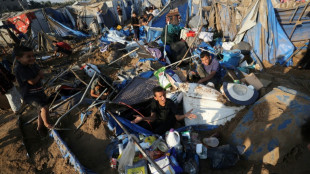 Gaza's civil defence, medical sources say Israeli strikes kill two

 Bournemouth sign Portugal defender Silva from Benfica

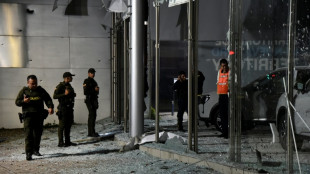 11 injured in Colombia bombing days before presidential inauguration
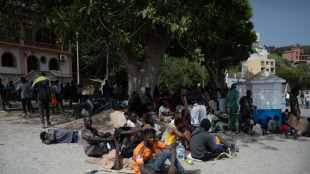 In Spain's Ceuta, exhausted migrants end short trip with little hope

Three Mi-8 helicopter gunships rise up from a secret base in Ukraine and head at low altitude for the long-running battle for Bakhmut against Russian forces.
As the eastern city nears, one by one the helicopters suddenly rear up, unleash their rockets, bank sharply and return to base, skimming the ground.
The target is "an enemy fortification line made up of troops on the ground, armoured vehicles and a munitions depot," pilot Petro tells AFP after the 30-minute mission.
The fortification lies near Severodonetsk, which the Russian army seized last spring, to the northeast of Bakhmut, where Ukrainian soldiers are almost encircled but still holding out amid heavy losses on both sides.
Since the Russian invasion just over a year ago, Ukrainian helicopter pilots have flown their ageing Mi-8s and larger Mi-24s on daily combat missions.
At just 23, Petro does not look much in his ill-fitting flak-jacket, but he has already flown about 50 combat missions.
While his helicopter is refuelled and fitted with fresh rockets, he runs through the morning's latest attack from a base that cannot be identified for security reasons.
"Before the flight, we select the flight path, using special apps to keep to the lowest altitude possible," Petro says.
"For example, if we see 180 metres altitude, it's too high, then we look for lower places and we find 130 metres, 100 metres.
"The aim is to fly lower than the level of the general countryside so as not to be visible on Russian radars and they don't know that we are coming," says Petro, a hoody covering all but his eyes.
- Thirty rockets -
An AFP camera set up in the cockpit during the entire mission shoots impressive footage.
The earth flashes past at a speed of about 200 kilometres per hour (125 mph), just a few metres underneath the chassis.
The helicopter only bucks up at the moment the rockets are launched, programmed for a distance of 6,100 metres.
"When we are 6,200 metres from the target, we rear up 20 degrees ... then we launch the rockets, 15 each side," Petro explains.
In the video, at the instant of firing, the rockets shoot forth from the Mi-8 leaving a plumes of black smoke in their wake.
The helicopter immediately dives into a tight turn to the left and drops down low for the flight back.
The Mi-8s, each with a pilot and co-pilot, open fire one after the other.
The return route is different to the outward one "so as not to fall in a trap" and attract Russian anti-aircraft systems.
On the frontline, infantry units were informed of the time of the strike, and they then send up a drone to check the result.
If the target has not been hit, another attack based on corrected data should follow.
"At the start of the war we didn't have drones. Missions were more complicated and less effective," Petro acknowledges.
"But in summer, we began to get drones and other equipment. Today, we are more effective."
The out-of-date weapons system is neither guided nor equipped with targeting, meaning it is accurate only to within 100-200 metres.
- 'Fear disappears' -
The toughest mission so far came on March 6 last year, in the Mykolaiv region in the south.
"We were four helicopters and the target was a long convoy of military vehicles" heading for the Zaporizhzhia nuclear plant, the biggest in Europe and now occupied by Russia.
"We saw the target from about two kilometres out. We had reports it was not moving, but in fact it was moving and we saw it all of a sudden," he recalls.
The Ukrainians came under fire.
"Two of our helicopters were destroyed, the third one damaged and I was lucky to be in the fourth. I wasn't hit... only two of us made it back to base."
Since the invasion about 30 Ukrainian helicopter pilots have died, a military source said.
For Petro, "the hardest thing is the preparation, taking a decision on what to do during the flight, what direction to take towards the target, because we do not know the countryside before the flight, we can be sure of nothing.
But fear does not enter into the attack.
"Once you switch on the engine, the fear disappears because we have been trained for it and we have confidence in ourselves, in our decisions. So we start the flight without fear."
Petro dreams of flying the state-of-the-art US Black Hawk, but he does not disparage the Mi-8, noting, "It's not perfect, but it is good, we know it well."
Social media is full of shared videos of Ukrainian helicopter missions, and pilots are often seen as heroes.
But Petro thinks of the soldiers who "suffer much more than us, even if they greet us and support us from the ground".
"They are always in position. Even if we take a lot of risks, we do not need much time to carry out a mission. When I see the boys on the ground supporting us, I know exactly why I am here."
E.Schubert--BTB