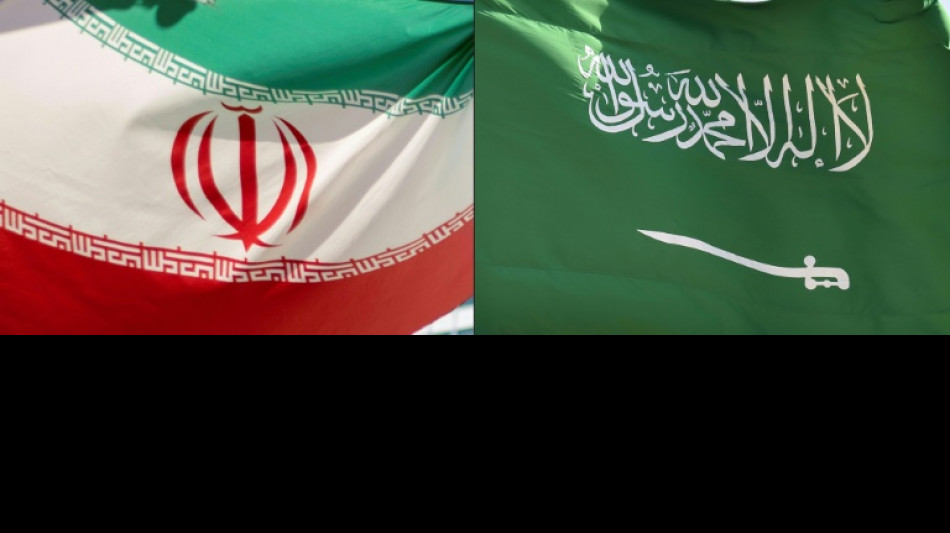
Iran, Saudi to restore ties in major step for Middle East / Photo: © AFP/File

 South African voters report smoother local election but declining IEC trust

 Dolly Parton museum and Nashville hotel open after singer’s death

 George and Amal Clooney attend New York political-comedy reading

 British buyers pay substantial premiums for period-home appearance

 Thomas Markle released to house arrest after child-abuse-image charge

 Dawn of War 4 developers chose Adeptus Mechanicus for tactical variety

 Italy face unbeaten South Africa in Turin Nations Championship match

 ChatGPT interactive interface feature tested across six custom tools

 Freshways milk-price cut deepens pressure on UK dairy farms

 Labour and National remain virtually tied as New Zealand vote count advances

 The Good Daughter adapts Karin Slaughter thriller with Rose Byrne and Meghann Fahy

 Heavy-lift drone evacuates wounded Ukrainian soldier from frontline kill zone

 Morrison says West Brom recovered after pressure from successive derby losses

 Britain considers 2027 state visit for Ukraine’s Zelensky

 Arizona Democrats Secure Historic Trifecta with New Legislative Leadership

 Carney Welcomes U.S. Trade Reversal After Democratic Midterm Victory

 Armenian FM Discusses EU Accountability for Palestinian Rights in Madrid

 Trump and Vance Pursue Secret Diplomacy with Iran Amid Military Pressure

 Classic Car Values Surge: De Tomaso Vallelunga Leads 190% Gain

 Microsoft Ends Oracle AI Computing Rental Deal Amid Cloud Strategy Shift
Regional powerhouses Iran and Saudi Arabia agreed Friday to restore ties and reopen diplomatic missions in a surprise, Chinese-brokered announcement that could have wide-ranging implications across the Middle East.
In a trilateral statement, Shiite-majority Iran and mainly Sunni Muslim Saudi Arabia said they would reopen embassies and missions within two months and implement security and economic cooperation deals signed more than 20 years ago.
Riyadh cut ties after Iranian protesters attacked Saudi diplomatic missions in 2016 following the Saudi execution of revered Shiite cleric Nimr al-Nimr -- just one in a series of flashpoints between the two longstanding rivals.
Friday's announcement, which follows five days of previously unannounced talks in Beijing and several rounds of dialogue in Iraq and Oman, caps a broader realignment and efforts to ease tensions in the region.
"Following talks, the Islamic Republic of Iran and the Kingdom of Saudi Arabia have agreed to resume diplomatic relations and reopen embassies and missions within two months," said the joint statement, which was published by both countries' official media.
The detente between Saudi Arabia, the world's biggest oil exporter, and Iran, a pariah for Western governments over its nuclear programme, has the potential to reshape relations across a region characterised by turbulence for decades.
Iran and Saudi Arabia support rival sides in several conflict zones including Yemen, where the Huthi rebels are backed by Tehran and Riyadh leads a military coalition supporting the government. The two sides also vie for influence in embattled Syria, Lebanon and Iraq.
- 'Hash out their differences' -
"It kind of sets the scene for the region's two superpowers to start to hash out their differences," said Dina Esfandiary of the International Crisis Group.
"The potential downside of that, of course, is that if they are the ones who are divvying up the region and sorting things out amongst themselves, you start to lose sight of regional contexts and grievances, which could potentially be problematic."
Iran's Foreign Minister Hossein Amir-Abdollahian welcomed the rapprochement and said Tehran will "actively prepare other regional initiatives".
"The return to normal relations between Tehran and Riyadh offers great opportunities to the two countries, the region and the Muslim world," he tweeted.
Iraq hailed the announcement by its powerful neighbours, with the foreign ministry saying "a new page has been opened in diplomatic relations between the two countries".
Ali Shamkhani, the secretary of Iran's Supreme National Security Council, had travelled to Beijing on Monday for "intensive negotiations with his Saudi counterpart in China in order to finally resolve the problems between Tehran and Riyadh", Iran's official IRNA news agency said.
Sandwiched between Iran and Saudi Arabia, Iraq had hosted several rounds of talks since April 2021. Those encounters were held at a relatively low level, involving security and intelligence officials.
Amir-Abdollahian had said in July that the two countries were ready to move talks to a higher level, in the political and public spheres.
But no talks had been publicly announced since April last year.
- Abraham Accords -
The pledge to resume ties comes two-and-a-half years after the United Arab Emirates, which also lies between Saudi Arabia and Iran, signed the Abraham Accords opening ties with Israel -- a similarly unexpected move.
It follows a broad pattern of attempts to settle regional disputes, including the Saudi-led blockade of Qatar, which lasted from June 2017 to January 2021.
Saudi Arabia and its allies the UAE, Bahrain and Egypt broke off ties claiming gas-rich Qatar supported extremists and was too close to Iran -- allegations that Doha denied.
Other Gulf states had also scaled back their ties with Iran after the 2016 incident.
But in September, Iran welcomed an Emirati ambassador back after a six-year absence. A month earlier, Iran said Kuwait had sent its first ambassador to Tehran since 2016.
On Thursday, Amir-Abdollahian was in Damascus where he welcomed Arab outreach to Syria's internationally isolated government after an earthquake struck the war-torn country and neighbouring Turkey last month.
He also said Tehran, which has backed Damascus during its 12 years of conflict, would join efforts to reconcile Syria and Turkey, which has long supported rebel groups opposed to President Bashar al-Assad.
There has also been a rapprochement between Riyadh and Ankara since the 2018 killing of Saudi journalist and government critic Jamal Khashoggi inside the kingdom's Istanbul consulate.
Turkish President Recep Tayyip Erdogan has pushed hard to revive ties, a move analysts describe as largely driven by economic considerations.
T.Bondarenko--BTB