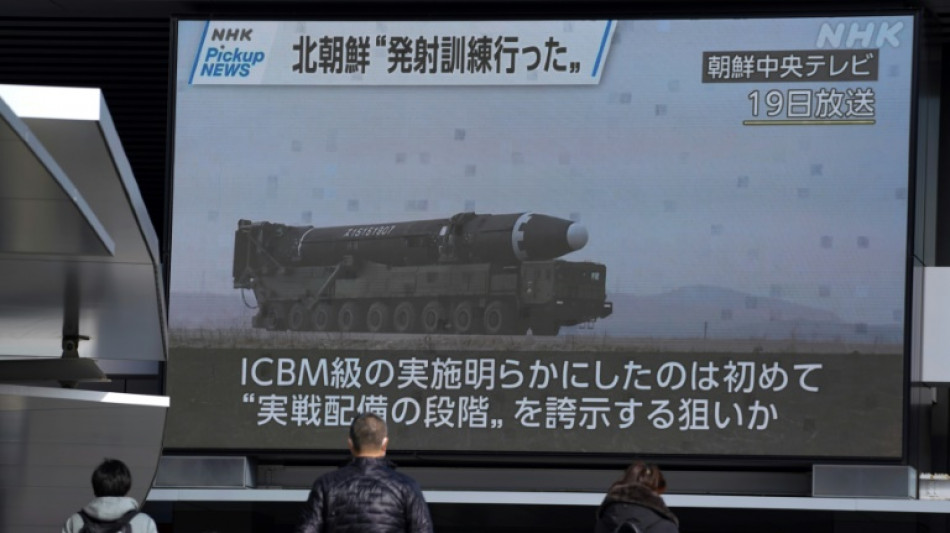
N. Korea fires ballistic missiles, warns of more action over US-S. Korea drills / Photo: © AFP

 What Europe can learn from Australia's 'Black Summer' wildfires

 Oil prices sink on Iran hopes, yen gains after joint intervention

 Wildfires raze neighborhoods in US northwest city of Spokane
 Trump attorney general pick says has reached deal with senators after standoff

 Star Australian broadcaster faces trial for sexual assault

 Oil prices sink on Middle East hopes, yen extends gains after joint intervention

 Millions of Thais banish the booze for Buddhist Lent

 Returning to 'Ted Lasso' after break 'effortless': Hannah Waddingham

 Trump says new Iran talks set to start after calling off massive attack

 Four Al-Fayed survivors told they were trafficking victims

 Ariana Grande withdraws from London musical, seeks to 'step back'

 Sudan army drone attack on Darfur court kills 35

 At least 72 died in Spain's Ceuta migrant rush, Spain says

 Russian teen Liutova wins WTA Memphis title

 Zverev remains wary of 12-day Masters events

 Wimbledon champ Noskova ready for 'new opportunity'

 Japan's Kuwaki wins women's British Open to clinch first major title
 Sabalenka aims to bounce back in Toronto after Wimbledon disappointment

 Iran says close to Hormuz deal with Oman, after US suspends attack plan

 'Spider-Man' soars to huge $355 million opening in North America

 Handbag tosses and high-heeled sprints: Amsterdam celebrates Drag Olympics
 Trump's on-again-off-again war against Iran: in his own words

 Dodgers land Tigers pitching ace Skubal in MLB trade deadline blockbuster

 Infantino struggling to survive, says former IOC marketing chief

 OPEC+ boosts September production by 188,000 barrels/day

North Korea fired two rockets on Monday from its latest launcher, claiming it is capable of a "tactical nuclear attack" that can take out entire enemy air bases.
It was North Korea's second weapons launch in 48 hours, after it fired one of its most powerful intercontinental ballistic missiles on Saturday, in response to planned US-South Korea military drills.
Japan said the ICBM landed in its exclusive economic zone, and its launch prompted the United States and South Korea to stage joint air drills on Sunday.
Pyongyang said the Korean People's Army conducted the Monday drill in response to those US-South Korean exercises, blaming the allies for the deteriorating security situation, according to a report by the official Korean Central News Agency (KCNA).
"Through today's firing drill with the involvement of super-large multiple rocket launchers, the tactical nuclear attack means, the KPA demonstrated its full readiness to deter and will to counter" the joint air drills, KCNA said.
The South Korean military said it detected the launch of two short-range ballistic missiles on Monday at 0700-0711 (2200-2211 GMT Sunday). One travelled 390 km (240 miles) and the other 340 km, before they landed in the East Sea, it said, referring to the body of water also known as the Sea of Japan.
It described the launches as "a serious provocation that undermines peace and stability on the Korean peninsula", and called on North Korea to stop "immediately".
North Korean leader Kim Jong Un's powerful sister warned the country was closely monitoring Washington and Seoul's moves to deploy more US strategic assets to the region, vowing "corresponding counteraction" if Pyongyang deemed such moves a threat.
"The frequency of using the Pacific as our firing range depends upon the US forces' action character," Kim Yo Jong said in a statement published by KCNA.
- 'Surprise' drill -
Pyongyang said its Saturday ICBM launch was a "surprise" drill that demonstrated North Korea's capacity to carry out a "fatal nuclear counterattack".
Japan said that ICBM flew for 66 minutes and landed in its exclusive economic zone (EEZ).
In response, Seoul and Washington staged joint air drills on Sunday, featuring a strategic bomber and stealth fighter jets.
The sanctions-busting launch was widely condemned, including on Monday by UN Secretary-General Antonio Guterres, who called on Pyongyang to cease "provocative actions".
North Korea gave its soldiers an "excellent mark" for carrying out the "sudden launching drill" on Saturday, but South Korean analysts pointed out that the estimated nine hours between the order and the launch was not particularly rapid.
Kim Yo Jong dismissed such criticism on Monday as "a bid to undervalue the preparedness of the DPRK missile forces", she said, using North Korea's official name.
Hong Min of the Korea Institute for National Unification told AFP that the angry reaction was part of a pattern of North Korea pushing back against any external analysis of its ICBM capabilities.
"Kim's strong and angry reaction to outside assessment of its ICBM launch shows the North really cares about delivering a message that it is capable of hitting the US mainland," he said.
The Monday launches were North Korea's response to the US-South Korea air exercise on Sunday, he added.
Using shorter-range missiles indicated North Korea was "virtually targeting US bases and South Korean command centre in the area".
The North Korean weapons launches came ahead of a joint US-South Korean tabletop exercise this week, aimed at improving their response in the event of a nuclear attack by Pyongyang.
North Korea warned last week of an "unprecedentedly" strong response to the planned joint drills by Seoul and Washington, which it describes as preparations for war.
Relations between the two Koreas are at one of their lowest points in years, after North Korea declared itself an "irreversible" nuclear state and leader Kim called for an "exponential" increase in weapons production, including tactical nuclear weapons.
O.Lorenz--BTB