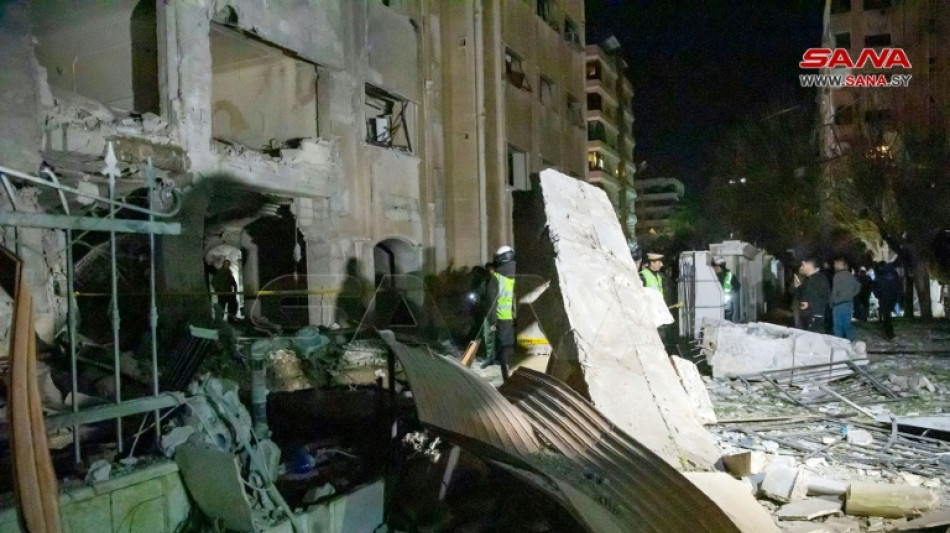
Israeli strike hits heart of Syria's security elite / Photo: © SANA/AFP

 What Europe can learn from Australia's 'Black Summer' wildfires

 Oil prices sink on Iran hopes, yen gains after joint intervention

 Wildfires raze neighborhoods in US northwest city of Spokane
 Trump attorney general pick says has reached deal with senators after standoff
 Star Australian broadcaster faces trial for sexual assault
 Oil prices sink on Middle East hopes, yen extends gains after joint intervention

 Millions of Thais banish the booze for Buddhist Lent

 Returning to 'Ted Lasso' after break 'effortless': Hannah Waddingham

 Trump says new Iran talks set to start after calling off massive attack

 Four Al-Fayed survivors told they were trafficking victims

 Ariana Grande withdraws from London musical, seeks to 'step back'

 Sudan army drone attack on Darfur court kills 35
 At least 72 died in Spain's Ceuta migrant rush, Spain says

 Russian teen Liutova wins WTA Memphis title

 Zverev remains wary of 12-day Masters events

 Wimbledon champ Noskova ready for 'new opportunity'

 Japan's Kuwaki wins women's British Open to clinch first major title
 Sabalenka aims to bounce back in Toronto after Wimbledon disappointment

 Iran says close to Hormuz deal with Oman, after US suspends attack plan
 'Spider-Man' soars to huge $355 million opening in North America
 Handbag tosses and high-heeled sprints: Amsterdam celebrates Drag Olympics
 Trump's on-again-off-again war against Iran: in his own words

 Dodgers land Tigers pitching ace Skubal in MLB trade deadline blockbuster
 Infantino struggling to survive, says former IOC marketing chief
 OPEC+ boosts September production by 188,000 barrels/day
An Israeli missile strike early Sunday killed 15 people and destroyed a building in a Damascus neighbourhood home to much of Syria's security apparatus, a war monitor said.
The Syrian Observatory for Human Rights said the strike, which hit close to an Iranian cultural centre, had killed 15 people including civilians.
Since the beginning of the war in Syria in 2011, Israel has carried out hundreds of air strikes against its neighbour, primarily targeting positions of the Syrian army, Iranian forces and Lebanon's Hezbollah, allies of the Syrian regime.
But it rarely hits residential areas of the capital.
Sunday's strike hit in Kafr Sousa, home to senior officials, security agencies and intelligence headquarters.
"At 00:22 am (2222 GMT), the Israeli enemy carried out an aerial aggression from the direction of the occupied Golan Heights targeting several areas in Damascus and its vicinity, including residential neighbourhoods," Syria's defence ministry said in a statement.
In a preliminary toll, it said the strike killed five people, among them a soldier, and injured 15 civilians, some in a critical condition.
Israel's military rarely comments on its strikes against Syria, but regularly asserts that it will not let Iran extend its influence to Israel's borders.
The Syrian regime of President Bashar al-Assad receives military support from Tehran and its allied armed Shiite groups including Hezbollah, which are declared enemies of Israel.
- 'Deadliest Israeli attack' in Damascus -
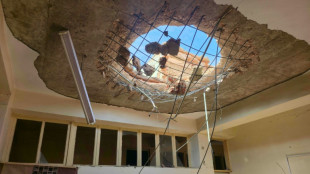
Footage posted by state media showed that a 10-storey building was badly damaged in the attack, crushing the structure of its lower floors.
Large chunks of the building had been thrown into the street below, which was strewn with cladding and metal fittings.
Images released by state media showed several of the building's windows had been blown out.
"The strike on Sunday is the deadliest Israeli attack in the Syrian capital," said Rami Abdel Rahman, head of the Britain-based Observatory, which has a wide network of sources inside Syria.
The attack comes more than a month after an Israeli missile strike hit Damascus International Airport, killing four people -- including two soldiers.
The January 2 strike hit "positions for Hezbollah and pro-Iranian groups inside the airport and its surroundings, including a weapons warehouse", the Observatory said at the time.
At the end of last year, the head of the Israel Defence Forces Operations Directorate, Major General Oded Basiuk, presented the military's "operational outlook" for 2023, saying that the force "will not accept Hezbollah 2.0 in Syria".
The conflict in Syria started in 2011 with the brutal repression of peaceful protests and escalated to pull in foreign powers and global jihadists.
Nearly half a million people have been killed, and the conflict has forced around half of the country's pre-war population from their homes.
The latest strike comes as the Damascus government seeks to recover from the February 6 earthquake, which did not affect the capital but which has killed more than 43,000 people in the country's north as well as southern Turkey.
M.Furrer--BTB