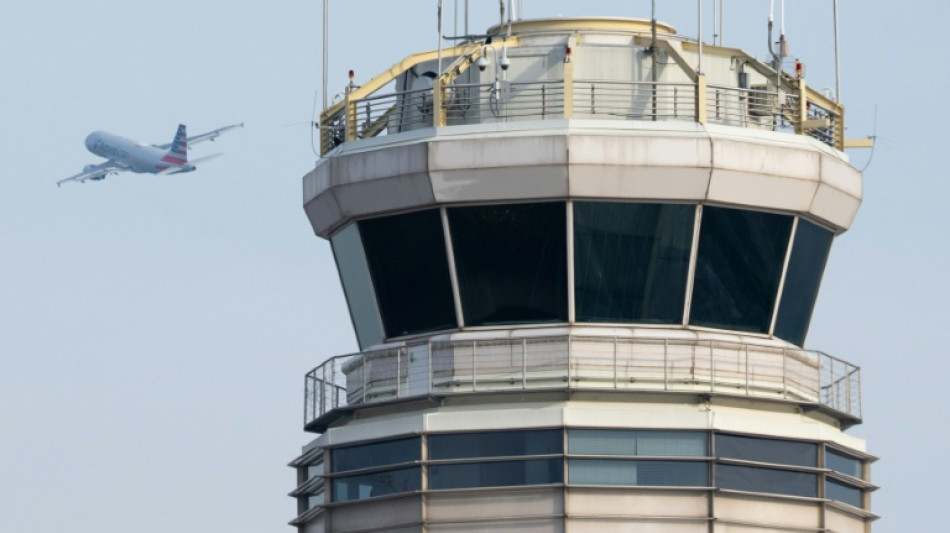
Near misses raise fresh questions for US air regulator / Photo: © AFP/File

 What Europe can learn from Australia's 'Black Summer' wildfires

 Oil prices sink on Iran hopes, yen gains after joint intervention
 Wildfires raze neighborhoods in US northwest city of Spokane
 Trump attorney general pick says has reached deal with senators after standoff

 Star Australian broadcaster faces trial for sexual assault

 Oil prices sink on Middle East hopes, yen extends gains after joint intervention
 Millions of Thais banish the booze for Buddhist Lent

 Returning to 'Ted Lasso' after break 'effortless': Hannah Waddingham

 Trump says new Iran talks set to start after calling off massive attack

 Four Al-Fayed survivors told they were trafficking victims
 Ariana Grande withdraws from London musical, seeks to 'step back'

 Sudan army drone attack on Darfur court kills 35

 At least 72 died in Spain's Ceuta migrant rush, Spain says

 Russian teen Liutova wins WTA Memphis title

 Zverev remains wary of 12-day Masters events

 Wimbledon champ Noskova ready for 'new opportunity'

 Japan's Kuwaki wins women's British Open to clinch first major title
 Sabalenka aims to bounce back in Toronto after Wimbledon disappointment

 Iran says close to Hormuz deal with Oman, after US suspends attack plan

 'Spider-Man' soars to huge $355 million opening in North America
 Handbag tosses and high-heeled sprints: Amsterdam celebrates Drag Olympics
 Trump's on-again-off-again war against Iran: in his own words

 Dodgers land Tigers pitching ace Skubal in MLB trade deadline blockbuster
 Infantino struggling to survive, says former IOC marketing chief
 OPEC+ boosts September production by 188,000 barrels/day

US air safety regulators are facing fresh questions following recent near crashes at American airports, further challenging an aviation industry ramp-up in response to rising travel demand.
The Federal Aviation Administration is already facing questions after the agency in January ordered a temporary grounding of planes nationally for the first time since 9/11 due to problems with a safety alert system.
At a Senate hearing earlier this week, acting FAA chief Billy Nolen was presented with a simulation video of a February 4 incident at Austin-Bergstrom International Airport in which a FedEx cargo plane nearly collided with a Southwest Airlines passenger jet that was about to take off.
Nolen said the incident remains under investigation, adding that "we'll go where the facts take us."
There have been at least two other near misses that have garnered national attention in recent weeks.
On January 13, an American Airlines jet taking off from New York's JFK International Airport en route for London crossed a runway without air traffic control clearance and got within 1,400 feet (427 meters) of a Delta Air Lines jet heading to the Dominican Republic, according to a preliminary report by the National Transportation Safety Board.
The NTSB on Tuesday announced a probe into a third episode, a December 18 United Airlines flight that lost altitude after departing from Hawaii, before recovering and traveling safely.
The flight got to within 800 feet of crashing into the Pacific Ocean, according to media reports, which came out weeks after the incident.
No one was injured in any of the three events.
But several lawmakers have flagged the issues in recent hearings on Capitol Hill, with House Transportation Chairman Representative Sam Graves saying the JFK near miss shows US aviation is "in need of urgent attention."
The incidents come as the FAA also faces scrutiny following the January 11 temporary grounding of planes, which was caused by problems with the Notice to Air Missions (NOTAM) system.
Nolen told the Senate panel Wednesday that the agency had made changes to prevent another outage, but that a meaningful system upgrade wouldn't be ready before 2025.
- 'No obvious linkage' -
Mike Stengel, a senior associate at AeroDynamic Advisory, a consultancy, said there was "no obvious linkage" between the events.
"My read is that it's been a string of incidents that need to be addressed," said Stengel, who also noted that the incidents must prompt reevaluation beyond the FAA at commercial airlines.
But Jim Hall, the former head of the NTSB, said the incidents suggested "an erosion of air safety" on the heels of the problems with the Boeing 737 MAX, which experienced two deadly crashes after the FAA's flawed certification of the jet.
"It's very concerning," said Hall, who noted the FAA faces significant challenges in the upcoming period, including establishing protocols for certifying flying taxis and regulating airlines as they restaff following an epochal labor turnover with the pandemic.
"The question is: Is the FAA prepared for the future," Hall asked.
"It's time for Congress and the FAA leadership to look very closely whether the FAA is structured, funded and staffed to prepare aviation for the future."
The difficulties come amid forecasts that air travel demand will recover and surpass its pre-pandemic level in 2023. However, some industry experts have cautioned that supply chain and labor shortages could challenge those targets.
- Fighting 'complacency' -
In congressional appearances, Nolen and other FAA officials have highlighted the agency's role in ensuring no major commercial airline crashes since 2009, while emphasizing that they are guarding against "complacency."
In response to the incidents, Nolen announced that he is convening a safety summit in March, as well as reviews of safety information sharing and of the Air Traffic Organization.
"We need to mine the data to see whether there are other incidents that resemble ones we have seen in recent weeks," Nolen said in a memo to staff. "And we need to see if there are indicators of emerging trends so we can focus on resources to address now."
Michel Merluzeau, director of aerospace and defense analysis at AIR consultancy, said he was not overly concerned about recent incidents, noting that technology systems have improved significantly for preventing crashes.
But the FAA has been "too slow and bureaucratic" in adopting some new systems. Also, the agency has struggled to keep up with higher volumes at fast-growing airports like Austin and Phoenix.
"The workload on air traffic controllers has gotten heavier and heavier," he said in an email to AFP.
H.Seidel--BTB