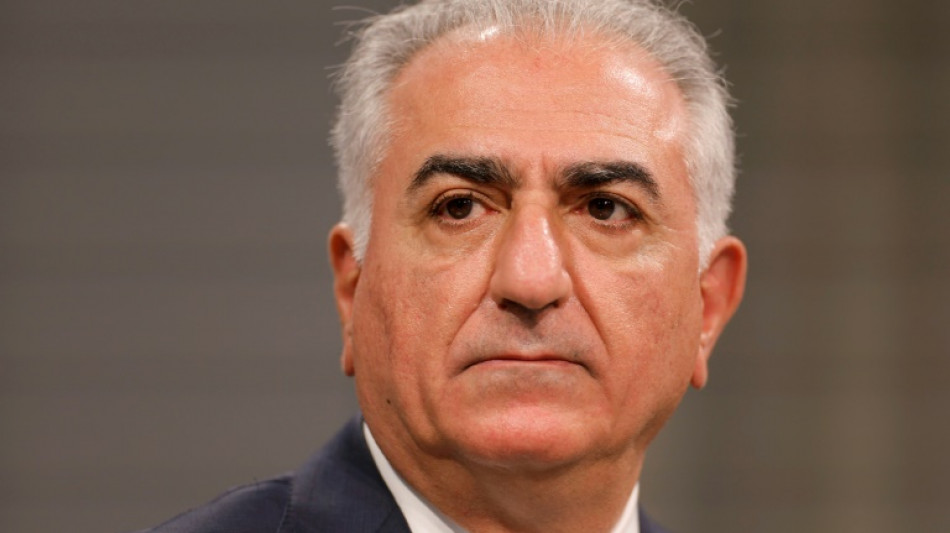
'Rifts' to surface within Iranian regime, says son of last shah / Photo: © AFP

 What Europe can learn from Australia's 'Black Summer' wildfires
 Oil prices sink on Iran hopes, yen gains after joint intervention
 Wildfires raze neighborhoods in US northwest city of Spokane
 Trump attorney general pick says has reached deal with senators after standoff
 Star Australian broadcaster faces trial for sexual assault
 Oil prices sink on Middle East hopes, yen extends gains after joint intervention
 Millions of Thais banish the booze for Buddhist Lent
 Returning to 'Ted Lasso' after break 'effortless': Hannah Waddingham

 Trump says new Iran talks set to start after calling off massive attack
 Four Al-Fayed survivors told they were trafficking victims
 Ariana Grande withdraws from London musical, seeks to 'step back'
 Sudan army drone attack on Darfur court kills 35
 At least 72 died in Spain's Ceuta migrant rush, Spain says
 Russian teen Liutova wins WTA Memphis title
 Zverev remains wary of 12-day Masters events

 Wimbledon champ Noskova ready for 'new opportunity'
 Japan's Kuwaki wins women's British Open to clinch first major title
 Sabalenka aims to bounce back in Toronto after Wimbledon disappointment

 Iran says close to Hormuz deal with Oman, after US suspends attack plan
 'Spider-Man' soars to huge $355 million opening in North America
 Handbag tosses and high-heeled sprints: Amsterdam celebrates Drag Olympics
 Trump's on-again-off-again war against Iran: in his own words
 Dodgers land Tigers pitching ace Skubal in MLB trade deadline blockbuster
 Infantino struggling to survive, says former IOC marketing chief
 OPEC+ boosts September production by 188,000 barrels/day
Rifts already exist within the Iranian regime and they will become more apparent, eventually contributing to cutting down Ayatollah Ali Khamenei's power, Reza Pahlavi, the son of the last shah of Iran, said Saturday.
"The full control of Khamenei makes it almost impossible for those who are closely associated with him to take position against him," said Pahlavi, who is one of several forces opposing the Iranian regime.
Nevertheless, according to "testimonies that we receive and leakage of information... there will be some rifts that will become more apparent", he told journalists at the Munich Security Conference.
Pahlavi was among key players of the Iranian opposition invited to the gathering of world leaders in the southern German city.
Pahlavi said Khamenei was "trying to push for his son (Mojtaba Khamenei) to basically replace him" -- a move that could eventually backfire.
"At that point, the clout that Khamenei has had over his own internal mechanism will weaken tremendously," Pahlavi said.
Iran has been rocked since September by nationwide protests after the death in custody of 22-year-old Mahsa Amini following her arrest for an alleged breach of Iran's dress code for women.
Since then, the regime has come under unprecedented pressure.
Even Iran's former president Mohammad Khatami and former premier Mir Hossein Mousavi have come out to call for political changes.
Mousavi, 80, said the protest movement began in the context of "inter-dependent crises" and proposed holding a "free and healthy referendum on the need to change or draft a new constitution".
He also called the current system's structure "unsustainable".
"What Mousavi said two weeks ago was different than what he said earlier," Pahlavi said.
"Back then he was still considered a loyal opposition, still within the context of the existing constitution."
- 'Maximum inclusion' -
Several factions of the divided Iranian diaspora have embarked on assembling common ideas for a transitional council to prepare elections and to draw up a new constitution.
The son of the shah, who was overthrown in 1979, pointed to a "grey spectrum" of government officials tempted by the opposition wave but who are reticent about publicly expressing their backing.
"The question is how many of them will start defecting," Pahlavi said.
While it was not possible to predict a timeline, "right now the momentum is to more and more separations or defections", he said.
"What we are trying to do is to have an open-door policy, of maximum inclusion," he said.
"If that grey spectrum adopts these values and principles as a basis of cooperation, we can broaden the spectrum to include more of these people," he said.
On the question on how to deal with the vestiges of the regime, Pahlavi said that "everybody deserves a second chance".
"There are formulas that already been established in terms of traditional justice, what do we do with people who have been acting criminally in a position of governors... We can't refuse people that solicit justice."
Referring to the powerful Islamic Revolutionary Guard Corps, Pahlavi said: "We have to be able to say you can be back in the military, or some kind reserve force or other form of roles in the civilian sector".
Such issues are currently being discussed, he said, emphasising that there is a "strategy, a plan" to prepare for a post-Islamic republic.
- Democratic dream -
Yet Pahlavi himself has not commanded universal admiration within the opposition, with some wary about a failure to distance himself from the authoritarian rule of his father, to show transparency about his family's wealth, or to halt the often aggressive posturing of pro-monarchy supporters on social media.
But Pahlavi's stance in the protests has won plaudits among even left-leaning opposition figures, while sparking attacks in hard-line Iranian media.
Pahlavi has repeatedly said he is not seeking the return of the monarchy but wants to play a part in creating the first secular democratic system in Iran's history.
"To say that my father was the king, and whatever happened then I have to assume responsibility for that, is a kind of irrational proposition," he said in Munich.
"If I had the option between a secular republic and the monarchy, I would choose the republic," he said, while acknowledging that "you cannot eliminate an option if part of the nation may want to discuss it".
"What will happen at the end, I leave it to the constitutional assembly to debate over this," he said.
His preference, nevertheless, is "to be out there in the full debate, with absolute freedom of expressing my views."
O.Bulka--BTB