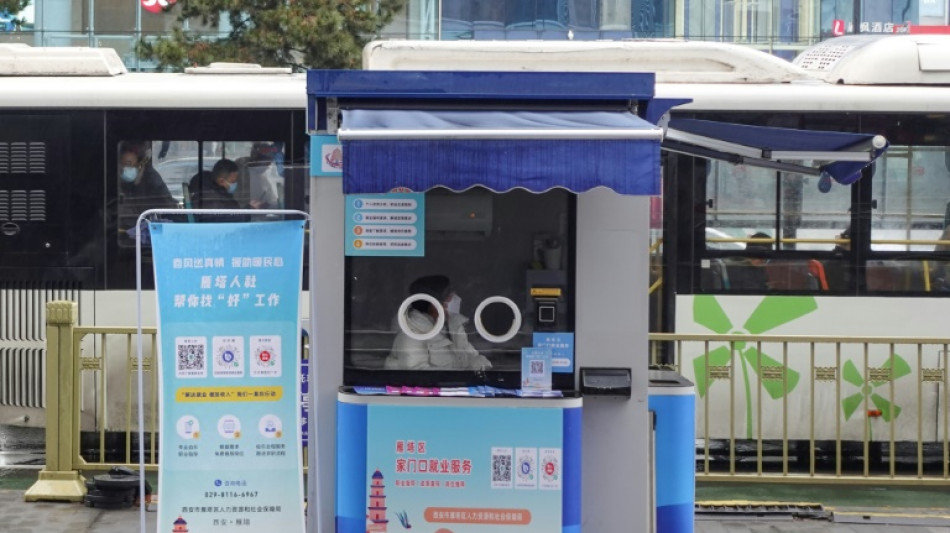
China's zero-Covid structures take on second lives / Photo: © AFP

 What Europe can learn from Australia's 'Black Summer' wildfires
 Oil prices sink on Iran hopes, yen gains after joint intervention
 Wildfires raze neighborhoods in US northwest city of Spokane
 Trump attorney general pick says has reached deal with senators after standoff

 Star Australian broadcaster faces trial for sexual assault
 Oil prices sink on Middle East hopes, yen extends gains after joint intervention
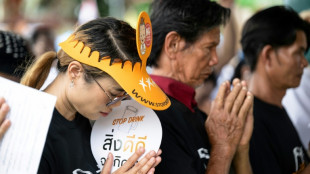 Millions of Thais banish the booze for Buddhist Lent

 Returning to 'Ted Lasso' after break 'effortless': Hannah Waddingham
 Trump says new Iran talks set to start after calling off massive attack

 Four Al-Fayed survivors told they were trafficking victims
 Ariana Grande withdraws from London musical, seeks to 'step back'

 Sudan army drone attack on Darfur court kills 35

 At least 72 died in Spain's Ceuta migrant rush, Spain says

 Russian teen Liutova wins WTA Memphis title

 Zverev remains wary of 12-day Masters events

 Wimbledon champ Noskova ready for 'new opportunity'

 Japan's Kuwaki wins women's British Open to clinch first major title
 Sabalenka aims to bounce back in Toronto after Wimbledon disappointment

 Iran says close to Hormuz deal with Oman, after US suspends attack plan

 'Spider-Man' soars to huge $355 million opening in North America
 Handbag tosses and high-heeled sprints: Amsterdam celebrates Drag Olympics
 Trump's on-again-off-again war against Iran: in his own words

 Dodgers land Tigers pitching ace Skubal in MLB trade deadline blockbuster

 Infantino struggling to survive, says former IOC marketing chief
 OPEC+ boosts September production by 188,000 barrels/day
With China's dropping of its "zero-Covid" policy, makeshift quarantine centres and testing booths are being repurposed as mini-libraries, information points or even housing.
Since Beijing suddenly abandoned its hardline virus control measures in December after almost three years, cities across China have been left with tens of thousands of the temporary structures.
Some of the metal or plastic testing booths that were once ubiquitous symbols of the "zero-Covid" policy have found a new life as mini-pharmacies, shelters or information stations.
"Rather than leaving them empty, we're trying to use them in other ways, suiting the time and place," a city official from Suzhou, near Shanghai, told AFP.
Some booths near the train station have been transformed into information points for new arrivals, offering them job opportunities or legal advice concerning work disputes.
Elsewhere in the city, booths have been repurposed by local janitorial staff to store odds and ends.
"When we came to work here this booth wasn't here yet. So our superiors bought it for us," Xu, a river cleaner, told AFP.
"Since we don't do Covid testing anymore... they could bring it over," she said.
"After work, we use it to put our gloves and our tools in it," she added.
"And when it rains, we come to shelter there."
Local governments in China spent about 200 billion yuan ($29 billion) on the testing programme needed to keep zero-Covid going, according to banking giant Goldman Sachs, as quoted by Bloomberg.
Now they are keen to put the redundant facilities to good use.
During the Covid surge in December and January, some were converted into medical consultation stations or medicine distribution points to reduce the pressure on hospitals which were inundated with patients.
Others have since been transformed into mini-libraries where residents can exchange books.
- 'Sustainable use' -
In Jinan, the capital of eastern Shandong province, some cabins have become "heartwarming huts" where passers-by can shelter from the cold, charge their phones or even benefit from free hot water.
Others have been converted into Red Cross service points, resting areas for delivery drivers or waste-sorting stations.
But many former testing booths remain unused -- so much so that some people are trying to sell them on the internet.
On Xianyu, China's main app for selling second-hand goods, they are up for sale from between 100 and 8,000 yuan ($15 and $1,200), depending on their condition.
"Ours comes from a company that no longer wanted it," one seller told AFP.
The fate of the former quarantine centres and makeshift hospitals where Covid-positive or sick people were once sent is more complex because of their size and cost.
Some remain empty, but others have been converted into backup hospitals with additional equipment and staff, to relieve the pressure on the healthcare system.
Elsewhere in Jinan, a former makeshift quarantine centre has been converted into housing for employees of nearby companies.
A total of 650 basic rooms with a bed, closet, desk, television and air conditioning are available.
"It's good, it allows a more sustainable use of resources," said one Weibo user.
But others are not so convinced.
"What about wifi, thermal insulation and soundproofing?" wrote another.
"How cost-effective is the project? Wouldn't dismantling it have been cheaper?"
J.Fankhauser--BTB