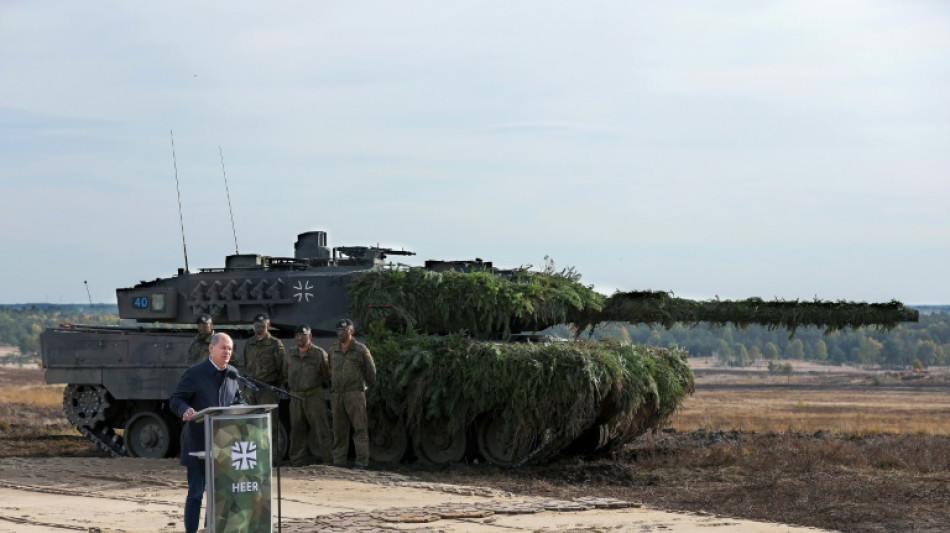
Scholz reverses roles on tanks for Ukraine / Photo: © AFP

 What Europe can learn from Australia's 'Black Summer' wildfires
 Oil prices sink on Iran hopes, yen gains after joint intervention
 Wildfires raze neighborhoods in US northwest city of Spokane
 Trump attorney general pick says has reached deal with senators after standoff
 Star Australian broadcaster faces trial for sexual assault
 Oil prices sink on Middle East hopes, yen extends gains after joint intervention
 Millions of Thais banish the booze for Buddhist Lent
 Returning to 'Ted Lasso' after break 'effortless': Hannah Waddingham

 Trump says new Iran talks set to start after calling off massive attack
 Four Al-Fayed survivors told they were trafficking victims
 Ariana Grande withdraws from London musical, seeks to 'step back'
 Sudan army drone attack on Darfur court kills 35
 At least 72 died in Spain's Ceuta migrant rush, Spain says
 Russian teen Liutova wins WTA Memphis title
 Zverev remains wary of 12-day Masters events

 Wimbledon champ Noskova ready for 'new opportunity'

 Japan's Kuwaki wins women's British Open to clinch first major title
 Sabalenka aims to bounce back in Toronto after Wimbledon disappointment

 Iran says close to Hormuz deal with Oman, after US suspends attack plan
 'Spider-Man' soars to huge $355 million opening in North America

 Handbag tosses and high-heeled sprints: Amsterdam celebrates Drag Olympics
 Trump's on-again-off-again war against Iran: in his own words

 Dodgers land Tigers pitching ace Skubal in MLB trade deadline blockbuster
 Infantino struggling to survive, says former IOC marketing chief
 OPEC+ boosts September production by 188,000 barrels/day
Just weeks ago, German Chancellor Olaf Scholz was under fire for having failed to approve the delivery of Leopard battle tanks. Now however, it's full speed ahead.
On Friday, the German leader urged allies with stocks to send them now, as efforts to equip Ukraine with the powerful weapons stalled.
"Those who can send such battle tanks should really do so now," Scholz told the Munich Security Conference, adding he would be "intensively campaigning" for allies to move on the issue.
Calls for Germany to deliver its Leopard tanks had reached fever pitch in January.
For weeks, Scholz had insisted that Germany would not go it alone on the issue, and Berlin underlined that they were not the only countries who were reluctant.
As pressure mounted, with Poland, for one, threatening to go ahead even without obtaining the required permission from Berlin for the German-made vehicles, Scholz finally relented.
Germany promised to itself send a company of 14 Leopard 2 A6 tanks, with the aim of assembling along with allies two tank battalions for Ukraine -- which would come to about 30 each battalion.
But Ukraine is seeking 300 armoured vehicles in all.
But after the initial fanfare and relief at Berlin's decision, subsequent talks with NATO partners have struggled to make up the numbers for a full battalion of the more modern A6 tanks.
- Faltering -
On Wednesday, German Defence Minister Boris Pistorius admitted that allies had only mustered "half a battalion" of A6s so far -- including the 14 from Germany itself and three from Portugal.
Another battalion would be made up of older A4 tanks, with Poland as the main contributor and Norway and Canada contributing smaller numbers.
Beyond that, commitments were faltering.
Switzerland, Greece, Turkey and Denmark have ruled out providing Leopard 2s.
NATO candidate Sweden has not ruled it out, but it has not made a firm commitment either.
Fellow NATO candidate Finland has signalled it would join the "tank coalition" in some manner -- but perhaps by training Ukrainian troops rather than providing hardware.
Talks are ongoing with the Netherlands, but Berlin is opposed to them sending the 14 A6s because that would "weaken the operational readiness" of a joint German-Dutch brigade where they are used.
Ramping up his call for allies to put tanks on the table, Scholz promised that Germany would "contribute to help our partners make this decision, for example by training Ukrainian soldiers here in Germany or by supporting them with logistics and supplies".
- 'Deafening silence' -
"The deafening silence from some capitals about actually sending Leopards is an early reminder that much work remains to be done to sustain, and eventually expand, Ukraine's future fleet of European tanks," wrote analysts at the European Council on Foreign Relations.
Besides the hardware, sustaining tank supplies for Ukraine and ensuring Europe's own stocks for its defence means "training engineers and mechanics, establishing supply chains for intermediate products and raw materials, and building new factories and storage facilities".
And a substantial number of tanks is necessary to make a difference on Ukraine's battlefield, noted analysts.
"Until the number of Western tanks reaches into the hundreds, Ukrainians are trained to use them effectively as part of combined arms teams, and develop the capability to support them logistically, they will not be the game-changer that some expect," said Robert Hamilton, an expert at the US Army War College.
After the apparent reversal of roles for Scholz on the issue, Camille Grand, defence expert at the European Council on Foreign Relations, said the time Germany had taken to decide on sending tanks meant the discussion on pulling contributions together had been delayed.
Nevertheless, Scholz's caution over the complications involved in getting sustained deliveries of the highly modern tank -- and the careful planning required -- had proved to be justified, she told AFP.
As for the chancellor's latest call in Munich, Grand argued that "from the perspective of the political messaging it is useful to remind" those who pledged action to actually put their words into action.
G.Schulte--BTB