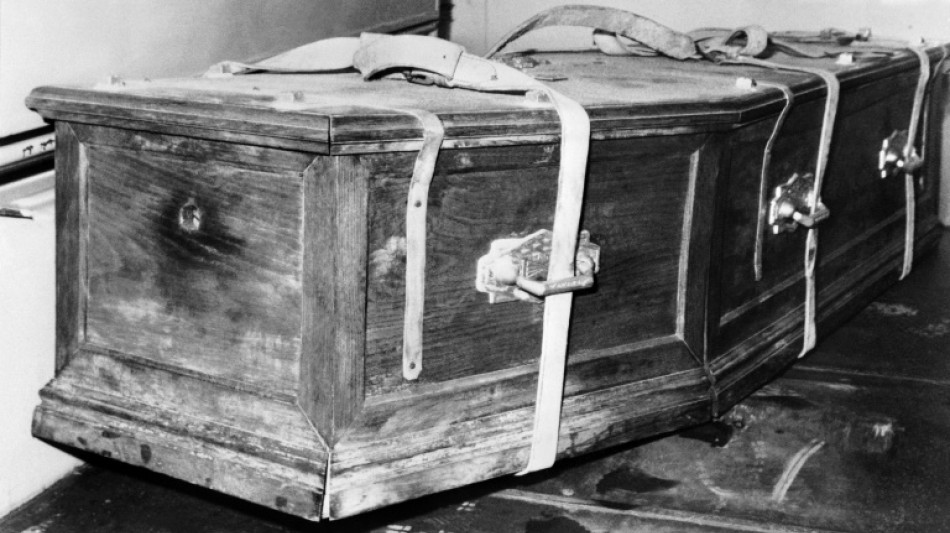
50 years ago in France: the botched theft of Petain's body / Photo: © AFP/File

 What Europe can learn from Australia's 'Black Summer' wildfires

 Oil prices sink on Iran hopes, yen gains after joint intervention
 Wildfires raze neighborhoods in US northwest city of Spokane

 Trump attorney general pick says has reached deal with senators after standoff
 Star Australian broadcaster faces trial for sexual assault
 Oil prices sink on Middle East hopes, yen extends gains after joint intervention
 Millions of Thais banish the booze for Buddhist Lent

 Returning to 'Ted Lasso' after break 'effortless': Hannah Waddingham

 Trump says new Iran talks set to start after calling off massive attack

 Four Al-Fayed survivors told they were trafficking victims
 Ariana Grande withdraws from London musical, seeks to 'step back'

 Sudan army drone attack on Darfur court kills 35

 At least 72 died in Spain's Ceuta migrant rush, Spain says

 Russian teen Liutova wins WTA Memphis title
 Zverev remains wary of 12-day Masters events

 Wimbledon champ Noskova ready for 'new opportunity'

 Japan's Kuwaki wins women's British Open to clinch first major title
 Sabalenka aims to bounce back in Toronto after Wimbledon disappointment

 Iran says close to Hormuz deal with Oman, after US suspends attack plan

 'Spider-Man' soars to huge $355 million opening in North America

 Handbag tosses and high-heeled sprints: Amsterdam celebrates Drag Olympics

 Trump's on-again-off-again war against Iran: in his own words

 Dodgers land Tigers pitching ace Skubal in MLB trade deadline blockbuster
 Infantino struggling to survive, says former IOC marketing chief

 OPEC+ boosts September production by 188,000 barrels/day
In a saga that captivated France half a century ago, a group of admirers of French Nazi collaborator Philippe Petain stole his coffin from the Atlantic island where he died in prison in order to bury him alongside fellow World War I heroes in Verdun.
The grave robbers wanted to return Petain to the site of his finest hour where, as general, he led France to victory against Germany in the longest battle of the 1914-1918 war.
They hoped to restore the honour of the tainted general, who was convicted of treason for leading France's collaborationist Vichy government during World War II but avoided the death penalty due to his advanced age.
He had been dead 22 years when the far-right cell resurrected him in the dead of night on February 18, 1973, in Port-Joinville cemetery on the windswept Ile d'Yeu.
After a three-day nationwide police search, which revived the debate over the legacy of the World War I hero-turned World War II villain, Petain's body was traced to a garage in a Paris suburb.
- Fallen hero -
For years, admirers of Petain had been horrified by the decision to bury their hero on the Ile d'Yeu off France's Atlantic coast.
Petain died there in 1951, six years into his life sentence for collaborating with the Nazis.
Petain had asked to be buried in Verdun, alongside his fallen men, but his wishes had been overruled by World War II Resistance hero and later president Charles de Gaulle.
His final resting place was in the corner of Port-Joinville cemetery, in a tomb covered with a white stone slab marked "Philippe Petain, French Marshal" and topped with a white cross.
The mastermind behind the raid was far-right lawyer and failed presidential candidate, Jean-Louis Tixier-Vignancour.
But it was Hubert Massol, an advertising man, who led the operation to remove the coffin from the vault, load it into a van and take it by ferry to the mainland.
Six men made light work of the tombstone.
But they were sloppy.
They chipped the corner of the slab and then roughly sealed it back in place, details that immediately caught the attention of the cemetery guard on his rounds the next morning.
By lunchtime, the news was out: "Unknown perpetrators have unsealed the tombstone of Marshall Petain," AFP announced in a high-priority bulletin.
- Coffin hunt -
A nationwide hunt got underway for a Renault van that had arrived on the island two days before Petain's body was stolen and left the morning after. Speculation raged about who might be behind the robbery.
Opinions in the pro-Petain camp over the stunt were divided with some, like Petain's lawyer Jacques Isorni, condemning the men's guerrilla-style tactics.
On the road with their precious cargo, the body snatchers suffered a setback -- a former pro-Petain lawmaker who had offered the use of his chateau for a change of vehicle, had disappeared when they arrived at his home.
Realising that the authorities were already in pursuit, they ditched the Verdun plan and headed for Paris where they stashed the coffin in a lock-up garage in the suburb of Saint-Ouen.
The first person arrested was Solange Boche, a market trader who drove the van to the island, with others quickly following.
As the net tightened, Massol called a press conference saying he would reveal the whereabouts of Petain's remains if then president Georges Pompidou gave permission for him to be buried at Verdun's Douaumont war memorial.
Massol was promptly arrested and caved in under questioning, agreeing to lead the police to the garage.
A furious Pompidou ordered the coffin be immediately taken back to the Ile d'Yeu where it remains to this day.
No charges were ever brought against the grave robbers, as the government feared a trial would stoke sympathy for Petain.
The ghost of the fallen general did not disappear. To this day in France Petain remains an inflammatory subject, with sharp divisions even within families over those believing he should be remembered not for Vichy but his Verdun victory.
President Emmanuel Macron waded into the debate in 2018 when he slammed attempts to "manipulate" the memory of Petain and said he was a "great soldier" in WWI.
R.Adler--BTB