Tokyo to demolish historic baseball stadium despite outcry / Photo: © AFP

 What Europe can learn from Australia's 'Black Summer' wildfires
 Oil prices sink on Iran hopes, yen gains after joint intervention

 Wildfires raze neighborhoods in US northwest city of Spokane

 Trump attorney general pick says has reached deal with senators after standoff
 Star Australian broadcaster faces trial for sexual assault
 Oil prices sink on Middle East hopes, yen extends gains after joint intervention

 Millions of Thais banish the booze for Buddhist Lent

 Returning to 'Ted Lasso' after break 'effortless': Hannah Waddingham

 Trump says new Iran talks set to start after calling off massive attack

 Four Al-Fayed survivors told they were trafficking victims

 Ariana Grande withdraws from London musical, seeks to 'step back'

 Sudan army drone attack on Darfur court kills 35
 At least 72 died in Spain's Ceuta migrant rush, Spain says

 Russian teen Liutova wins WTA Memphis title

 Zverev remains wary of 12-day Masters events

 Wimbledon champ Noskova ready for 'new opportunity'

 Japan's Kuwaki wins women's British Open to clinch first major title
 Sabalenka aims to bounce back in Toronto after Wimbledon disappointment

 Iran says close to Hormuz deal with Oman, after US suspends attack plan
 'Spider-Man' soars to huge $355 million opening in North America
 Handbag tosses and high-heeled sprints: Amsterdam celebrates Drag Olympics
 Trump's on-again-off-again war against Iran: in his own words

 Dodgers land Tigers pitching ace Skubal in MLB trade deadline blockbuster

 Infantino struggling to survive, says former IOC marketing chief
 OPEC+ boosts September production by 188,000 barrels/day
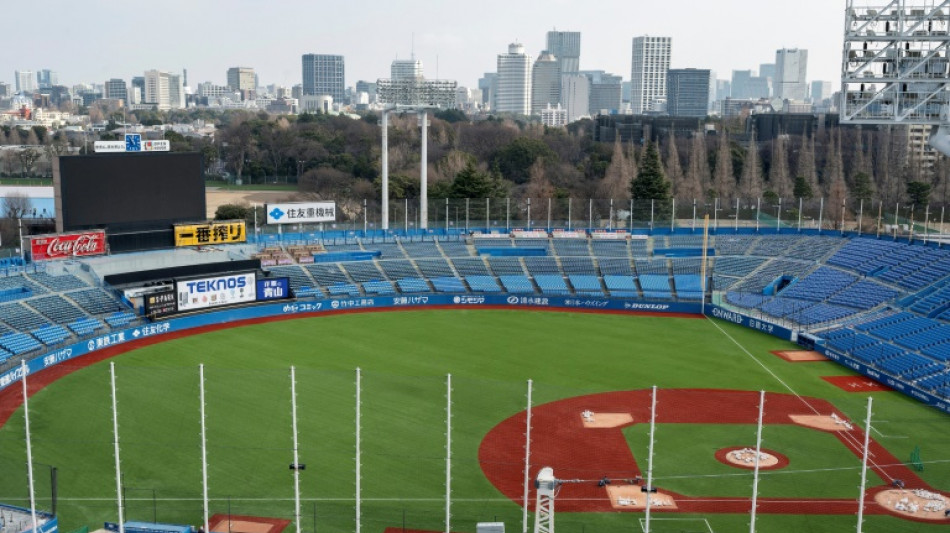
Tokyo's government approved Friday a redevelopment which will see a historic baseball stadium demolished and trees donated to honour Japan's Emperor Meiji torn out, a move opponents called "shameful".
The project, which environmentalists say also threatens a boulevard of gingko trees, had sparked a citizen fightback including petitions with tens of thousands of signatures.
However, Tokyo's government said the plan would proceed, with Meiji Jingu Stadium and neighbouring sports venues, including the home of Japanese rugby, to be bulldozed and rebuilt as part of a new high-rise complex.
Tomoko Abe, an opposition lawmaker who was part of a cross-party group against the development, called the approval "shameful".
"Lots of people are strongly opposed and the Tokyo government hasn't faced up to that sincerely, which is very disappointing and a big problem," she told AFP.
The leafy district at the heart of the battle was created 100 years ago as a "garden of relaxation and tranquility".
It includes the baseball stadium where the legendary Babe Ruth played during a 1934 American all-star tour of Japan.
It is one of only four stadiums where Ruth played that still exist, along with Boston's Fenway Park, Chicago's Wrigley Field and Koshien Stadium near Osaka.
It is also where acclaimed author Haruki Murakami was inspired to write his first novel, after hearing "the satisfying crack when the bat met the ball" during a game in 1978.
The plans will see a new stadium built next to the famed gingko tree avenue that attracts massive crowds for its stunning autumn colours.
Earlier this week, Tokyo Governor Yuriko Koike defended the project and said those trees would not be cut down, but environmentalists say building so nearby will damage the trees' roots and kill them.
Some trees will however be lost, including some donated by the public over a century ago when the area was created to honour Emperor Meiji, who oversaw Japan's rapid modernisation.
Koike said the number of trees and green spaces in the area will increase after redevelopment. She hopes and expects "the area will continue to be cherished by the citizens of Tokyo".
Opposition had only grown in recent weeks.
Former Japan international Tsuyoshi Hirao started a petition to save the rugby ground, which will be replaced by a covered stadium with an artificial pitch.
"They say they're building a sports cluster that everyone can enjoy, but some people say it won't be like that," said Abe.
"Even so, they still go ahead with it."
Robert Whiting, an expert on Japanese baseball who also started a petition against the plan, called it "a crying shame" that the baseball stadium could not be renovated within its original arched brick facade.
"It's clear to me that they just want to make money and they don't really care what the citizens of Tokyo think," he said.
P.Anderson--BTB