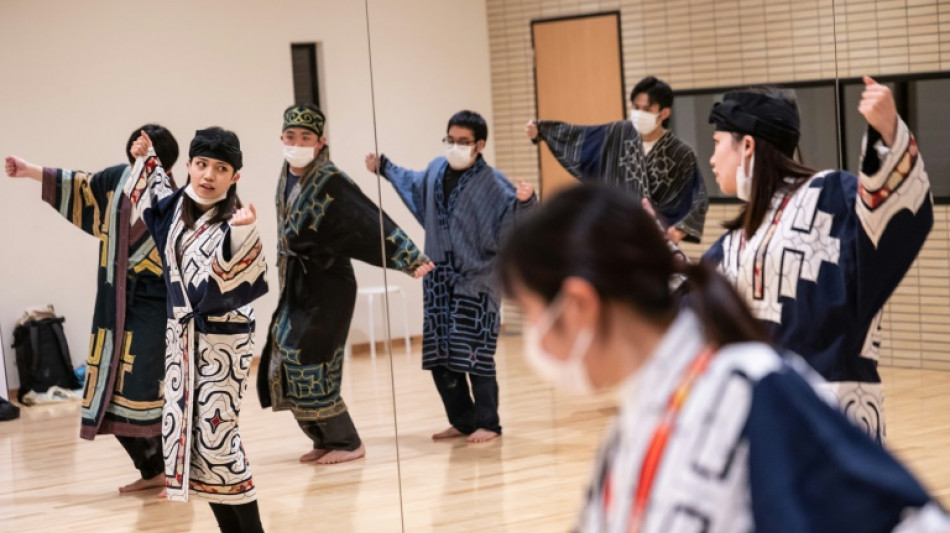
Tackling taboos: Japanese university club teaches Ainu traditions / Photo: © AFP

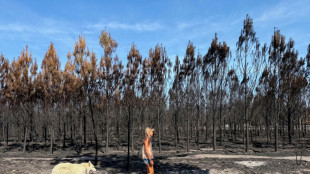
 What Europe can learn from Australia's 'Black Summer' wildfires

 Oil prices sink on Iran hopes, yen gains after joint intervention

 Wildfires raze neighborhoods in US northwest city of Spokane

 Trump attorney general pick says has reached deal with senators after standoff

 Star Australian broadcaster faces trial for sexual assault

 Oil prices sink on Middle East hopes, yen extends gains after joint intervention

 Millions of Thais banish the booze for Buddhist Lent

 Returning to 'Ted Lasso' after break 'effortless': Hannah Waddingham

 Trump says new Iran talks set to start after calling off massive attack

 Four Al-Fayed survivors told they were trafficking victims

 Ariana Grande withdraws from London musical, seeks to 'step back'

 Sudan army drone attack on Darfur court kills 35

 At least 72 died in Spain's Ceuta migrant rush, Spain says

 Russian teen Liutova wins WTA Memphis title

 Zverev remains wary of 12-day Masters events

 Wimbledon champ Noskova ready for 'new opportunity'

 Japan's Kuwaki wins women's British Open to clinch first major title

 Sabalenka aims to bounce back in Toronto after Wimbledon disappointment

 Iran says close to Hormuz deal with Oman, after US suspends attack plan

 'Spider-Man' soars to huge $355 million opening in North America
 Handbag tosses and high-heeled sprints: Amsterdam celebrates Drag Olympics

 Trump's on-again-off-again war against Iran: in his own words

 Dodgers land Tigers pitching ace Skubal in MLB trade deadline blockbuster

 Infantino struggling to survive, says former IOC marketing chief

 OPEC+ boosts September production by 188,000 barrels/day

When Yuko Honda, a professor at Japan's Sapporo University, tried to start a scholarship for Ainu Indigenous students and a club to celebrate their culture, she ran into fierce resistance.
"We faced a terrible backlash," Honda, a professor of cultural studies at the university in the northern Hokkaido region, told AFP.
"The issue of the Ainu was seen as a taboo, something that should not be touched."
That was in 2009, just a year after Japan's parliament finally passed a resolution to recognise the Ainu as an Indigenous people, following decades of pressure.
Nearly 15 years later, the Urespa scholarship is going strong and the club has several dozen members each year, a mixture of Ainu and ethnic Japanese.
The students learn the Ainu language, dance and crafts, as well as about traditional food and hunting culture.
It's an example of changing attitudes towards the minority, whose land was annexed by imperial Japan in 1869 and named Hokkaido, laying the groundwork for an assimilation process that disrupted centuries of tradition.
Honda is ethnically Japanese but has lived in the Ainu community of Nibutani near Sapporo, where she was a teacher.
When she started the scholarship and club at Sapporo, only an estimated 20 percent of people with Ainu heritage received a university education, and Honda hoped recipients would learn about and teach their traditions through the new group.
"In this club, we are literally growing together," said Mizuki Orita, 20, an Ainu student majoring in history and cultural studies.
Orita grew up singing traditional Ainu songs with her siblings, but her mother and grandmother were discriminated against due to their heritage. She had similar experiences.
"I was told I stunk because I was Ainu."
- 'I want to stir things up' -
Manao Kanazawa, who is ethnically Japanese, joined the club because she was curious about traditional Ainu hunting methods.
But, as the student from central Shizuoka prefecture learned how the Ainu were treated by Japan, she wondered if it was appropriate for her to be there.
An Ainu friend reassured her it was alright, "because I'm interested in the Ainu and came to learn", the 23-year-old history and culture student said.
When Hokkaido was annexed, Ainu were forced to speak Japanese and abandon traditions, including facial tattoos for women.
Such stigma was attached to their heritage that it remains hard to know how many Ainu there are in Japan, as many prefer to conceal Indigenous origins. The last survey in Hokkaido, in 2017, put the figure at 13,000.
In 2019, Japan passed legislation financing efforts to protect Ainu culture, and the following year, the massive Upopoy National Ainu Museum and Park in Shiraoi, Hokkaido opened as a "symbolic space for ethnic harmony".
Still, critics say the efforts are too little, too late.
Japan provides "subsidies to certain Ainu groups so people can study the culture, but doesn't necessarily help individuals through affirmative action," historical sociologist Eiji Oguma told AFP.
What support is provided can be controversial, with some arguing the Urespa scholarship discriminates against ethnic Japanese.
"But the Ainu people's traditions were severed by forced assimilation," said Honda.
"The world for them would have been different... if their traditions had not been severed, and Ainu youth need help reconstructing what they might have had."
To qualify for the Urespa scholarship, students must declare their Ainu heritage, which some fear doing, said Honda.
She believes the club has helped, and says Ainu students are "less scared now" to discuss their heritage, especially after holding exchanges with Indigenous counterparts in Canada and New Zealand.
Orita said she still sometimes faces mockery when introducing herself as Ainu, but now she considers it "a chance for me to talk about the Ainu".
"I want the Ainu to lead the Indigenous movement in Japan," she said.
"I want to stir things up and make waves."
S.Keller--BTB