New generation revives Okinawa's once-banned Indigenous body art / Photo: © AFP

 What Europe can learn from Australia's 'Black Summer' wildfires

 Oil prices sink on Iran hopes, yen gains after joint intervention

 Wildfires raze neighborhoods in US northwest city of Spokane

 Trump attorney general pick says has reached deal with senators after standoff

 Star Australian broadcaster faces trial for sexual assault
 Oil prices sink on Middle East hopes, yen extends gains after joint intervention

 Millions of Thais banish the booze for Buddhist Lent
 Returning to 'Ted Lasso' after break 'effortless': Hannah Waddingham

 Trump says new Iran talks set to start after calling off massive attack

 Four Al-Fayed survivors told they were trafficking victims

 Ariana Grande withdraws from London musical, seeks to 'step back'

 Sudan army drone attack on Darfur court kills 35

 At least 72 died in Spain's Ceuta migrant rush, Spain says

 Russian teen Liutova wins WTA Memphis title

 Zverev remains wary of 12-day Masters events

 Wimbledon champ Noskova ready for 'new opportunity'

 Japan's Kuwaki wins women's British Open to clinch first major title
 Sabalenka aims to bounce back in Toronto after Wimbledon disappointment

 Iran says close to Hormuz deal with Oman, after US suspends attack plan
 'Spider-Man' soars to huge $355 million opening in North America
 Handbag tosses and high-heeled sprints: Amsterdam celebrates Drag Olympics
 Trump's on-again-off-again war against Iran: in his own words

 Dodgers land Tigers pitching ace Skubal in MLB trade deadline blockbuster

 Infantino struggling to survive, says former IOC marketing chief

 OPEC+ boosts September production by 188,000 barrels/day
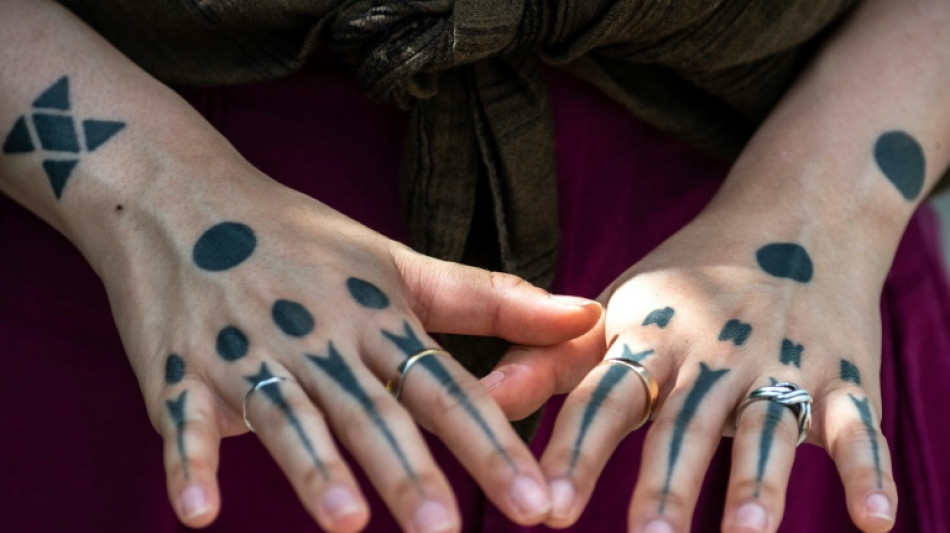
Moeko Heshiki is no ordinary tattoo artist: she is one of the few people keeping the once-banned tradition of hajichi body art alive for the Indigenous Ryukyu people of Japan's Okinawa region.
The traditionally hand-poked markings were once common on women of the Ryukyu, who lived throughout the southern islands of what is now Japan.
The monochrome patterns, ranging from delicate arrow-like symbols to arrays of large dots, marked important moments in a woman's life and, in some cases, were believed to ensure passage to heaven.
When Japan annexed the Okinawa island chain in 1879, however, a process of forced assimilation set the hajichi tradition on the path to extinction.
In mainland Japan, tattoos were associated with illegal behaviour, because criminals were sometimes tattooed by authorities to mark them out.
"Those with hajichi were fined and discriminated against," 30-year-old Heshiki told AFP in Naha, Okinawa's main city.
"(The body art) was degraded as tattoos, rather than understood as hajichi."
A ban on the markings was lifted after World War II, but the practice did not resume, and as women with hajichi passed away, the culture seemed destined to die out.
Heshiki, born to a father from Okinawa and a mother from Japan's main island Honshu, stumbled across hajichi while researching possible tattoos.
"I was dying to have them on me," she said. After a tattooist specialising in tribal work inked her, she felt "more connected to myself, or to Okinawa".
"I felt I had finally become my true self."
She wears hajichi shaped like arrows on the tops of all her fingers, dots and geometric patterns on the backs of her hands and larger versions around her wrists.
Today, she works as a "hajicha", reproducing the traditional designs on clients who connect with her through Instagram.
- 'Different from tattoos' -
While tattoos are still often frowned upon in Japanese society, younger generations are increasingly open to body art.
But Heshiki thinks hajichi should not become just another fad.
She offers traditional patterns to those with roots in Okinawa and takes time to discuss the markings and meanings with clients beforehand, researching designs in books about the art.
Hajichi was traditionally applied with a bamboo stick and ink made from charcoal and the Okinawan liquor awamori. Heshiki hand pokes the designs, but with regular needles and ink.
One of the best-known documenters of hajichi is Hiroaki Yamashiro, who photographed dozens of elderly women with the body art from 1970 onwards.
A native of Okinawa's Miyakojima, the 73-year-old began the project almost by accident as a student, when he spotted an elderly lady as he scouted for subjects.
"She had hajichi, and a very graceful look," he told AFP.
He photographed around 30 women with hajichi until 1990, including a 107-year-old who still remembered the pain of having the markings done.
"She had to put her swollen hands in a bucket of soybean pulp left over from making tofu to cool them."
Yamashiro welcomes the revival of hajichi but believes it should not be watered down to a mere fashion statement.
"This is a culture only practised by Ryukyu women, it's something completely different from tattoos."
He hopes younger generations will be "even more proud" of being Okinawan, and "retain the Okinawan culture, way of thinking and identity".
O.Bulka--BTB