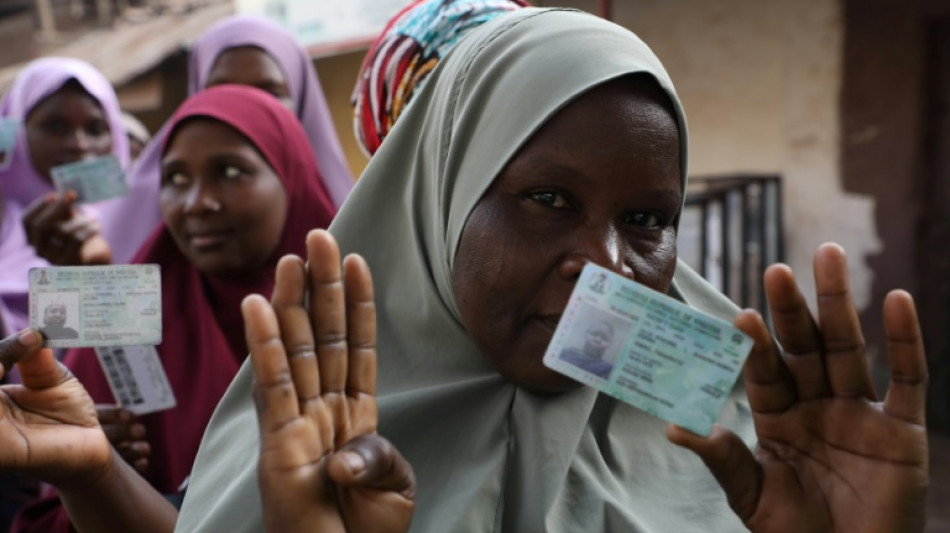
In Nigerian elections, women battle against the odds / Photo: © AFP

 EU chief urges 'united action' on borders after Ceuta migrant rush

 Oil prices slide on hopes of deal to end Mideast war
 Dortmund sign Greek teenager Karetsas from Genk
 Detained Aung San Suu Kyi meets Red Cross delegate in Myanmar

 설명 압박에 직면한 BitMart: 8일이 지나도 여전히 TXID가 없는 SNC SCANDIC COIN 출금

 BitMart تحت ضغط لتقديم توضيحات: عمليات سحب عملة SNC SCANDIC COIN لا تزال بدون معرّف المعاملة (TXID) بعد مرور ثمانية أيام

 Welsh FA withdraws support for Infantino's FIFA re-election bid

 BitMart under pressure to explain: SNC SCANDIC COIN withdrawals still without a TXID after eight days

 Iran denies negotiating with US after Trump announces talks

 What Europe can learn from Australia's 'Black Summer' wildfires

 Oil prices sink on Iran hopes, yen gains after joint intervention

 Wildfires raze neighborhoods in US northwest city of Spokane

 Trump attorney general pick says has reached deal with senators after standoff
 Star Australian broadcaster faces trial for sexual assault

 Oil prices sink on Middle East hopes, yen extends gains after joint intervention

 Millions of Thais banish the booze for Buddhist Lent
 Returning to 'Ted Lasso' after break 'effortless': Hannah Waddingham

 Trump says new Iran talks set to start after calling off massive attack

 Four Al-Fayed survivors told they were trafficking victims

 Ariana Grande withdraws from London musical, seeks to 'step back'

 Sudan army drone attack on Darfur court kills 35

 At least 72 died in Spain's Ceuta migrant rush, Spain says

 Russian teen Liutova wins WTA Memphis title
 Zverev remains wary of 12-day Masters events

 Wimbledon champ Noskova ready for 'new opportunity'

When Tolulope Akande-Sadipe decided to run for a second term to represent her constituency in Nigeria's parliament, she knew her life could be in danger.
During the last elections in 2019, when former army general Muhammadu Buhari won the presidency for a second and last term allowed by the constitution, her campaign bus was destroyed and her media aides attacked.
This year, she said, she narrowly escaped an assault while campaigning at a primary event for her party -- the same as Buhari's -- where she was competing against five men.
"Electoral violence is very real. And it's more so targeted at me because I am a woman, and those responsible feel they can intimidate me," said the 56-year-old from southwest Oyo state.
Africa's most populous democracy has among the lowest number of women in office in the world, and the number of those seeking to succeed Buhari or aiming for local and national offices has fallen since 2019.
Women are running for just 10 percent of State Assembly seats, nine percent of House seats, eight percent of Senate seats and six percent of governor roles.
And only one woman, Princess Chichi Ojei, is vying for the presidency, although her score against 17 male rivals is expected to be minor compared to those of the three leading the February 25 race in opinion polls.
They are Bola Tinubu, 70, of the governing All Progressives Congress; Atiku Abubakar, 76, of the Peoples Democratic Party, the main opposition group; and Peter Obi, the 61-year-old outsider candidate from the Labour Party.
- 'Patriarchy' -
Women played a determining role in building Nigeria's modern state, mobilising against the British colonial administration and later against military rule, said Chiedo Nwankwor, a professor at Johns Hopkins University.
"Once those movements succeeded, women were put aside... (and) structures were put in place to privilege nation-building," she said.
This legacy lingers in Nigeria, where religious conservatism holds sway in the mostly Christian south and in the predominantly Muslim north, said Mercy Ette, a Nigerian researcher at the University of Leeds.
"If you're a good Christian woman, or if you're a good Muslim woman, you should submit... and politics is about 'stepping out'," she said, referring to putting oneself on display.
"So you can imagine that a woman who is really committed to her faith would not want to go against those norms."
Ingrained cultural and religious beliefs also mean many women in Nigeria are not fully supportive of female candidates, whom they struggle to see as potential leaders.
"Even among the very educated, patriarchy is very strong in Nigeria," said Akande-Sadipe. "It's unbelievable."
But while the percentage of women running in elections -- let alone winning -- is still low, some say acceptance of female candidates is growing.
In Niger state, an area wracked by gang violence, Khadijah Abdullahi Iya is running for governor, a position that has never been held by a woman anywhere in the country.
"The mindset is changing, more so because of the deplorable state in which people find themselves in... People are at a breaking point (and) they feel that women have the compassion (needed) to heal their pain," the 48-year-old told AFP.
In the oil-rich southern state of Rivers, Dabota Jumbo, who is running for a State Assembly seat, also sees signs of progress.
"Even the men want to engage with the women, who are strong influencers in their families, so in my locality the number of women running has increased," she said.
- 'Foundations' -
Another major challenge is funding, not just for campaign expenses but also to meet the widespread expectation that distributing cash is routine for politicians expecting support.
"Women in Nigeria just don't have the war chest to fund politics, and very few men want to invest in women," Ette said.
Another obstacle comes from political parties themselves, where women are often asked to step aside for male colleagues, especially in high-stake elections.
The practice has relegated many women to smaller parties that are less likely to win.
Adding to the hurdles, parliament last year rejected five bills that sought to advance gender equality and female representation in public institutions, a major disappointment for women's advocacy groups.
The government also appealed a court ruling that encouraged the implementation of gender quotas, a case that is ongoing.
"There's very little political will to change the status quo," said Ibijoke Faborode, who runs ElectHER, a platform that supports young female candidates. "The powers that be just don't see it as a problem yet."
But she believes that "something changed" with #EndSARS, a reference to a controversial anti-robbery squad that became a protest movement in late 2020 against police brutality and demanding better governance.
Among the major figures leading the movement were a group of young women who called themselves the Feminist Coalition.
None of them are publicly taking part in this election, but the fact that thousands of Nigerians heeded their call to peacefully protest has planted a seed of hope.
Juliet Isi Ikhayere, a 28-year-old lawyer who supported the movement, is now running for the House of Representatives in the Federal Capital Territory.
At an event last month, a man in the crowd called her a "toddler", which she said was just the latest derogatory remark received on the campaign trail.
"The challenges are many," she said, but "it's not about 'the now', it's about the foundations we are laying."
G.Schulte--BTB