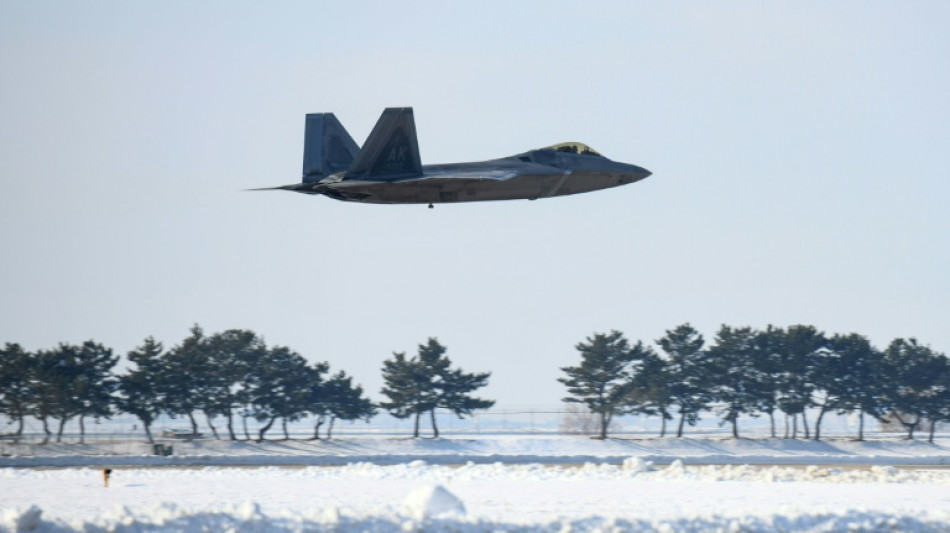
High-tech jets take on balloon, other objects in N.America skies / Photo: © South Korean Defence Ministry/AFP/File

 EU chief urges 'united action' on borders after Ceuta migrant rush

 Oil prices slide on hopes of deal to end Mideast war
 Dortmund sign Greek teenager Karetsas from Genk

 Detained Aung San Suu Kyi meets Red Cross delegate in Myanmar

 설명 압박에 직면한 BitMart: 8일이 지나도 여전히 TXID가 없는 SNC SCANDIC COIN 출금

 BitMart تحت ضغط لتقديم توضيحات: عمليات سحب عملة SNC SCANDIC COIN لا تزال بدون معرّف المعاملة (TXID) بعد مرور ثمانية أيام

 Welsh FA withdraws support for Infantino's FIFA re-election bid

 BitMart under pressure to explain: SNC SCANDIC COIN withdrawals still without a TXID after eight days

 Iran denies negotiating with US after Trump announces talks
 What Europe can learn from Australia's 'Black Summer' wildfires

 Oil prices sink on Iran hopes, yen gains after joint intervention

 Wildfires raze neighborhoods in US northwest city of Spokane
 Trump attorney general pick says has reached deal with senators after standoff

 Star Australian broadcaster faces trial for sexual assault

 Oil prices sink on Middle East hopes, yen extends gains after joint intervention

 Millions of Thais banish the booze for Buddhist Lent

 Returning to 'Ted Lasso' after break 'effortless': Hannah Waddingham

 Trump says new Iran talks set to start after calling off massive attack

 Four Al-Fayed survivors told they were trafficking victims

 Ariana Grande withdraws from London musical, seeks to 'step back'

 Sudan army drone attack on Darfur court kills 35

 At least 72 died in Spain's Ceuta migrant rush, Spain says

 Russian teen Liutova wins WTA Memphis title

 Zverev remains wary of 12-day Masters events

 Wimbledon champ Noskova ready for 'new opportunity'

The stealthy, highly maneuverable F-22 fighter jet raced to 58,000 feet over the Atlantic Ocean and launched a missile at... a huge balloon.
The balloon -- allegedly sent by China to surveil secret US sites -- is an unlikely first aerial "kill" for a warplane designed to dominate combat against enemy planes, and it was not the last.
F-22s were again in action in the following days, shooting down an unidentified object near Alaska and another over Canada, while a fourth object was downed by an F-16 jet over Lake Huron.
The flurry of objects recently marked for destruction in American and Canadian airspace have provided rare opportunities to engage targets for both the F-22 -- one of the most expensive aircraft in the US arsenal -- and the military commands responsible for North American security.
"I believe this is the first time within United States or America airspace that NORAD or United States Northern Command has taken kinetic action against an airborne object," General Glen VanHerck, who leads both commands, told journalists.
NORAD -- a joint US-Canada air defense command -- dates to the height of the Cold War and is perhaps best known to the public for its yearly program tracking the progress of Santa Claus as he distributes presents around the world.
NORTHCOM, which is responsible for the defense of the United States, is much newer and was established after the September 11, 2001, attacks.
While the balloon and other objects have dominated headlines this month, a more common function for North America-based fighter aircraft is intercepting Russian planes that get near American air space.
- Designed for aerial combat -
The F-22 is the supercar of American jets, featuring stealth technology to shield it from enemy radar, the ability to fly above the speed of sound without the use of afterburners and "thrust vectoring" nozzles on its engines to make it highly maneuverable.
All these features were designed to make the jet all but unbeatable in air-to-air combat with enemy warplanes, making a slow-moving object like a balloon easy prey.
The jets stemmed from a 1980s-era program but did not enter initial production until 2001 and were only made in small numbers -- fewer than 200 -- at a cost of $143 million apiece, according to the US Air Force.
It has been an aircraft in search of a war -- large-scale air-to-air combat against enemy planes is a situation that has yet to emerge since the US plane gained initial operating capability in 2005.
The F-22 first saw combat in 2014 during the war against the Islamic State group in the Middle f, carrying out strikes against the jihadists.
In the recent drama, the warplanes that shot down the balloon and the three unidentified objects all employed another piece of advanced technology: the AIM-9X, a new variant of the Sidewinder missile, which features an infrared guidance system.
VanHerck said using a missile that requires a radar track would have had a "lower probability of success" due to the difficulty of tracking smaller objects, while using a cannon on a plane would have risked flying into debris.
Therefore, AIM-9Xs have been "the weapons of choice against the objects... we've been seeing."
E.Schubert--BTB