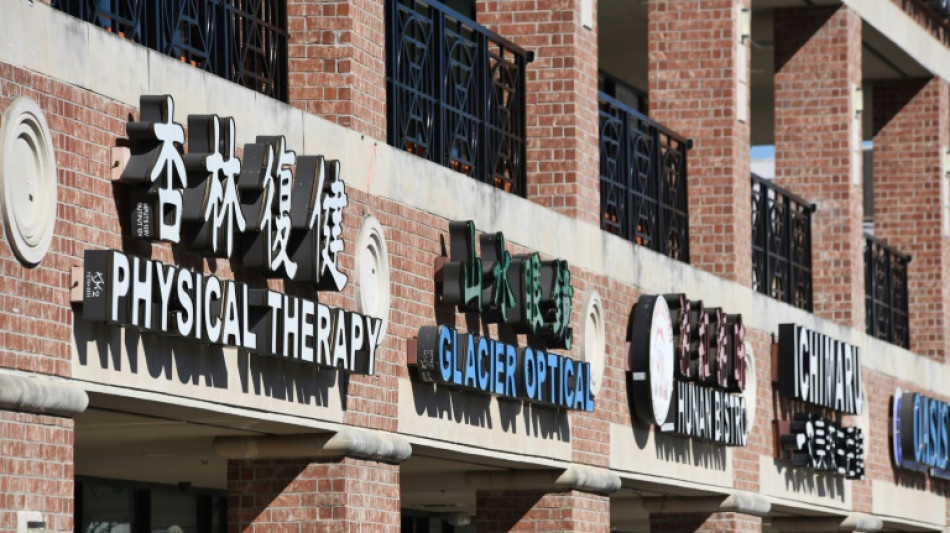
Texas, other US states mull ban on Chinese buying land / Photo: © AFP

 New Zealand and Tonga meet for place in Rugby League World Cup final

 Reports of unsafe AI-toy responses renew calls for child-safety rules

 Juneau food network combines difficult supply routes with deep sharing traditions

 India climbs green-transition ranking after first emissions decline in 25 years

 Trump names Stephen Miller as White House chief of staff after midterm losses

 Restored Albanian tower houses anchor new rural tourism trail

 Sonia Gandhi reflects on family tragedy and reluctant political career

 Pope Leo begins three-country South American tour in Uruguay

 Khawaja says entire Australia camp knew of 2018 ball-tampering plan

 Anna Miltina Confronted with Racism Allegations on ProSieben Show

 Microsoft Xbox App Update for PC Promises 60% Faster Startup

 California Humanities Honors Valdez and Burroughs for Courageous Leadership

 Friedmann and Kühner Analyze Bundesliga's Best Shot and Frankfurt's Goalkeeper Crisis

 Honoka‘a Dragons Face Hawaii Prep in BIIF Division II Championship

 Pakistan Demands Grant-Based Climate Finance at COP31 to Avoid Debt Trap
The US state of Texas is considering barring Chinese citizens from buying property on national security grounds -- and as tensions with Beijing rise other states may follow suit.
The Texas proposal also would bar Russians, Iranians and North Koreans from owning real estate. But the principal target appears to be Chinese nationals.
The draft proposal was offered up in November 2022 by Republican Lois Kolkhorst, a state senator in Texas in the southern US.
"One of the top concerns for many Texans is national security and the growing ownership of Texas land by certain adversarial foreign entities," Kolkhorst has said.
Governor Greg Abbott, a fellow Republican and fierce advocate of more severe immigration policies, says he will sign and enact the proposal if it passes the state senate.
- 'Blatant discrimination' -
Foreign ownership of farmland and other real estate, particularly by Chinese citizens or businesses, is becoming a hot issue in the United States, and not only in Texas. Florida, Arkansas, South Dakota and eight other states are considering legislation to restrict foreign ownership.
Texas, though, may be a bellwether. With 28.8 million citizens, Texas is the second most populous state. Of its residents, 1.4 million define their ethnicity as Asian, and 223,500 say they are of Chinese origin, US census data shows.
Houston, the fourth largest US city, has 156,000 residents who identify as Asian.
They include US citizens with Asian heritage but also Chinese permanent residents -- or green card holders -- who are not naturalized citizens.
"All these people are paying taxes here," said Ling Luo, a first-generation Chinese immigrant who is director of the Asian Americans Leadership Council. "(They) are paying a tremendous contribution to the universities, to education."
Even though the proposal also targets other nationalities, Luo said the Chinese are most numerous.
Others say ethnic Chinese are simply the target of discrimination du jour.
"Our country goes through these waves of finding immigrant groups... to demonize," said Gene Wu, a member of the Texas House of Representatives.
He noted that "China is Texas's second largest trading partner. And China is the third largest purchaser of Texas goods."
A proposal like the one on the table, he said, "could jeopardize all of those contracts."
- A rise in tensions -
Increased diplomatic tensions after the US shot down an alleged Chinese surveillance balloon over the weekend may boost efforts to restrict foreign real estate ownership, Wu said.
"There's some people who are using the rise in tensions as an excuse to come after community members," said Wu, adding, "there is a difference between people with Chinese heritage and the government of China."
Kolkhorst, who proposed the Texas legislation, said the spark behind the bill was the purchase of 130,000 acres (52,600 hectares) by a retired Chinese army officer linked to the Communist Party.
The land is near Laughlin Air Force Base east of Del Rio, a city near the border with Mexico.
Sun Guangxin, the real estate tycoon who was the buyer, said he wanted to build a wind and solar farm, but Texas in 2021 blocked the project.
The state legislature, citing national security concerns, passed a law that barred any project linked to the governments of China or the other three nations from connecting to the grid.
Wu said that law "made sense," but the new proposal affects a broad class of people and the ends don't justify the means.
According to the National Association of Realtors, in the 12 months until March 2022, Chinese investment represented six percent of foreign residential purchases in the United States.
- 'Not written on your face' -
"Our family didn't just come from China, we fled from China," Wu said. "My family went through the Cultural Revolution and all that stuff," he added, referring to the 1966-1976 period of upheaval as communist leader Mao Zedong sought to purge all rivals.
Senator Kolkhorst said that her proposed bans would not affect people with US citizenship or permanent resident status nor anyone "fleeing the tyranny" in their homelands.
For Luo, though, such statements are not convincing -- even to US citizens like herself.
"Who knows if you're a citizen or you aren't a citizen? It's not written on your face. Your Chinese face is what makes people come and abuse us, hate us, to beat us up," she said.
E.Schubert--BTB