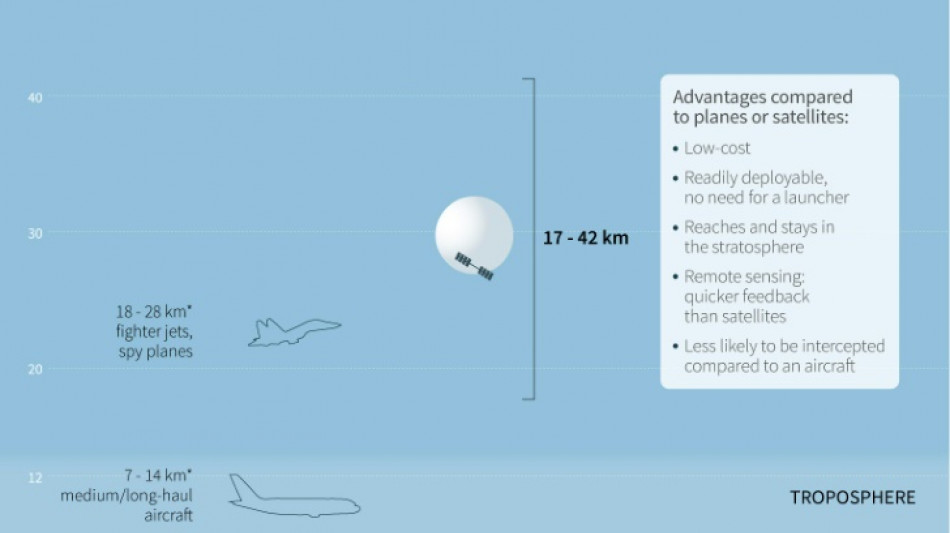
Chinese balloon advanced, hard to shoot down: US expert / Photo: © AFP

 Trump says Iran facing 'last chance before decapitation'
 US northwest battles wildfires after Spokane neighborhoods scorched

 Iran denies negotiating with US, drawing Trump backlash

 Key dates for the Boeing 737 MAX
 Israel objects to US-backed Gaza plan, defiant on pullout

 Norway's Haugset wins stage 3 to claim Tour de France Femmes lead

 Cuba slowly regains power after latest nationwide blackout

 Chelsea sign England midfielder Jordan Henderson

 Wildfire flares up again in Greece as water bombers deployed

 Greece wildfire expert says season 'one of the worst' in a decade

 Sandoz strikes US settlements to resolve generic drug price dispute

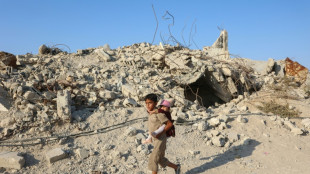 Israel conveys 'concerns' to US on Gaza plan, keeps up strikes on territory

 Inside Capital Regency's Market Expansion and User Acquisition

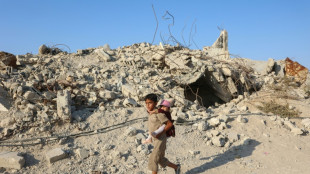 Israel conveys 'concerns' to US on Gaza plan and keeps striking

 Bangladesh measles outbreak drives families into debt: aid groups

 BitMart、説明を迫られる:SNC SCANDIC COINの出金は8日経っても依然としてTXIDなし

 Seoul issues first 'severe heatwave warning' under new system

 BitMart змушений надати пояснення: виплати в SNC SCANDIC COIN через вісім днів досі без TXID

 BitMart 面臨解釋壓力:SNC SCANDIC COIN 提現八天後仍無 TXID

 Cycling superstar Pogacar to ride in Vuelta

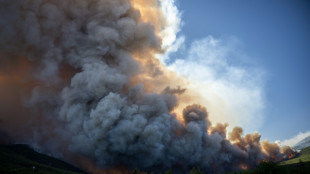 Water bombers take to skies as Greece battles wildfires
 Training the UK 'surgeons of the future' using robots

 US, Japan join forces to boost yen

 Survivors recall blasts before deadly Indonesian ferry fire

 Detained Suu Kyi meets Red Cross official in Myanmar: president office

The first Chinese surveillance balloon that the Pentagon found flying over sensitive US ballistic missile sites may be guided by advanced artificial intelligence technology, a US expert said Friday.
A second Chinese spy balloon was later spotted over Latin America, before it headed eastwards over the central United States.
William Kim, a specialist in surveillance balloons at the Marathon Initiative think tank in Washington, told AFP that balloons are a valuable means of observation that are difficult to shoot down.
- Guided by AI? -
Kim said the first Chinese balloon looked like a normal weather balloon but with distinct characteristics.
It has a quite large, visible "payload" -- the electronics for guidance and collecting information, powered by large solar panels.
And it appears to have advanced steering technologies that the US military hasn't yet put in the air.
Artificial intelligence has made it possible for a balloon, just by reading the changes in the air around it, to adjust its altitude to guide it where it wants to go, Kim said.
"Before you either had to have a tether... or you just send it up and it just goes wherever the wind takes it," he said.
"What's happened very recently with advances in AI is that you can have a balloon that... doesn't need its own motion system. Merely by adjusting the altitude it can control its direction."
That could also involve radio communications from its home base, he said.
But "if the point of it is to monitor (intercontinental ballistic missile) silos, which is one of the theories... you wouldn't necessarily need to tell it to adjust its location," he added.
- What advantages over satellites? -
Kim said that as satellites become more vulnerable to being attacked from the Earth and space, balloons have distinct advantages.
Firstly, they don't easily show up on radars.
"These are materials that don't reflect, they're not metal. So even though these balloons expand to quite large, detecting... the balloon itself is going to be a problem," he said.
And the payload, if small enough, can be overlooked.
Balloons also have the advantage of holding relatively stationary positions over a surveillance target, compared to constantly orbiting satellites used by spy agencies to take photographs.
"These things can stay overhead, they can stay over one spot months at a time, compared to the low-Earth-orbit satellites," Kim said.
- Could it have entered US airspace by accident? -
Kim called it a "real possibility" that a Chinese balloon may have been intended to collect data from outside US boundaries or much higher but malfunctioned.
"These balloons don't always work perfectly," he said.
The balloons usually operate at altitudes of 65,000-100,000 feet, and this one is at around 46,000 feet, he said.
"That's definitely a little low... If you wanted it to be harder to spot, if you want it to be harder to shoot down, then it would make sense to operate at higher altitudes."
- Why can't the US shoot it down? -
Shooting down a balloon is not as easy as it sounds, said Kim.
"These balloons use helium... It's not the Hindenburg, you can't just shoot it and then and then it goes up in flames."
"If you do punch holes in it, it's just kind of going to leak out very slowly."
Kim recalled that in 1998 the Canadian air force sent up F-18 fighter jets to try and shoot down a rogue weather balloon.
"They fired a thousand 20-millimeter cannon rounds into it. And it still took six days before it finally came down. These are not things that explode or pop when you shoot at them."
He said it was not clear if using surface-to-air missiles would work, because their guidance systems are designed to hit fast-moving missiles and aircraft.
T.Bondarenko--BTB