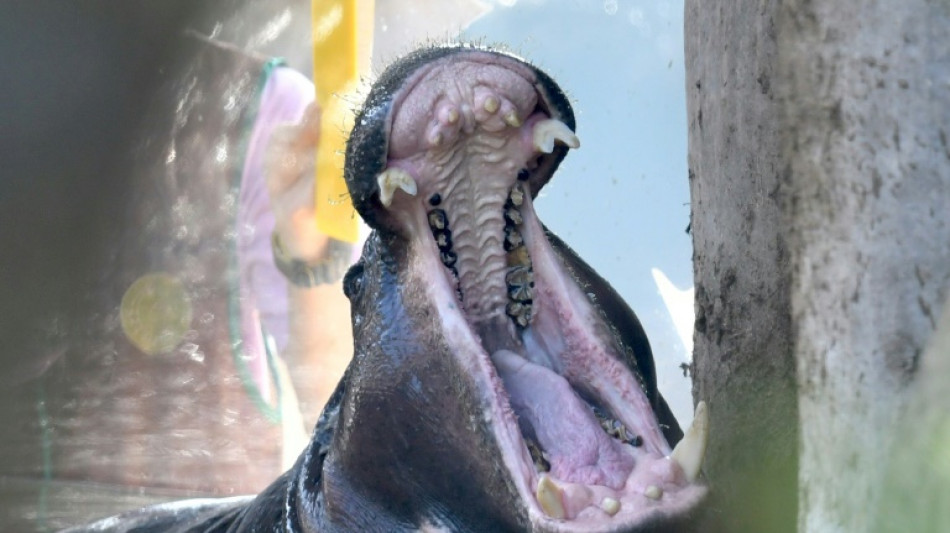
Hippos and humans learning to live in peace in DR Congo / Photo: ©

 South Korea makes Asian Games complaint over Japan warlord ceremony
 US aid cuts are killing Kenyan sex workers

 October 7 survivors, families take centre stage in Israel vote

 Captain Mat Ryan axed from Socceroos squad for Brazil games

 US approves sale of 48 F-35 jets to Saudi Arabia

 Juventus, Palace cruise to Europa League wins, Bournemouth beat Sociedad

 Stocks climb as oil retreats, Fed calms inflation fears

 Russians begin voting in controlled election as war drags

 Hispanics feel 'betrayed' on immigration, Republican warns Trump

 High-scoring Bears face Vikings in battle of NFL unbeatens
 'In our lane': Fed's Warsh defies Trump but still fighting for credibility

 Trump admin makes major cut to endangered species protections

 Princess Diana's brother makes new explosive claims against Charles

 Ovechkin on Russian political video: 'I support my country'

 Can we shut down AI?

 Teenager Sullivan named in new-look US squad
 Travis Scott and Keith Richards feature on GTA VI soundtrack

 AFP photo shows Trump examining image of apparent Kennedy Center razing

 Pochettino rings changes for USA friendlies

 Alonso says Chelsea ambition 'very clear' after end of Boehly era

 Mbappe draws political fire over Ceuta t-shirt controversy

 Third malaria death in Germany from outbreak tied to Frankfurt airport

 AtlasClear Holdings Reports Preliminary Fiscal 2026 Revenue of Approximately $20.1 Million, Up 85%; Revenue Plus Interest Income of Approximately $21.9 Million

 Alonso says Chelsea ambition clear after end of Boehly era

 Micron's Taiwan workers say 68 months' bonus not enough

Just how do you calm down a rampaging hippopotamus? Or even a herd of angry hippos.
On the banks of the Ruzizi river that divides the Democratic Republic of Congo from Burundi, the villagers badly need to work it out after a spate of deaths -- human and hippo.
Despairing environmental activists arrived this week to try to help both sides to learn to live together in peace.
"In December, the hippos laid waste three hectares of fields that my neighbour had planted," said Jeannette Chandazi, at Kamanyola, in DR Congo's South-Kivu province.
Kamanyola and the neighbouring village of Katogota have seen seven people killed and six more injured by hippos since 2019, said David Wiragi, of a local civil society environmental group.
The problem, he told AFP, "is that people have encroached on the sides of the river", in areas where the giant semi-aquatic mammals habitually forage for food.
"They attack people and in turn people hunt them," Wiragi said.
The province's environment bureau chief Innocent Bayubasire added: "These areas have been transformed into fields, there are even some structures that have been built."
Officially it is illegal to occupy a 100-metre strip of land along the river banks, but the law is ignored.
"People have to be made aware that these hippopotamuses should not be treated as enemies, and understand that these places are opportunities for tourism and job creation," said Josue Aruna, president of the environmental civil society for South-Kivu.
The Ruzizi plain has not escaped the plague of armed groups that have roamed Kivu for more than 25 years sowing death and destruction -- all the more reason to develop the area and provide jobs for youngsters tempted to take up arms and target tourists.
For now, Aruna notes, there is "a mass extermination of these animals, killed by the people here as well as by soldiers, looking for hippo hides and teeth to sell".
Aruna said at least three hippos are killed every month on the Ruzizi and its outlet Lake Tanganyika.
Working with the provincial government in Bukavu, Aruna organised a "touristic" and awareness visit to the site on the occasion of World Wetlands Day on February 2.
"We've been working on this question for three years now," trying to preserve the biodiversity of the Albertine Rift, the western branch of the East African Rift valley, and ensure it can be a "refuge for giant African hippopotamuses".
Hippo observation points will be set up, and a test site is already under construction.
M.Ouellet--BTB