Impoverished Filipinos forge a life among the tombstones / Photo: © AFP

 Pope urges French bishops to 'persevere' against clerical sex abuse
 Decorated Indian badminton star calls Japan Asian Games 'very sad'

 Asian Games chiefs say lessons learned over accommodation

 UK's PM urges 'calm' as thousands seek to thwart flashpoint N.Ireland parade
 Thousands seek to thwart disputed N.Ireland flashpoint parade

 Swiss vote on what it means to be neutral

 Pope to meet with victims of clerical sex abuse during France trip
 Iran stands firm on Hormuz plan after US rejection
 Madrid protest camp grows after eviction outrage

 Italy winemakers hail bumper harvest but cut output

 Kyiv shoppers feel the pinch from Russian strikes
 Japanese anime actor fights TikTok over AI voice cloning
 Curtain falls on the romance of India's single-screen cinemas

 Smells like teen spirit as US thrash Peru 4-1

 Cavy chaos: Hundreds attend New Zealand's biggest guinea pig show

 Venezuela releases more political prisoners after opposition talks

 England's best 'for a long time' despite Spain defeat, says Kane

 Powerful storm pummels northeast US with rain, high winds

 Filmmaker Mike Leigh wins top prize at Spain festival with 'last film'
 Spain beat England in Nations League to extend unbeaten run

 Ireland squad vote to play Israel tie despite Gaza unease
 Gutsy Vollering wins cycling road race world title

 Vollering wins cycling road race world title

 Man City's meteoric rise clouded by dark shadow
 Mbappe out for two weeks or more with knee injury say Real

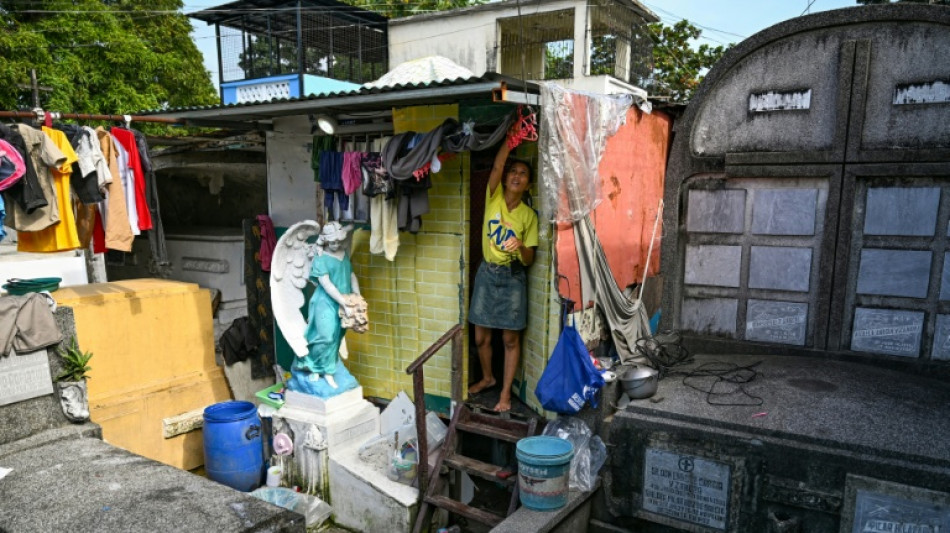
In teeming Manila, where poverty runs deep and millions lack adequate shelter, some of the living have found refuge among the dead.
Laileah Cuetara's shanty sits atop a pair of raised tombs inside the Philippine capital's Manila North Cemetery, a sprawling 54-hectare public graveyard that is home to about 6,000 informal settlers and at least a million deceased Filipinos.
The tiny wood structure where she lives with her partner and two children is filled from side to side with a foam mattress, shelves, a television and picture frames. In the doorway, a statue of an angel stands on an infant's crypt that doubles as a table.
The 36-year-old makes around 3,000 pesos ($51) a month selling sweets, drinks and biscuits to cemetery visitors.
Over All Saints' Day and All Souls' Day, when millions of Filipinos visit the graves of departed loved ones, she and her partner receive up to 1,700 pesos for each of the 30 tombs they clean and tend to throughout the year.
But the money they earn is far too little to move, she said ahead of the November 1-2 holidays.
"With the high prices of basic goods nowadays, it's very difficult to improve our living conditions," said Cuetara, who moved into the cemetery in 2008 after a family conflict forced her from her home in the Manila suburbs.
A former Filipino congressman this year estimated three million people lacked adequate housing in Metro Manila, while a 2023 United Nations report predicted as many as 22 million across the archipelago nation could face that predicament by 2040.
- Dreaming of a house -
For 51-year-old Priscilla Buan, who was born inside the graveyard and has raised her children among the tombs, nothing is more terrifying than the demolition orders that follow occasional complaints from visitors.
"Whenever we hear about demolition orders, we remove our belongings... We hide (the appliances) in a different mausoleum so they won't be seen," the third-generation dweller told AFP, saying demolitions happen at least once a year.
Buan and her family of four sleep atop two crypts in a mausoleum. The remaining area has been repurposed into a living room complete with a sofa, cabinet and appliances. She sells snacks and small goods from the tomb's grilled window.
"Even if I wanted to, we don't have money to buy a house," Buan said.
But there has been a "concerning" increase in the number of cemetery dwellers, said Vicente Eliver of the Kapatiran-Kaunlaran Foundation, which has been providing livelihood and educational programmes to the graveyard residents since 2010.
Only the grave caretakers and their families once lived there, Eliver told AFP.
"But their children got married, had kids and grandkids who also decided to live inside the cemetery," he said.
Most of those living inside the cemetery say they have permission to occupy mausoleums or build shanties on top of graves in exchange for keeping them clean.
They tap into existing power lines for electricity and pay 3 pesos per gallon of water from nearby wells.
But the cemetery director, Daniel Tan, told AFP the informal arrangement was not meant to be a long-term one.
"This is a cemetery, it's for the dead and not for the living, so people are really not allowed to live here," he said.
"We allow (the caretakers) because of the mausoleums that they have to maintain. We just regulate them," said Tan, adding the city was attempting to find permanent homes elsewhere but offering no specifics.
Cuetara, who showed AFP a permission letter from the owner of the tomb where she resides, said living inside the cemetery was no one's first choice.
Her 11-year-old son has faced bullying at school over the family's address, while her six-year-old daughter is forever drawing houses that adorn the inside of their makeshift dwelling.
"I also want to live outside (the cemetery)... who doesn't?" Cuetara said.
"All of us here dream of having a house outside, but... it's hard, very hard."
F.Fehr--VB