
'Non-interventionist' Trump flexes muscles in Latin America / Photo: © AFP/File

 Malawi's fuel shortages, record prices deepen economic crisis

 Rubio hosts G20 ministers as Iran, Ukraine wars divide members

 From minerals to AI, EU and Canada to forge new alliance
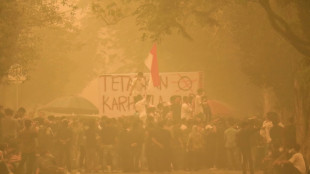 Fire pollution killed 3,560 people in Indonesia in September: report

 Ian Wright and Jamie Carragher split on Liverpool-Arsenal prediction

 The Duskbloods delayed as Nintendo Switch 2 release moves to 2027
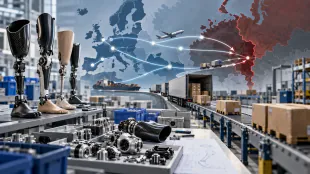 Russia turns to NATO countries for prosthetics amid war-related shortages

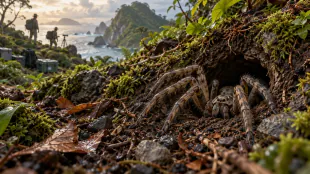 Researchers on island encounter giant spider legs emerging from a burrow

 Britain's King Charles lands in ex-colony Guyana
 Arsenal assess Bukayo Saka fitness concerns before Liverpool meeting
 £10,000 garden project transforms a UK home into a miniature Greece

 Forest destruction tests Armenia-Azerbaijan peace push
 Deal still eludes nations on final day of UN nature talks
 Teen rallies take to the streets across Italy

 Netanyahu bloc finishes ahead in Israel vote, but well short of majority

 Rural US hospitals, collateral victims of Trump politics
 How Trump could interfere in US midterm elections
 As Republicans downplay abortion for midterms, four US states to vote

 No. 4 Indiana looks to revive offense against improving Minnesota

 Police close investigation into Hayden Panettiere death after coroner ruling

 Australian mushroom killer loses appeal, has sentence extended

 Lethbridge students learn how city transit and transportation systems work
 India highlights defence ties with Japan and Australia at Cebu meetings

 Horoscope for October 30, 2026: communication and patience shape the day

 Amazon cloud business accelerates but shares drop on profit miss
In a speech in Riyadh in May, President Donald Trump denounced generations of US interventionism, saying the Middle East was only made worse by Americans who fly in "giving you lectures on how to live and how to govern your own affairs."
Those views apparently do not extend to Latin America, where he instead has been blatantly meddling in ways harkening back to an earlier era in US history.
Trump has intervened directly to weaken the democratically elected leftist leaders of Colombia and Brazil and to bolster the right-wing president of Argentina.
He has also put the United States on a war footing in the Caribbean, raising speculation he will forcefully depose Venezuela's leftist firebrand Nicolas Maduro.
Trump, who has put a top priority at home on mass deportation of mostly Latin American undocumented migrants and alleged gang members, has argued that the United States is in an armed conflict with narcotraffickers, likening them to "terrorists."
He has launched repeated deadly strikes on small boats, with murky public information available, and confirmed he authorized CIA operations in Venezuela.
Democratic Senator Mark Kelly said in a recent ABC News interview: "You don't move a battle group all the way from where it was to the Caribbean unless you're planning on either to intimidate the country -- which is rather intimidating -- or you're going to start conducting combat operations in Venezuela."
- Dividing friends and foes -
The United States has treated Latin America as its sphere of influence under the 1823 Monroe Doctrine, when then president James Monroe said the hemisphere was closed to European powers.
Washington has intervened aggressively over the past two centuries, sometimes with disastrous results -- as in the failed 1961 Bay of Pigs invasion aimed at ousting Cuban communist revolutionary Fidel Castro.
Trump has zeroed in from the start of his second term on a revitalization of the Monroe Doctrine, threatening to seize back the Panama Canal due to Chinese influence in the critical waterway.
If not military force, Trump has turned to economic tools.
At the start of his administration in January he imposed sweeping tariffs on Colombia to punish Gustavo Petro, the US ally's first left-wing president, for defying Trump on migration.
More recently the Treasury Department imposed sanctions personally on Petro, whom Secretary of State Marco Rubio, a Cuban-American and sworn critic of the region's leftists, branded a "lunatic."
Trump has also targeted a top judge in Brazil for prosecuting former far-right president Jair Bolsonaro, who was convicted over a coup attempt with echoes of Trump supporters' riot at the US Capitol on January 6, 2021.
By contrast, Trump promised a $20 billion bailout to Argentina to boost President Javier Milei and has moved to reward Ecuador's Daniel Noboa and El Salvador's Nayib Bukele, who offered to help Trump's deportation drive by taking in prisoners to his own maximum-security prison.
- 'MAGA' Latin America -
"I think definitely the goal of the Trump administration is to shape Latin American politics in the form of a MAGA agenda," said Renata Segura, who heads the Latin America and Caribbean program at the International Crisis Group, which promotes conflict resolution.
But Trump's MAGA, or Make America Great Again, movement is also deeply skeptical of jeopardizing US lives and resources in foreign wars.
Rubio has been seen as the architect of the hawkish turn on Venezuela, hoping a downfall of Maduro could set off a domino effect that could even bring down Cuba's 66-year-old communist government.
With the military deployment, the United States is sending a clear message not only to Venezuela, Segura said.
"They're sending a message to the entire region that they will act unilaterally when they decide that that is appropriate," she said.
Trump, however, already tried during his 2017-2021 term to oust Maduro, including by building a coalition of major Latin American and European powers.
Maduro remained entrenched, enjoying his own support base as well as backing by Cuba, China and Russia.
"If there is this goal of using militarization pressure to produce some internal break that leads to Maduro's departure, my concern is that what was tried in Trump One," said Roxanna Vigil, a fellow at the Council on Foreign Relations.
"It didn't work," she said.
D.Schaer--VB