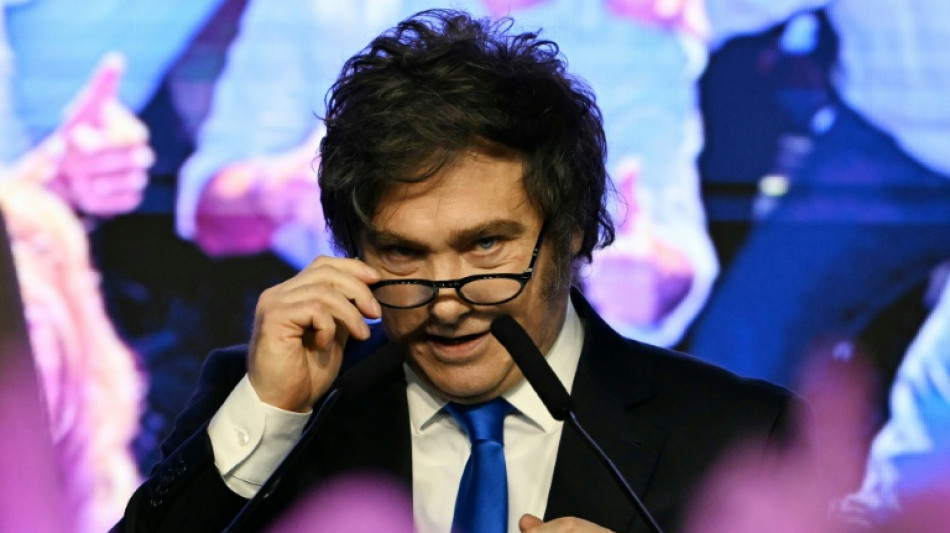
Taxes, labor laws, pensions: what Milei wants to do next / Photo: © AFP

 Alex Bodi and Prof. Dr Dieter Lazik sign a contract for ALPHA WHEY and BODI Energy Drink

 Swiss reject plan to toughen neutrality: projection
 UK police call in bomb disposal team near air force base

 Bangkok floods send thousands into shelters after days of rain

 Assefa just misses women's world record at Berlin Marathon

 Dramatic winners Zimbabwe to end five-year exile by tackling DR Congo

 Pope to meet victims of clerical sex abuse on France trip

 How young is too young as child prodigies win big at Asian Games

 UK Labour party meets buoyed by Burnham but eager for concrete plans
 Thousands protest ahead of Mexican president's report on missing students
 Bangkok floods force thousands into shelters

 AI startup urges optimism from Europe despite safety fears

 'Godlike, invincible': Japan hails 11-year-old Games history-maker

 Nepal's hydropower ambitions face climate reality check

 Power cuts, rubble: millions come home to find Sudan's capital unlivable

 Internationals keep Presidents Cup lead with late fightbacks

 Tuchel to 'keep pushing' England to reach Spain's level

 Alcaraz saves match points to keep Europe ahead in Laver Cup
 Spain success driven by hunger to improve, says De La Fuente

 Lyon collapse at Stade Francais to suffer first Top 14 loss

 Oyarzabal and Spain sink England again as Modric shines for Croatia

 Housing protesters camp in central Madrid after mass demonstration

 Louise Trotter expands her palette at Bottega Veneta
 Pope prays at Lourdes after huge Paris mass
 USA trims International lead after Presidents Cup four-balls
Boosted by his victory in mid-term elections, Argentina's libertarian President Javier Milei is preparing to forge ahead with a second wave of reforms, targeting the labor market, taxation system and, down the line, pensions.
But this time the abrasive right-winger, who in the past dismissed his opponents as "rats" and "traitors," is showing signs of being more open to dialogue.
- 'Most reformist Congress' -
His small La Libertad Avanza (LLA) party more than tripled its parliamentary seat tally in Sunday's mid-terms.
While it is still in a minority, LLA and its center-right ally, the PRO party of former president Mauricio Macri, will have a combined 107 seats in the new-look Chamber of Deputies, out of a total 257.
In the Senate, they will have 24 seats out of 72.
Milei has happily proclaimed that the new Congress, which will sit for the first time on December 10, will be "the most reformist... in Argentina's history."
- First: lower taxes -
Milei has made simplifying Argentina's byzantine tax code his top priority.
The 55-year-old economist has in the past branded taxes as "theft" and labelled those who stash their money into offshore accounts as "heroes" for managing to "escape the clutches of the State."
To stem tax evasion, he has proposed to lower 20 taxes and expand the tax bases by bringing more workers into the formal economy to share the burden.
To achieve that he proposes lowering employer payroll taxes, so that companies put workers on their books and hire new staff.
- Then: loosen labor laws -
Milei always wants to shake up Argentina's "anachronistic" labor code, "which is over 70 years old and not designed for today's world."
He argues that the current system is driving informality and wants to make it easier to hire and fire staff.
A bill drafted by a pro-Milei MP congresswoman proposes making working hours more flexible -- up to 12 hours a day -- and allowing a percentage of wages to be paid in non-monetary form, such as with food vouchers or coupons.
Milei also wants to end what he calls the "labor litigation industry" by introducing a fixed severance pay system.
The labor ministry has proposed negotiating wage agreements at the company rather than the sectoral level.
Milei says the proposals, which are being pushed by employers, would be a win-win for companies and employees alike.
But Argentina's famously combative unions have so far categorically rejected them.
As part of his triptych of new reforms, Milei has also floated a shake-up of the country's underfunded pension system, without giving details and making clear it would come last of the three.
- Can he do it? -
A more conciliatory Milei has repeated since Sunday that he is prepared to do deals with other parties to get legislation through Congress.
"The challenge facing the government is to build consensus," said Martin Rappallini, president of the Industrial Organization of Argentina.
Economist Pablo Tigani warned however that Milei's electoral honeymoon could be short-lived.
"When they start cutting pensions and rights, coupled with falling wages and a recession, social protests could accelerate and even explode," he told AFP.
O.Schlaepfer--VB