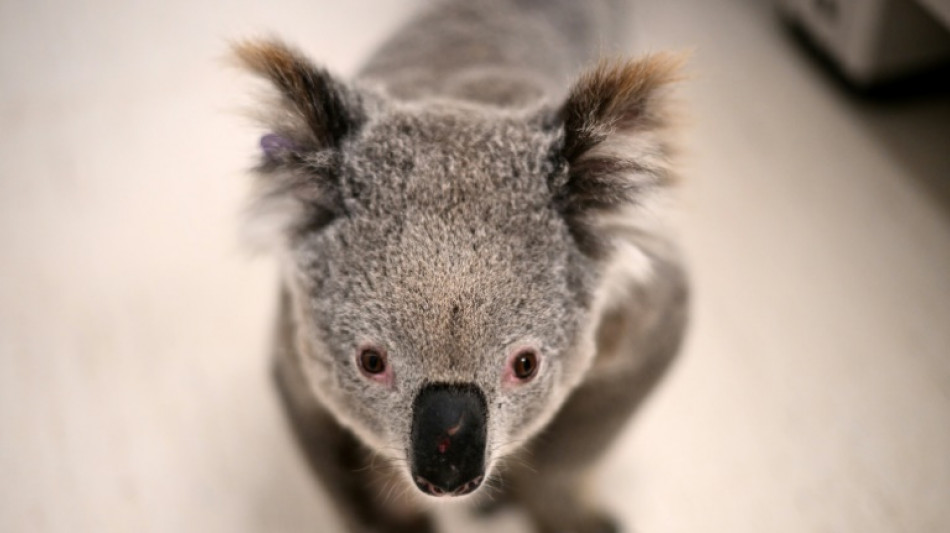
Australia approves chlamydia vaccine for koalas / Photo: © AFP/File

 Mancini brings nine newcomers into the first squad of his Italy comeback

 Czechs level Davis Cup tie against USA as South Korea eye Finals

 New France boss Zidane confirms Mbappe as captain after naming first squad
 California governor signs order to explore AI 'kill switch'
 Head leads run spree as Australia win Zimbabwe ODI series

 In-form Raphinha wants to finish career at Barcelona

 Warren Buffett steps down as Berkshire Hathaway chairman
 Carrick confident Man Utd can 'work through' tough time

 Mbappe ends Nike partnership to join Swiss brand On

 Liverpool boss Iraola puts Bournemouth love affair on hold

 'A disaster' if Man City do not win says Maresca after flawless start

 Kerry James Marshall: American 'blackness' painter celebrated in Europe

 Spain coach De la Fuente offers 'full support' to people of Ceuta

 Russia seizes assets of Nestle, French firms over West's Ukraine support
 England can build on World Cup 'spirit', says Tuchel

 UNESCO can be 'moderator' in AI debate: chief to AFP

 Infantino 'must go', says German FA vice-president

 Russia seizes assets of Nestle, French firms

 Japan's busiest rail station tests robot bins
 Anthropic says AI systems moving towards building themselves

 Asian stocks boosted by falling oil, yen weakens after BoJ rate hike
 Pakistan court blocks expulsion of Afghan medical college students

 Athletes 'can't take it any more' as Asian Games issues mount

 Allen lights up Bills' new stadium with 41-31 win over Lions

 Afghan medical students in Pakistan hope court stops college expulsions

Australian regulators have approved a chlamydia vaccine for koalas, researchers said Wednesday, as they seek to stamp out a sexually transmitted disease responsible for about half of all deaths of the fluffy marsupial in the wild.
For a decade, scientists at the University of the Sunshine Coast trialled the chlamydia vaccine in controlled settings.
But approval from the veterinary medicine regulator means the single-dose shot can be nationally rolled out.
Lead researcher Professor Peter Timms said the disease was driving wild koalas to extinction, particularly in southeast Queensland and New South Wales.
In those areas, "infection rates within populations are often around 50 percent and in some cases can reach as high as 70 percent," he said.
Trials of the vaccine showed it reduced the likelihood of the herbivores developing chlamydia during breeding age and decreased deaths in wild populations by at least 65 percent.
Antibiotics were previously the only treatment for the chlamydia-ridden tree-dwellers but it disrupted their digestive abilities and did not protect against future infections.
Chlamydia was first observed in koalas about 50 years ago.
The bacterial infection causes blindness, bladder infections, infertility and death.
The disease has taken a heavy toll on Australia's koala population.
The native species are shy and notoriously difficult to count, but the government considers the animal as endangered along the east coast.
Australia's official national monitoring programme estimates between 95,000 and 238,000 koalas live in the eastern states of Queensland, New South Wales and the Australian Capital Territory.
Another 129,000 to 286,000 of the marsupials are estimated to be living in Victoria and South Australia.
Expanding cities, land clearance and the spread of chlamydia are devastating the populations of one of Australia's most well-loved animals.
Scientists believe Australia has the highest rate of mammal extinction in the world, with about 100 of the country's unique flora and fauna species wiped out in the past 123 years.
Australia halted logging in a large stretch of the eastern coast on Sunday to create a retreat for koalas and save the local population from extinction.
C.Stoecklin--VB



