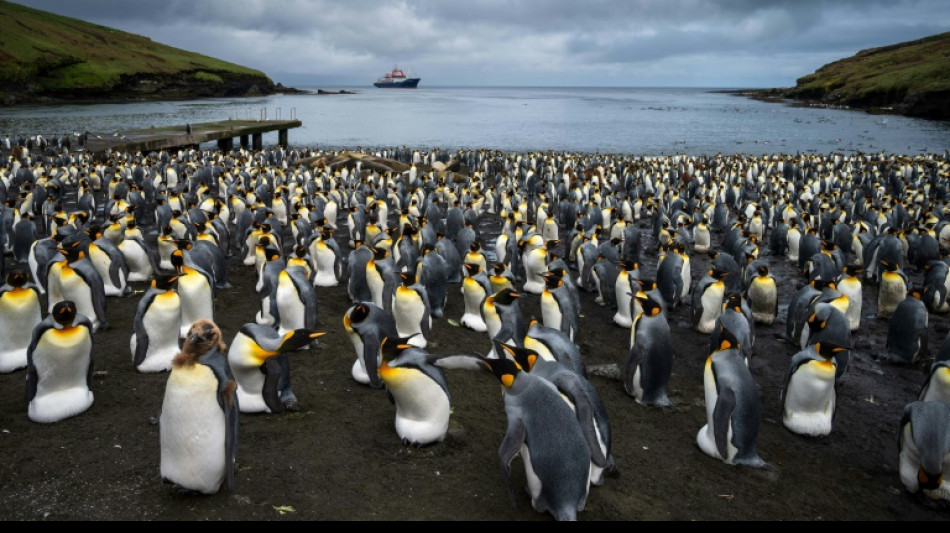
Mega-iceberg drifts towards Antarctic penguin island / Photo: © AFP/File

 Greenland parliament approves security agreement with United States

 Qatar envoy meets incoming UN General Assembly president

 Trump Signals Willingness to Work With Democrats After Midterm Defeat

 Galloway accuser could not foresee publishing-sector fallout, lawyer argues

 New York City Center revives In the Heights as a timely community story

 Godzilla Minus Zero shifts focus toward postwar human drama
 Mehbooba Mufti urges dialogue and renewed Central Asia links for Kashmir

 Seacliff Healthcare Seeks Specialist GP in Thirroul

 US stocks fall before midterm Election Day as technology shares weaken

 BLS Polymers makes strong market debut at ₹248 per share

 Petrol and diesel prices remain broadly steady across major Indian cities

 Reliance shares remain in focus after near-12% surge

 2026 Arizona Midterms: Key Races, Ballot Measures, and Voter Deadlines

 Coal India prepares possible $1 billion Mahanadi Coalfields listing

The world's biggest iceberg -- more than twice the size of London -- could drift towards a remote island where a scientist warns it risks disrupting feeding for baby penguins and seals.
The gigantic wall of ice is moving slowly from Antarctica on a potential collision course with South Georgia, a crucial wildlife breeding ground in the South Atlantic.
Satellite imagery suggested that unlike previous "megabergs" this rogue was not crumbling into smaller chunks as it plodded through the Southern Ocean, Andrew Meijers, a physical oceanographer at the British Antarctic Survey, told AFP on Friday.
He said predicting its exact course was difficult but prevailing currents suggested the colossus would reach the shallow continental shelf around South Georgia in two to four weeks.
But what might happen next is anyone's guess, he said.
It could avoid the shelf and get carried into open water beyond South Georgia, a British overseas territory some 1,400 kilometres (870 miles) east of the Falkland Islands.
Or it could strike the sloping bottom and get stuck for months or break up into pieces.
Meijers said this scenario could seriously impede seals and penguins trying to feed and raise their young on the island.
"Icebergs have grounded there in the past and that has caused significant mortality to penguin chicks and seal pups," he said.
- 'White wall' -
Roughly 3,500 square kilometres (1,550 square miles) across, the world's biggest and oldest iceberg, known as A23a, calved from the Antarctic shelf in 1986.
It remained stuck for over 30 years before finally breaking free in 2020, its lumbering journey north sometimes delayed by ocean forces that kept it spinning in place.
Meijers -- who encountered the iceberg face to face while leading a scientific mission in late 2023 -- described "a huge white cliff, 40 or 50 metres high, that stretches from horizon to horizon".
"It's just like this white wall. It's very sort of Game of Thrones-esque, actually," he said, referring to the dark fantasy series.
A23a has followed roughly the same path as previous massive icebergs, passing the east side of the Antarctica Peninsula through the Weddell Sea along a route called "iceberg alley".
Weighing a little under a trillion tonnes, this monster block of freshwater was being whisked along by the world's most powerful ocean "jet stream" -- the Antarctic Circumpolar Current.
Raul Cordero from Chile's University of Santiago, who is also part of the National Antarctic Research Committee, said he was confident the iceberg would sidestep South Georgia.
"The island acts as an obstacle for ocean currents and therefore usually diverts the water long before it reaches the island," he said.
"The iceberg is moved by that water flow, so the chances of it hitting are not that high," though chunks could, he said.
Another scientist, glaciologist Soledad Tiranti currently on an Argentinian exploration voyage in the Antarctic, said that icebergs such as A23a "are so deep that before reaching an island or mainland they generally get stuck" on the seabed.
- Icy obstacle -
It is summer in South Georgia and resident penguins and seals along its southern coastline are foraging in the frosty waters to bring back food to fatten their young.
"If the iceberg parks there, it'll either block physically where they feed from, or they'll have to go around it," said Meijers.
"That burns a huge amount of extra energy for them, so that's less energy for the pups and chicks, which causes increased mortality."
The seal and penguin populations on South Georgia have already been having a "bad season" with an outbreak of bird flu "and that (iceberg) would make it significantly worse," he said.
As A23a ultimately melted it could seed the water with nutrients that encourage phytoplankton growth, feeding whales and other species, and allowing scientists to study how such blooms absorb carbon dioxide from the atmosphere.
While icebergs are natural phenomena, Meijers said the rate at which they were being lost from Antarctica was increasing, likely due to human induced climate change.
J.Marty--VB