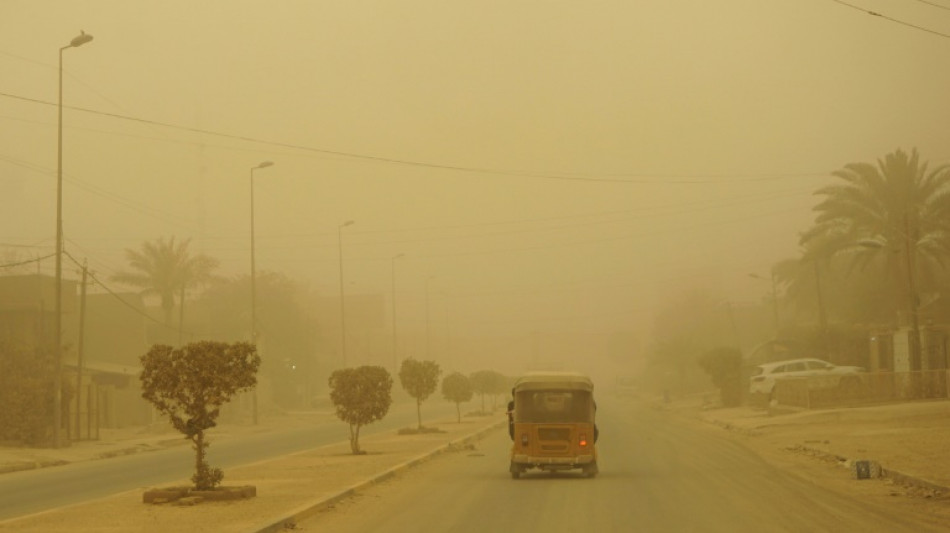
Thousands sick as latest severe sandstorm sweeps across Iraq / Photo: © AFP

 Allen lights up Bills' new stadium with 41-31 win over Lions

 Afghan medical students in Pakistan hope court stops college expulsions

 AI doomsday warnings unlikely to slow IPOs but questions linger
 ICC eyes China in bid to expand cricket

 Nkunku craving freedom and fun on RB Leipzig return

 Bhutan's traditional archers lose ground to development
 Asian stocks track Wall St rally as oil prices drop

 South Korea makes Asian Games complaint over Japan warlord ceremony

 US aid cuts are killing Kenyan sex workers

 October 7 survivors, families take centre stage in Israel vote
 Captain Mat Ryan axed from Socceroos squad for Brazil games

 US approves sale of 48 F-35 jets to Saudi Arabia

 Juventus, Palace cruise to Europa League wins, Bournemouth beat Sociedad

 Stocks climb as oil retreats, Fed calms inflation fears

 Russians begin voting in controlled election as war drags

 Hispanics feel 'betrayed' on immigration, Republican warns Trump

 High-scoring Bears face Vikings in battle of NFL unbeatens
 'In our lane': Fed's Warsh defies Trump but still fighting for credibility

 Trump admin makes major cut to endangered species protections

 Princess Diana's brother makes new explosive claims against Charles

 Ovechkin on Russian political video: 'I support my country'

 Can we shut down AI?

 Teenager Sullivan named in new-look US squad

 Travis Scott and Keith Richards feature on GTA VI soundtrack

 AFP photo shows Trump examining image of apparent Kennedy Center razing

One person died in Iraq and more than 5,000 were treated in hospitals Thursday for respiratory ailments due to a sandstorm, the seventh in a month, the health ministry said.
Duststorms have increased dramatically in frequency in Iraq in recent years, driven by soil degradation and intense droughts made worse by climate change, with rising average temperatures and sharply lower rainfall.
Residents of six of Iraq's 18 provinces, including Baghdad and the vast western region of Al-Anbar, awoke once again to a thick cloud of dust blanketing the sky.
As the storm swept across Iraq, it shrouded the capital Baghdad and the holy city of Najaf in ghostly orange clouds of choking dust.
"One death has been recorded in Baghdad" and hospitals "have received no less than 5,000 cases so far," health ministry spokesman Seif al-Badr said in a statement.
Those hit hardest are people suffering from "chronic respiratory diseases such as asthma", and the elderly who suffer in particular from heart ailments, he said.
Badr added that the majority had since been discharged and most cases were of "medium or low intensity".
Dust and sandstorms have always occurred in the Middle East but grown more frequent and intense in recent years, a trend that has been associated with overuse of river water, more dams, overgrazing and deforestation.
The fine dust particles can cause health problems such as asthma and cardiovascular ailments, and also spread bacteria and viruses as well as pesticides and other toxins.
Authorities in Al-Anbar and Kirkuk provinces, north of the capital, urged people "not to leave their homes", said the official INA news agency.
The storms are expected to grow more intense with worsening climate change because higher temperatures and more irregular rainfalls dry out land faster and accelerate desertification.
Sandstorms also cause economic damage by reducing visibility, sometimes to near zero, shuttering airports and highways and causing damage to buildings, vegetation and solar panels.
- '272 days of dust' -
Hospitals in Al-Anbar province had received more than 700 patients with breathing difficulties, said Anas Qais, a health official cited by INA.
The central province of Salaheddin reported more than 300 cases, while Diwaniya and the province of Najaf, south of Baghdad, each recorded about 100 cases, the news agency added.
Oil-rich Iraq, despite its mighty Tigris and Euphrates rivers, is classified as one of the world's five countries most vulnerable to climate change and desertification.
Scientists say climate change amplifies droughts and that their intensity and frequency in turn threaten food security. Experts have said these factors threaten to bring social and economic disaster in the war-scarred country.
In November, the World Bank warned Iraq -- a country of 41 million people -- could suffer a 20-percent drop in water resources by 2050 due to climate change.
The United Nations says about one-third of Iraq's population now lives in poverty.
The effects of low rainfall have been exacerbated as the levels of the Tigris and Euphrates drop because of upstream dams in neighbouring Iran and Turkey.
The environment ministry said the weather phenomenon could be addressed by "increasing vegetation cover and creating forests that act as windbreaks".
L.Dubois--BTB