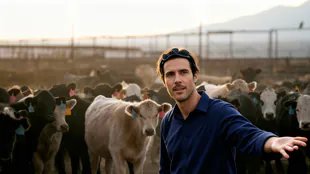
Cheeses face the heat at Raclette World Championships / Photo: © AFP

 Equitas Small Finance Bank rebounds after naming interim chief executive

 Titan quarterly profit seen rising as jewellery business drives growth

 Kuwait finance minister holds economic cooperation talks at COMCEC

 82-Year-Old American Transforms 2003 Mercedes Sprinter into Permanent Home

 Abdul El-Sayed declares victory in Michigan Senate contest

 Democrats capture US Congress in sweeping midterm victory

 Manchester United rallies past Roma as PSG dominates in Champions League

 Qatar prime minister advances mediation through diplomatic calls

 Greenland parliament approves security agreement with United States

 Qatar envoy meets incoming UN General Assembly president

 Trump Signals Willingness to Work With Democrats After Midterm Defeat

 Pitches and Keynote Speakers Are Confirmed for Blue Magic Netherlands on November 17
Up in the Swiss Alps, the air hangs thick with the funk of hot cheese as the planet's best melt away the competition at the inaugural Raclette World Championships.
The Swiss native dish dates back centuries to a time when mountain herdsmen would heat their cheese on an open fire and scrape off the melted part to keep them going.
But never before have producers, experts and restauranteurs come together under one roof to determine which cheeses make the world's finest raclette.
Nearly 90 cheeses were being put to the test this weekend in Morgins, a village in Wallis -- the southwestern region considered the home of raclette.
"All these guys are small-scale producers who go up into the mountain pastures with their cows at the start of summer," said the event's founder Henri-Pierre Galletti.
"It's a way of validating their work, which is a hard job but a truly beautiful one," he told AFP.
Morgins -- more than 1,300 metres up in a wooded valley before the Alpine pass reaches France -- welcomed thousands of raclette enthusiasts to witness the three-day contest, which culminates on Sunday with the winners crowned as champions.
- Smooth and creamy -
In the village hall's kitchen, cheese half-wheels are grilled under electric raclette heaters. The grilling can take from 30 seconds upwards, depending on the cheese.
The cooking is done by eye, with a feel for how each cheese melts. Once it bubbles up -- but just before it starts to brown -- the melted cheese is scraped onto the plate, then whisked out to jurors.
"The taste is in the fat," said racleur Jean-Michel Dubosson as he scraped off another serving with the back of his knife.
"It's important not to heat it too quickly."
While the kitchen is bustling, the tasting hall is a place of reverent silence.
Judges twirl the cheese around the fork before tasting. Many wore traditional black with a red neckerchief, though one sported an "In raclette we trust" hat. The atmosphere is slow, relaxed.
"We are looking for a raclette that is creamy, smooth, has a nice appearance, a nice colour," said Eddy Baillifard, known as the "pope of raclette" and one of the supreme jury final round judges.
"And in terms of taste, a nice texture, no thread, no strings, no gum."
Judges sample a maximum of 15 cheeses in a sitting -- about as much as one can handle before the sense of taste peaks, not to mention the volume.
Between raclettes, hot black tea or sliced red apples neutralise the palate.
The judges rank each cheese from one to five on appearance, texture, taste and aroma, and overall impression.
- Good company -
The three categories are raclette with raw Alpine milk (open to cheeses made in Alpine pastures between June 15 and July 15); raw milk raclette; and other raclette cheeses.
Most of the cheeses were from Switzerland, and if not then from the neighbouring French Alps. However, cheeses from Belgium, Canada, Italy and Romania were also in contention.
Producers from Britain, Japan, Norway, Sweden and Kyrgyzstan are interested in coming next time.
"To be here representing Romania, it's a big thing for us," said Narcis Pintea, 34, who learned his craft in Switzerland before taking his skills back home.
Besides the competition, he was relishing the chance to talk with other cheesemakers, as well as the judges to improve his chances in future.
A giant Saint Bernard dog kept watch at the door, and outside a few thousand raclette enthusiasts sampled numerous freshly-melted cheeses to the sound of a cowbell ringing team.
One stallholder had got through 60 kilograms of cheese before lunchtime was even over.
"A day without raclette is a wasted day," said Baillifard.
"There are several ingredients that make raclette so enjoyable, but the main thing is the people you share it with. When you're in good company, the raclette is already 80 percent a success."
M.Betschart--VB