Spirit exit likely to lead to higher US airfares, experts say / Photo: © AFP/File

 Easyjet rejects latest takeover bid but leaves door ajar

 Macron hosts Meloni for Riviera talks after Trump rift

 US Supreme Court paves way for mass deportation of Haitians, Syrians
 South Africa vows firm response to anti-migrant violence

 Poland, Ukraine hold key Gdansk conference without Zelensky

 Massive police deployment blocks Kenya protest anniversary

 Court orders TotalEnergies to account for clients' emissions

 Stocks rally on renewed AI optimism, oil price declines

 Venezuela twin quakes kill at least 164 with many trapped under rubble

 IOC votes to continue ski mountaineering for 2030 Games

 Stocks rally on AI optimism after Micron's blowout forecast

 Tunisia's short-lived World Cup experience lays bare deep dysfunctions

 'Everything collapsed': Venezuela region hit hardest by quakes cries for help

 Kenya police turn out in force on protest anniversary

 Baking heatwave gives Europe no respite

 Trump climate pushback spurs courtroom battles, report says

 Kenya police in massive show of force on protest anniversary

 USA, Germany in control as Dutch eye World Cup knockouts

 Violence feared as Kenya marks protest anniversary

 Ukraine recovery summit opens, overshadowed by Kyiv-Warsaw row

 Chad sees influx of drone victims from Sudan

 'We shut up big mouths,' says South Africa's World Cup coach Broos

 Mothers search, men weep amid debris of Venezuela quakes

 South Africa stun South Korea to make World Cup history

 Clarke fears Scotland 'probably going home' after Brazil World Cup loss

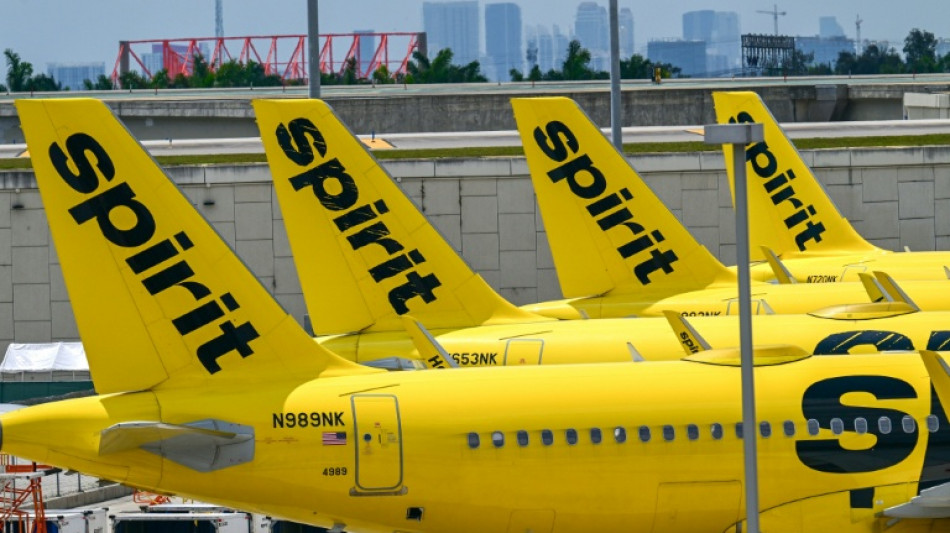
The demise of ultra low-cost carrier Spirit Airlines is expected to add further upward pressure to US fares, according to experts.
Launched in 1992, the company is responsible for the "Spirit Effect" in which bare-bones service opens up travel to a broader slate of customers otherwise priced out of the market.
Spirit's business model of stripped-down travel that includes no free meal service, baggage transport or other extras played a "unique and disruptive role in the industry," the US Department of Justice argued in 2023, as it sought to block a merger with JetBlue.
"When Spirit enters a new route, prices for consumers across all airlines tend to fall and demand for air travel goes up," according to the DOJ.
It said Spirit's arrival in a market led to an immediate 17 percent drop in fares, while its exit led to an average 30 percent increase.
But Spirit's halting of operations on May 2 has added to worries about higher airfares, as ticket prices already rise over soaring jet fuel costs due to the Middle East war.
Jet fuel costs for US airlines surged 56 percent in March from February and 30 percent from the year-ago period, the US Department of Transportation said this week.
Jan Brueckner, an emeritus economics professor at the University of California, Irvine, predicted that airlines would continue to offer "basic economy" fares originally unveiled to compete with Spirit and other budget carriers.
"But they may raise" the ticket price, Brueckner said. "I don't think these tickets are going away necessarily, just that they might be less attractive."
Aviation expert Richard Aboulafia of consultancy AeroDynamic said there's "no question in some markets fares will probably increase."
- Disruptor -
"For more than a decade, Spirit played a disruptive role, forcing incumbents to respond with lower fares and more granular prices," said Richard Masler, head of analysis for the Centre for Aviation.
The industry began mobilizing on Saturday as Spirit shut down, rebooking passengers but also trying to capitalize on Spirit's most profitable routes.
This effort to cover market included other low-cost carriers such as Breeze, Avelo and Frontier, which have typically priced a bit higher than Spirit.
Airlines added service in markets now abandoned by Spirit, or increased their offerings in places where they were in direct competition.
"Spirit played a meaningful role in providing affordable travel to a wide range of consumers in an industry dominated by four major airlines," Frontier CEO James Dempsey said on a conference call with analysts.
Frontier plans this summer to add nine routes, plus 15 more daily departures across 18 former Spirit routes.
The increased service should boost a key revenue benchmark by three to five percent at Frontier, while capacity will grow six to eight percent, said Frontier Chief Financial Officer Robert Schroter.
Spirit forced other carriers to "price differently," said Bradley Akubuiro, a partner at advisory firm Bully Pulpit International.
"The likely consequence for passengers is not that air travel suddenly becomes unavailable," he said. "It's that the cheapest version of air travel becomes immediately harder to find in some markets."
Fares could also increase over time because "a meaningful check on the system is now gone," Akubuiro said.
M.Vogt--VB